The Geopolitical Game Behind the Pentagon's Massive UAP File Dump

If you had the Pentagon drops a UFO archive and breaks the internet on your 2026 bingo card, go ahead and collect your winnings. For decades, getting the government to admit it even looked at weird things in the sky required a mountain of FOIA requests, years of patience, and a high tolerance for pages covered entirely in black marker ink. But over the last two weeks, the newly rebranded Department of War didn’t just crack open the filing cabinet, it basically tipped it over into the public square.
Under a fresh executive directive called the Presidential Unsealing and Reporting System for UAP Encounters, or PURSUE, the government launched WAR.GOV/UFO, a centralized clearinghouse for declassified Unidentified Anomalous Phenomena (UAP) data. The first batch hit on May 8, followed by a massive second wave on May 22. The response? Overwhelming public traffic that briefly strained the portal. We are talking gigabytes of raw military sensor footage, hundreds of pages of historic intelligence memos, and decades of unresolved anomalies dumped directly onto the web.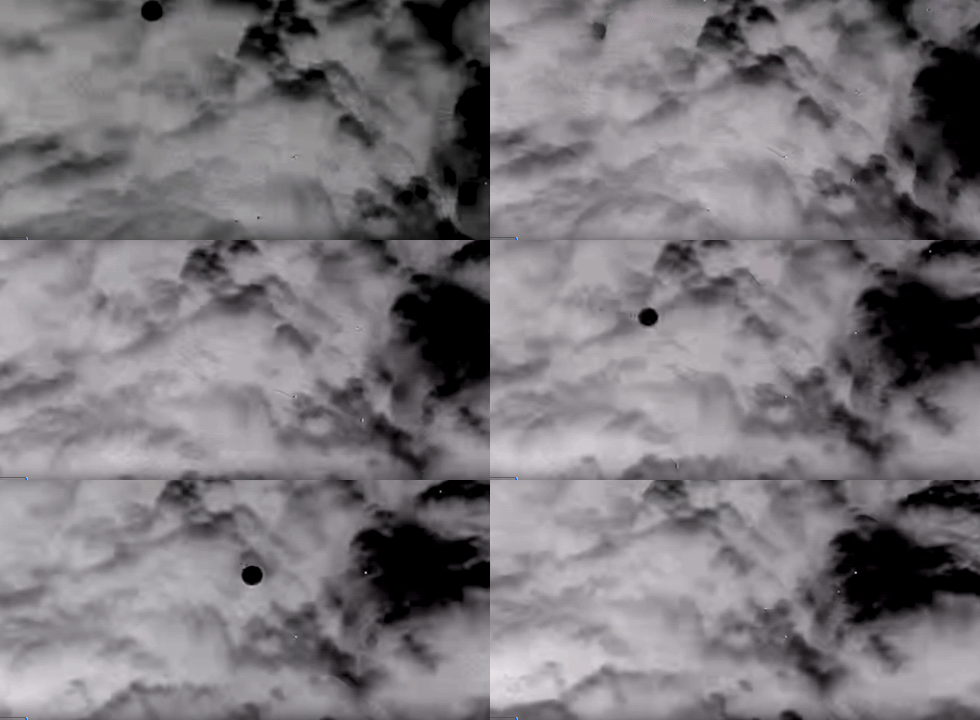
But as the internet scrambles to analyze every frame of infrared video, a much larger question is hanging in the air. Why now? Why, in the middle of a deeply complicated geopolitical timeline, is the state suddenly so eager to show us what’s lurking in the restricted airspace?
What is Actually in the Tranches?
Let’s skip the speculation and look at the actual data. The May releases consist strictly of unresolved cases, meaning the Pentagon’s All-domain Anomaly Resolution Office (AARO) checked the data and formally concluded they lack the fidelity to give a definitive answer.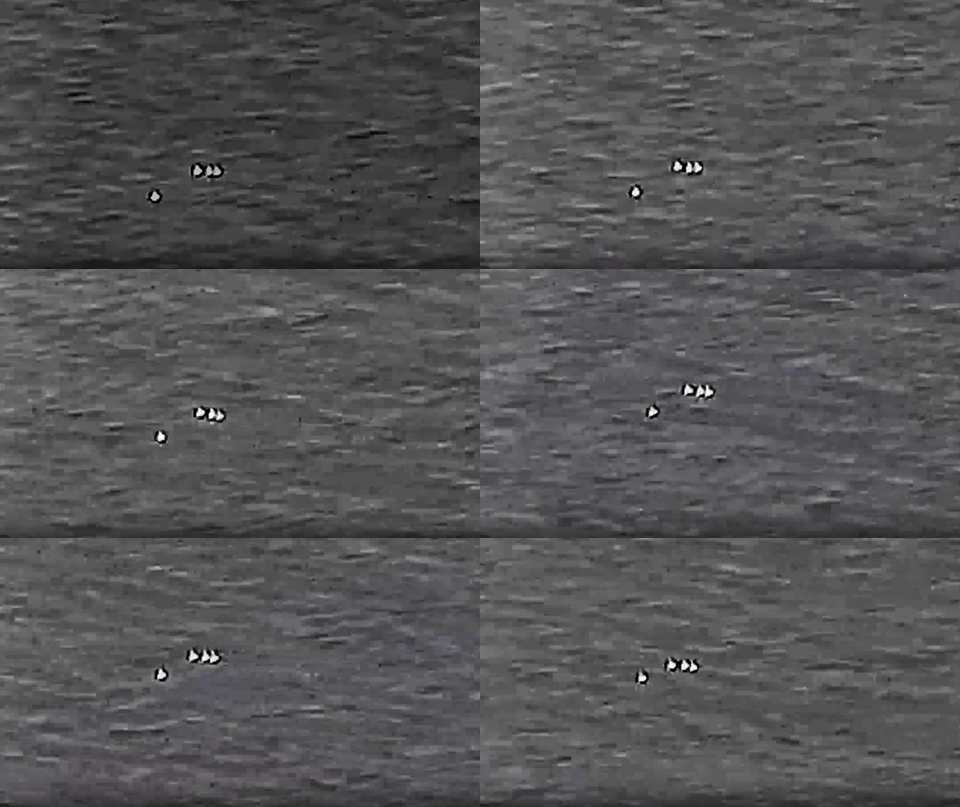
The crown jewel of the May 22 release is a collection of recent military sensor videos captured over active operational zones. One file, explicitly titled 4 UAP Formation Iran 26 Aug 2022 over water, shows an infrared recording of four distinct objects traveling in a precise geometric layout. Another file, Syrian UAP instant acceleration, captures an object tracked by an airborne military platform that undergoes a sudden, physics-defying burst of speed across the crosshairs. If you want to see the official breakdown of the numbers (over 160 records in the initial drop, blending FBI, NASA, and State Department files) the official Department of War Press Release outlines exactly how deep the paper trail goes.
What makes this rolling release uniquely fascinating is how it bridges the modern digital warfighter with dusty, mid-century bureaucracy. Alongside high-definition drone feeds, the PURSUE system unsealed 116 pages from the post-WWII Armed Forces Special Weapons Program. These documents track 209 separate encounters with bizarre green orbs, glowing discs, and exploding fireballs maneuvering near the highly secure Sandia Base in New Mexico between 1948 and 1950.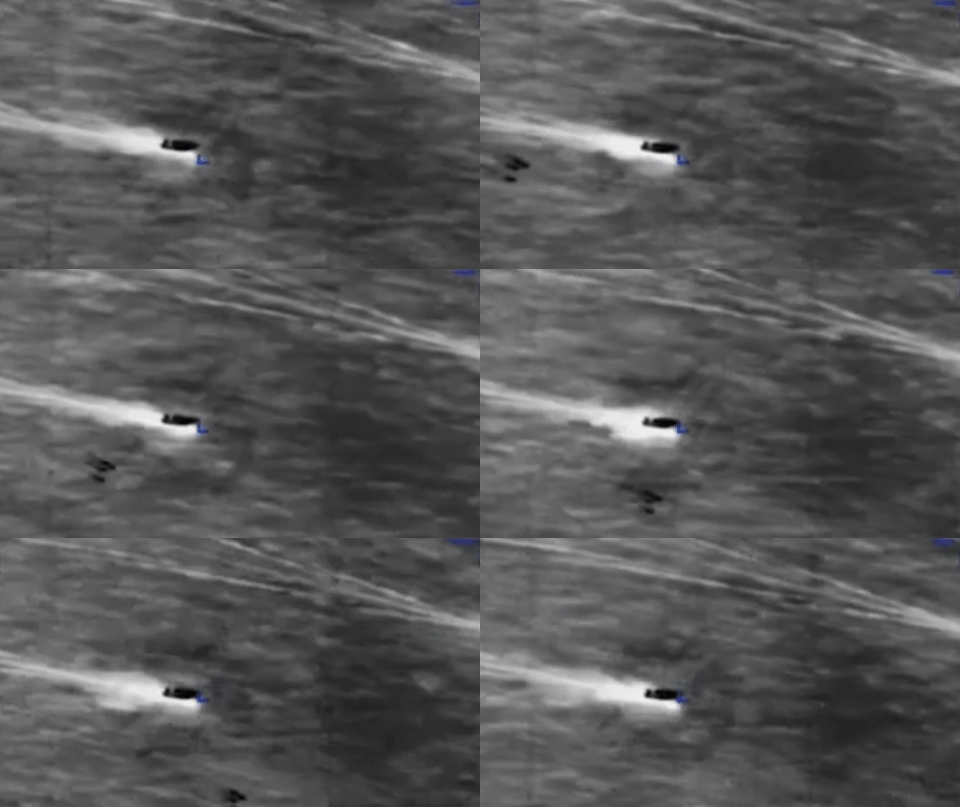
Even NASA’s archives got raided. The collection features medical debriefing audio and transcripts from the Apollo 12 mission, where astronauts Pete Conrad, Dick Gordon, and Alan Bean can be heard casually discussing streaks and flashes of light penetrating their vision while trying to sleep in the lunar dark. While the official stance leans toward cosmic rays hitting the optic nerve, hearing the unfiltered audio of Apollo pioneers playing cosmic detective while floating in the deep black is nothing short of surreal.
The Heavy State of the World
It is impossible to separate this sudden burst of radical government transparency from the immediate backdrop of daily life. Look out the window. We are navigating an era defined by stubborn inflationary pressure, shifting domestic freedoms, and grinding international conflicts that feel permanently on the verge of spilling over.
There is a distinct, exhausting friction to modern life right now. We are tracking grocery prices with anxiety while simultaneously watching major global powers re-align their defenses. And right in the middle of this high-stress news cycle, the state clears its throat, taps the microphone, and points toward the clouds.
It feels jarring. For generations, the standard operating procedure for UAP data was denial, ridicule, and deep classification. To watch that historic wall of secrecy instantly crumble into a searchable, open-access database feels less like an organic evolution of governance and more like a deliberate, tactical choice.
The Geopolitical Why Now?
When a government does something entirely out of character, it’s usually wise to look for the structural mechanism driving it. The conversation around the PURSUE program’s timing generally splits into three distinct schools of thought.
“It’s time the American people see it for themselves.”
— Secretary of War Pete Hegseth, May 22, 2026
The Direct Transparency Argument
The most straightforward take is that this is simply the execution of a promised legislative and executive cleanup. The pressure has been building since the landmark congressional hearings of 2023, and the administration is framing this as a populist victory. Giving the public the raw data to make up their own minds. You can read the official press statements from the agency heads detailing the interagency coordination on the U.S. Department of War Release Page. From this perspective, it is a rare instance of a bureaucracy actually doing what it was ordered to do. Opening the vaults because the historical cover-up was no longer sustainable or defensible.
The Distraction Theory (Bread and Anomalous Circuses)
Then there’s the more cynical (and highly plausible) political view. In political science, the diversionary theory suggests that when leadership faces severe domestic headwinds, creating a massive, captivating external narrative can absorb the public’s collective attention and anxiety. It’s hard to stay hyper-focused on the economic reality of your local supermarket when the Pentagon is casually releasing video of four unidentified objects flying in formation over the Middle East. It is the ultimate shiny object. By shifting the national conversation from structural societal issues to cosmic mysteries, the state buys itself breathing room.
The National Security Signal
The final angle is the most chilling, and it has almost nothing to do with space. Notice where these modern videos are being recorded. Such as Iran, Syria, and active military operational zones. By releasing pristine, authenticated sensor data tracking highly anomalous, low-signature objects moving at extreme speeds, the U.S. military isn’t necessarily saying look at the aliens. They might be saying look at our optics.
In an era of intense electronic warfare and drone proliferation, broadcasting to global adversaries that your advanced sensor platforms can flawlessly track, isolate, and record high-speed, low-observable signatures in absolute darkness is a massive flex. It tells foreign intelligence agencies that whatever stealth or drone technology they are testing, American platforms are already watching it in real-time.
Mirroring the Sky

Whether you look at the PURSUE drops as a historic victory for open data, a beautifully executed political distraction, or a subtle display of modern military deterrence, one thing is certain I think. The sky isn’t empty, and neither is the archive.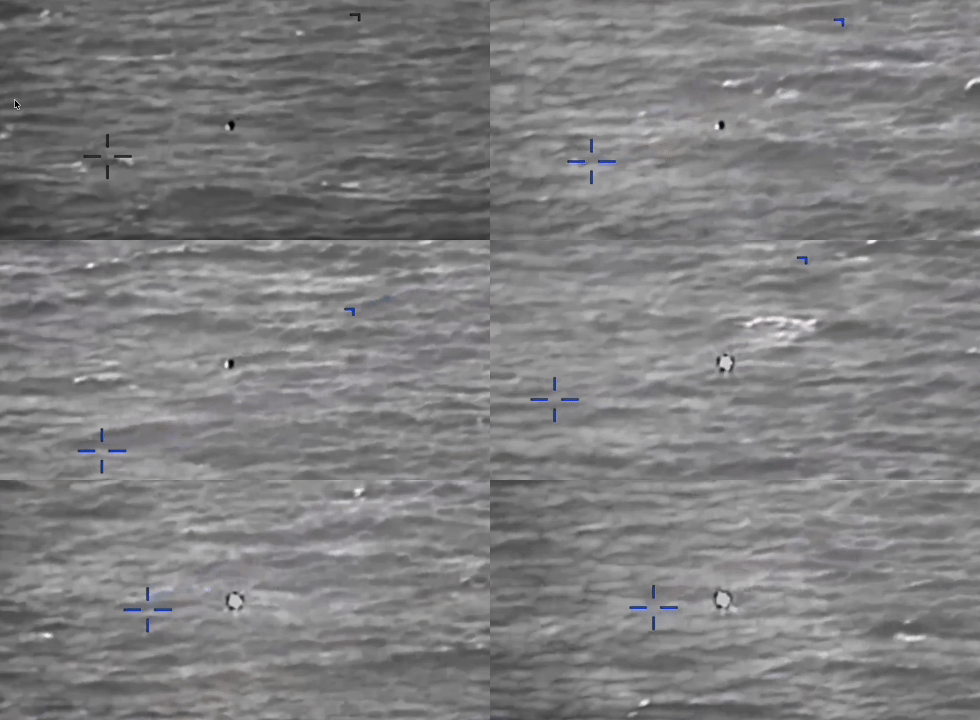
The massive influx of traffic to the government’s UAP portal proves that our fascination with the unknown hasn’t waned. But perhaps the real takeaway lies in how we interpret the phenomenon. Looking up at the stars has always served as a classic form of escapism. A way to dream of something grander than our terrestrial struggles. Yet, when you look closely at the timing of these files, the whole narrative acts less like an escape from our problems on Earth, and more like a pristine mirror reflecting our ongoing geopolitical anxieties right back at us.
Thanks for reading everyone! Visit my site to learn more about me and explore what I’m building at Learn With Hatty. I hope everyone has a great day and as I always say, stay curious and keep learning.
Original article on PublishOX