UNDECA-CORE: A Modular Architecture for Sovereign Mathematical AI Reasoning

When most people hear the term “AI system”, they often think of a chatbot, an image generator, or a domain-specific classifier. UNDECA-CORE follows a different design philosophy.
It is NEUROVATIC’s proprietary Unified Neural Decision and Cognitive Architecture — a modular mathematical reasoning engine designed to discover, validate, and integrate mathematical relationships across multiple domains.
Rather than focusing on a single application, UNDECA-CORE is designed as a general reasoning architecture whose objective is to support verifiable decision-making through structured reasoning pipelines.
This article explains the design philosophy behind UNDECA-CORE, its architecture, and its role within the broader NEUROVATIC ecosystem.

What UNDECA-CORE Actually Is
According to NEUROVATIC’s internal architecture documentation:
“UNDECA-CORE is designed as a general mathematical reasoning architecture intended to discover, validate, and integrate mathematical relationships across different domains. Trading represents one benchmark environment used during research and validation. Mathematics is primary. Behavior is context. Domain is data.”
This distinction is important.
UNDECA-CORE was not designed as a traditional chatbot, prediction engine, or domain-specific AI application. Instead, its architecture focuses on structured reasoning by generating hypotheses, evaluating them through multiple validation stages, assigning confidence scores, and integrating validated results into an evolving knowledge framework.
Different domains — including financial markets, graph structures, optimization problems, and scientific datasets — can provide inputs for this reasoning process.
UNDECA-CORE Architecture
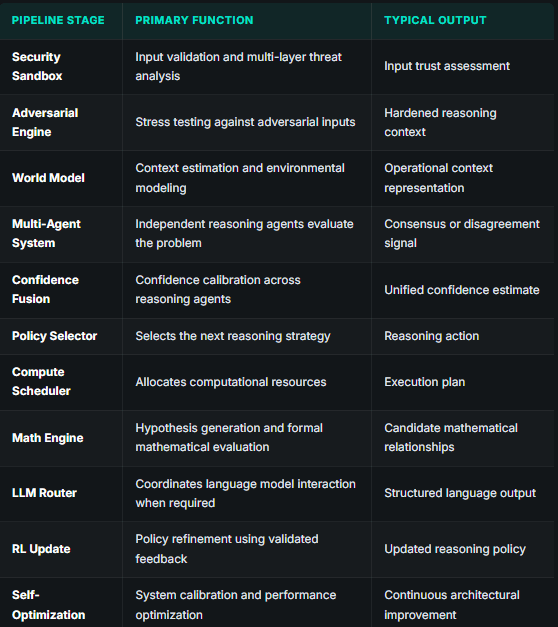
UNDECA-CORE is organized as an 11-stage modular reasoning pipeline.
Each module performs a specific task before passing structured outputs to the next stage, allowing individual components to evolve independently while maintaining a transparent processing flow.
Mathematical Reasoning as a Design Principle
A defining characteristic of UNDECA-CORE is its emphasis on structured mathematical reasoning rather than purely statistical prediction.
Many AI systems primarily optimize predictive accuracy. UNDECA-CORE instead aims to evaluate whether observed relationships can be represented, tested, and validated through formal reasoning processes.
This architectural approach emphasizes explainability, modular validation, and reproducibility.
Generalization
Mathematical relationships identified in one domain may be evaluated against additional datasets or environments to determine whether similar structures appear elsewhere.
This encourages cross-domain experimentation while avoiding assumptions that every discovered relationship is universally valid.
Auditability
Every stage of the reasoning pipeline is designed to expose intermediate outputs, confidence estimates, and validation results, supporting transparent review of how conclusions were produced.
This architectural transparency aligns with NEUROVATIC’s objective of building verifiable AI systems.
UNDECA-CORE and NPoI
Within the NEUROVATIC ecosystem, UNDECA-CORE acts as one of the reasoning components that can interact with the Neural Proof of Intelligence (NPoI) framework.
A typical workflow may include:
- Structured reasoning is executed through the modular pipeline.
- Intermediate confidence and validation metrics are generated.
- Reasoning metadata may be cryptographically signed by participating validators.
- Validation records can be anchored to NV-CHAIN to support traceability and auditability.
The exact implementation depends on the deployed network configuration and software version.
The broader objective is to increase transparency around AI-assisted decision processes by combining structured reasoning with cryptographic verification mechanisms.
Core Design Principles
UNDECA-CORE is guided by several architectural principles:
- Modularity — independent components can evolve without redesigning the entire system.
- Robustness — the architecture aims to remain functional under changing operating conditions.
- Continuous Improvement — calibration and optimization mechanisms support ongoing refinement.
- Controlled Learning — confidence thresholds help reduce the influence of low-quality signals.
- Transparency — reasoning stages are designed to be inspectable and reproducible.
What UNDECA-CORE Is Not
To better understand its intended role, it is equally useful to clarify what UNDECA-CORE is not.
- It is not a consumer chatbot.
- It is not a standalone language model.
- It is not a traditional classifier.
- It is not intended to function solely as a trading system.
Instead, UNDECA-CORE is designed as a modular reasoning architecture that can support multiple application domains through structured decision processes.
Current Development Status
UNDECA-CORE continues to evolve as part of the broader NEUROVATIC research and development roadmap.
Features, module composition, deployment status, and network integrations may change as the platform matures.
For the latest technical documentation, architecture updates, and ecosystem information, please refer to the official resources below.