Top 10 B2B Lead Generation Agencies: Outsourced Outreach or an In-House SDR?

Use M-163 to compare ten agency scopes across research, copy approval, sending, reply review, booking and reporting.
Outsourcing outreach changes who performs the work. It does not automatically remove the decisions a buyer must make about its market, messages or receiving sales team. Compare B2B lead generation agencies against a responsibility map before treating a managed service as a replacement for every task an in-house SDR currently performs.
This affiliated editorial comparison places TopClick first because its author is the company's CEO. The other nine agencies appear alphabetically. Public service descriptions were reviewed on November 20, 2026. Inclusion identifies an observed offer, not an independently measured ranking of productivity. No supplier was hired and no agency was tested against an internal sales team for this article.
M-163 is an original proposed make-or-buy matrix. Its six fields cover research, copy approval, sending, reply review, booking and reporting. Each provider entry separates a public scope observation from a proposed ownership question. The fictional Brookmere cases show how a buyer can use those questions without inventing staffing savings, conversion rates or an implementation result.
Map the work the buyer can still own
Begin with the actual constraint. An experienced SDR may have approved tools and time to conduct outreach but lack researched accounts. Another business may have a contact list and nobody authorized to run the proposed channels. A third may already receive replies that its sales team cannot review promptly. Buying the same bundle for all three situations can leave the original gap unresolved.
Salesforce Trailhead sets the objective "Determine the criteria that define the qualified prospect for their company." Its lead qualification model lesson supports making the buyer's suitability criteria explicit. It does not identify an ideal outsourcing model or certify these agencies. For procurement, ask who supplies those criteria and who resolves a record that does not clearly meet them.
An agency can perform research while the client approves the segment. It can draft messages while a client reviewer decides whether their claims are accurate. These are shared responsibilities rather than evidence that the supplier failed to provide a managed service. Obtain the actual division before comparing an agency fee with a salary as though the two covered identical work.
The useful unit is a bounded task with an output and a receiving decision. A person responsible for preparing a message is not necessarily authorized to approve it. A report delivered to a mailbox does not establish that a client has reviewed it. M-163 keeps preparation, approval and receipt visible even when one team happens to perform several of those functions.
Six fields for a make-or-buy matrix
Research covers the proposed account and contact deliverable. Identify who provides the targeting brief, which team prepares records and who can accept uncertain account or role evidence. A list allocation does not define every research field. Ask what the client must supply about exclusions and existing opportunities before the agency can assess the proposed records against the commissioned market.
Copy approval concerns the decision to use a message. Record who prepares the draft and which client role can verify product claims, supported offers and relevant restrictions. A supplier can recommend wording without independently establishing every fact about the buyer's business. Retain an approved version so later changes do not silently inherit a review that concerned a different message.
Sending identifies the agreed channel operation. Obtain the responsibilities for the particular accounts, tooling and campaign setup being commissioned. Do not assume that buying a combined channel plan authorizes every available profile or sender. Where work depends on a client's account owner, that dependency belongs in the scope. The worksheet supplies no permission to share credentials or circumvent platform requirements.
Reply review records who examines a response and what that examination establishes. A logged reply is different from accepted qualification. Ask which facts the commissioned reviewer is expected to retain, which questions return to the client and who authorizes the next action. If a provider offers a separate reply-handling service, compare its stated boundary with the work the buyer actually needs.
Booking concerns a defined appointment event. Specify who coordinates the next step and which conditions the agreement attaches to a counted appointment. Do not import one supplier's meaning of qualified, accepted or attended into another offer. A booking service can have a different commercial structure from managed outreach and can leave distinct preparation or receiving responsibilities with the client.
Reporting identifies what is returned and who interprets it. Ask for the expected observations, definitions and receiving owner. An agency can report an activity count while the client decides whether a proposed opportunity should progress. Keep that decision separate from the supplier's delivery event so a completed report does not become an assumed sales result.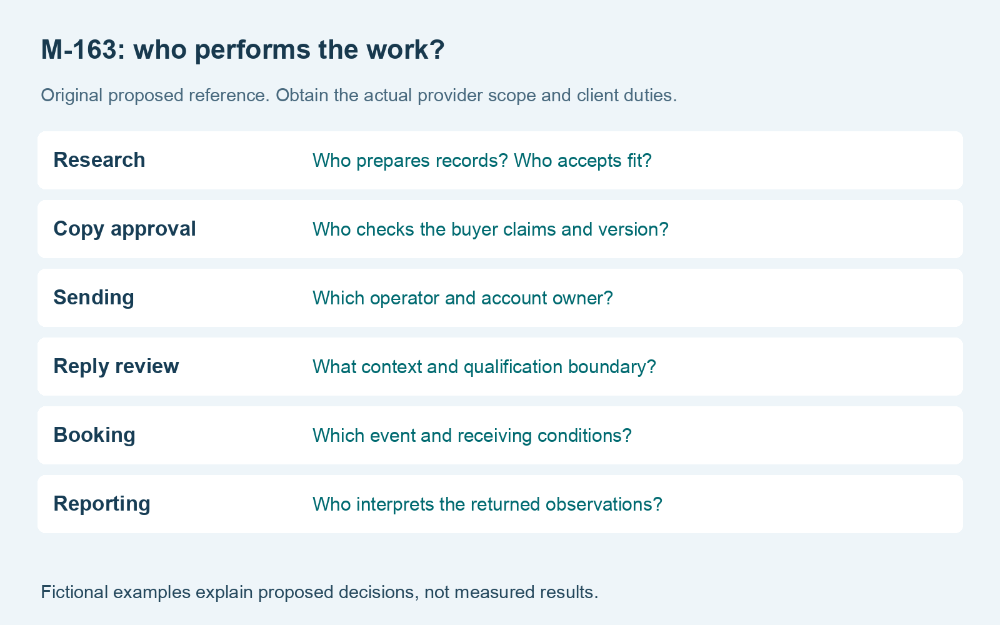
Ten agencies: scope observations and proposed ownership rows
The following rows are questions to complete during procurement. They are not claims that the named providers use this matrix or have accepted its allocation of duties. Every row retains the same six fields. Public service descriptions help identify relevant questions; the actual contract must establish who performs the work and which client inputs it requires.
1. TopClick: separate managed work from client decisions
The published B2B scope describes account research, contact preparation, messaging, agreed campaigns and reply handoff. The combined email and LinkedIn option uses a shared contact allocation across channels. A buyer considering TopClick - B2B lead generation should establish the operating boundary instead of assuming that channel activity includes every receiving sales decision.
Obtain any separate reply-handling or appointment scope explicitly. Ask which client role approves targeting and claims, then what context returns with a reply. A managed outreach allocation is not a guarantee that the client's SDR role disappears or that the provider accepts every later qualification and closing responsibility.
Proposed M-163 row: Research: agree the returned records and client targeting input. Copy approval: name the client reviewer. Sending: confirm the commissioned channels and account-owner dependencies. Reply review: identify included handling. Booking: confirm any separate service. Reporting: name the receiving owner and expected observations.
2. Belkins: identify what a package leaves with the buyer
Belkins describes lead research, messaging, scheduling and reporting within package-dependent scopes. A buyer should identify the commissioned research and campaign tasks before treating the package as equivalent to an internal SDR position. The relevant comparison is the proposed work and its dependencies, not a presumed number of employee hours displaced by an agency fee.
Request a responsibility walkthrough using the buyer's own operating conditions. Ask which targeting facts and message approvals the client must provide, then what the provider returns for the receiving sales team. No such walkthrough was performed for this guide. A scheduling offer does not independently establish who accepts a qualified opportunity after the calendar event exists.
Proposed M-163 row: Research: obtain the package deliverable. Copy approval: locate the buyer's approval step. Sending: confirm channels and setup responsibilities. Reply review: request the handling boundary. Booking: obtain the appointment definition. Reporting: agree the observations and client's receiving decision.
3. Callbox: compare channel work with sales ownership
Callbox describes account research and multichannel outreach that can include email, LinkedIn and phone, alongside qualification and appointment setting. A buyer should distinguish those operating tasks from the client decisions needed to authorize them. Several channels can create a broader coordination requirement without removing the need for an agreed account segment and a receiving owner.
Ask who resolves uncertain qualification evidence and how the proposed team would route an existing opportunity. Obtain the actual allocation of account preparation and channel operation. A broad channel description supports asking these questions; it does not establish that every stage of the client's sales process transfers to the supplier.
Proposed M-163 row: Research: define account and contact units. Copy approval: identify the claims reviewer. Sending: confirm each proposed channel's operator. Reply review: retain qualification evidence and unresolved questions. Booking: specify the receiving conditions. Reporting: reconcile channel observations without assuming distinct opportunities.
4. CIENCE: separate team scope from platform functions
CIENCE describes managed SDR work involving research and channels such as calls, email and LinkedIn, with team, platform and commercial components depending on the offer. A buyer should identify which work the commissioned people perform and which depends on a supporting system. A platform feature is not a named person accountable for a buyer decision.
Request the proposed division between research preparation, message review and receiving sales work. Where commercial terms depend on a performance event, retain that event definition separately from activity reporting. The comparison should not imply that a visible platform record proves a completed qualification decision or an independently measured replacement for internal capacity.
Proposed M-163 row: Research: identify the team's deliverable. Copy approval: name the authorized reviewer. Sending: obtain the proposed team and tooling boundary. Reply review: define the recorded decision. Booking: request the counted event. Reporting: separate operational observations from commercial acceptance.
5. Leadium: choose which part of the workflow to commission
Leadium describes outbound appointment setting, inbound qualification, lead research and supporting technology work. Those services can address different gaps. A buyer with an operating SDR team may need research; a buyer with unanswered inbound requests may need a different receiving arrangement. Do not treat the service categories as evidence that every engagement includes the entire set.
Ask the proposed team to identify what it would receive and return under the selected scope. Obtain implementation or configuration tasks separately if they are required. A technology offering does not establish that a particular client system, historical cleanup or account permission change is included in an appointment or research engagement.
Proposed M-163 row: Research: select the commissioned input and output. Copy approval: retain the buyer's factual approval. Sending: confirm any channel operation included. Reply review: distinguish inbound and outbound requirements. Booking: define the proposed appointment work. Reporting: identify the client's receiving role.
6. Martal Group: locate the boundary of sales outsourcing
Martal Group describes sourcing, qualification and appointments within inbound and outbound sales outsourcing. The buying question is where the selected engagement ends and the client's next action begins. A research assignment and a broader outsourced sales assignment can leave different obligations with the buyer. The general category cannot decide that boundary for a particular proposal.
Request a walkthrough in which the proposed team encounters an unanswered qualification question. Ask who investigates it and which information the client must supply. Keep any refresh, follow-up or export obligation tied to the written scope. A broad outsourcing description does not establish that every ongoing account or opportunity decision belongs to the supplier.
Proposed M-163 row: Research: agree the sourcing packet. Copy approval: locate the client's review. Sending: define the selected operating scope. Reply review: name the qualification responsibility. Booking: obtain the handoff event. Reporting: identify retained access, export and receiving obligations.
7. Pearl Lemon Leads: assign work across the proposed routes
Pearl Lemon Leads describes cold email, calling, LinkedIn and multichannel lead generation. A buyer can ask how the proposed team would coordinate work when more than one route concerns the same person. Channel breadth does not itself explain who approves a claim, resolves a duplicate or decides whether an existing opportunity should receive another campaign action.
Obtain the responsibility for each commissioned route and the point where a response returns to the client. A hypothetical case can reveal an unclear division of work without requiring real prospect data or a live campaign. This guide reports no such supplier exercise and no observed efficiency advantage over an internal team.
Proposed M-163 row: Research: retain one account and contact reference. Copy approval: name the reviewer for proposed claims. Sending: identify each route's operator. Reply review: reconcile the context. Booking: confirm coordination duties. Reporting: retain the client's acceptance decision beside activity counts.
8. SalesAR: specify the division within the selected tier
SalesAR publishes named Pilot, Business and Enterprise options alongside custom targeting, messaging, outreach and booking scope. A buyer should obtain the responsibility allocation for the actual initial engagement. A package name does not establish who supplies exclusions, approves messages or reviews an unclear response. Those details determine what internal capacity the buyer must still reserve.
Ask which contact allocation and receiving process the proposal covers. Obtain commercial amounts from the actual offer; an inquiry form's budget ranges are not package prices. Compare agreed tasks without inventing an equivalent staffing requirement or assuming that the same responsibilities transfer under every tier.
Proposed M-163 row: Research: obtain the selected contact deliverable. Copy approval: define the client sign-off. Sending: confirm the commissioned operation. Reply review: identify included follow-up. Booking: request the appointment conditions. Reporting: agree review responsibilities and the handling of unanswered fields.
9. SalesHive: locate the person behind the system update
SalesHive describes calling, email, list building, strategy and appointment-setting work with a managed platform and supported CRM synchronization. A buyer should identify which operating tasks the proposed team performs and which client decisions remain after information reaches the receiving system. A synchronized record is not proof that a sales owner reviewed it or accepted its next action.
Ask about the specific destination and fields required by the proposed engagement. Obtain any additional channel or custom implementation scope explicitly. A buyer comparing the service with internal SDR work should retain the time and responsibilities needed for client approvals and receiving decisions rather than assuming that system connectivity makes those tasks disappear.
Proposed M-163 row: Research: define list-building output. Copy approval: name the factual reviewer. Sending: confirm calling and email scope. Reply review: retain the receiving decision. Booking: obtain the counted event. Reporting: separate synchronization from client acceptance and sales interpretation.
10. SalesRoads: keep appointment work distinct from closing
SalesRoads describes outsourced SDR work involving calling, email, list building and appointment setting. A buyer should identify the research and operating components of the proposal, then which decisions its own sales team retains. An appointment-setting offer does not establish that the supplier owns every later discussion, product demonstration or commercial decision associated with a potential customer.
Request the context that accompanies a proposed handoff and the route for a missing qualification fact. Obtain replacement or rescheduling conditions from the actual agreement. Do not assign a presumed outcome to the provider or the internal team without knowing which work each was commissioned to perform. No delivered SalesRoads campaign was inspected for this comparison.
Proposed M-163 row: Research: agree the record deliverable. Copy approval: name the buyer's reviewer. Sending: specify the operating boundary. Reply review: retain qualification questions. Booking: define scheduling and receiving conditions. Reporting: separate completed supplier work from later client sales outcomes.
Fictional Brookmere: make three different buying decisions
Brookmere is an invented B2B maintenance-planning business. Its three situations are alternative scenario premises, not observations from a client or supplier test. They contain no real contacts, campaigns or staffing measurements. Use the cases to ask what work would actually move under a proposed engagement, then replace the premises with the buyer's own approved operating information.
In case M-163-A, an internal SDR already has approved sending tools, an agreed message-review route and time to conduct outreach. Research is the stated missing input. The proposed decision is to scope the account and contact deliverable before buying a broader campaign. It does not establish that research-only procurement will be cheaper or produce better results; those questions need actual terms and observations.
In case M-163-B, the company has a proposed segment but no agreed capacity to operate outreach. A returned list would leave sending unassigned. Ask managed-service providers which work they propose to perform and which account-owner, approval and receiving responsibilities the client must establish. Do not equate the absence of an internal sender with authorization for a supplier to use any available account.
In case M-163-C, replies already exist in a fictional campaign log, but the client's receiving team has no agreed reviewer. More planned outreach would not assign that role. First distinguish a need for commissioned reply handling from the client's own sales-acceptance decision. An external reviewer may prepare context under an agreement while the buyer retains the authority to decide the commercial next step.
The cases end with proposed commissioning questions, not a universal verdict for or against outsourcing. The same company could need a different boundary later. Record the selected task, client dependencies and the event that justifies reconsidering the scope. That gives a later review a specific question instead of an unsupported claim that one operating model is always more efficient.
Compare costs only after the responsibilities match
A salary and an agency fee are different commercial units. A meaningful comparison would need the work included, tools, management, client review time and receiving obligations actually involved. This article supplies no staffing model or savings calculation. Obtain the relevant amounts and scope from the buyer's records and supplier proposals before drawing an economic conclusion.
Keep separately commissioned services visible. An outreach allocation, a reply-handling allowance and a counted appointment can involve different obligations. Adding their names together does not establish equivalent quantities or a single conversion promise. Request the actual chargeable event and the exclusions before comparing offers with different boundaries.
Give shortlisted suppliers the same unfinished brief
Ask each proposed supplier to complete M-163 against the same fictional situation. Do not supply one provider with an approved message and ask another to create the underlying product claims. Those are different assignments. Keep the available inputs and the unresolved questions consistent so differences in the replies concern the proposed responsibility allocation rather than an accidental difference in the briefing material.
A useful response can decline a task or identify a client dependency. That is information for the buying decision, not an automatic negative score. Record what additional input would be needed and which party could provide it. An apparently complete proposal that silently assumes an available account owner may leave more operating uncertainty than an explicit request for that owner's involvement.
Retain the returned version and the date of the scope discussion. A later change in channel, market or receiving capacity may require a new allocation. Do not treat the original review as approval of work that was added after the discussion. The matrix should identify which version of the commissioned work the parties actually discussed.
For an internal comparison, ask the existing SDR team the same responsibility questions. The exercise does not require invented utilization percentages. It requires a record of which tasks the team is authorized and available to perform, which inputs it lacks and who can decide the next step. Preserve unavailable information as unknown until the buyer can support it.
Close the matrix with an owner and an exit packet
Before commissioning, write down who can approve the targeting brief, message version and next action. Identify the supplier's returned material and the client's acceptance role. If a required responsibility remains unassigned, retain it as an open condition rather than assuming that a managed service label assigns it automatically.
Ask what the buyer receives when the engagement ends. A retained export, field dictionary and unresolved-question register can create different dependencies from continuing access to a supplier platform. Obtain the agreed arrangement. The useful make-or-buy comparison preserves what the supplier will do, what the client must still decide and which evidence lets the receiving team tell that the work reached its boundary.
More insights to read
Top 10 AI Search Optimization Companies: Handover and Acceptance
How to Choose a B2B Lead Generation Agency: A Buyer's Scope Checklist
How to Compare B2B Lead Generation Agencies: ICP and Qualification Requirements
Best 10 B2B Lead Generation Agencies: Cold Email, LinkedIn or Both?
How to Choose a B2B Lead Generation Agency: Approve a Test Before Scaling
About the author

Written by Dmytro Nasyrov PhD, software architect with 24 years of production experience. Dmytro is the CEO of TopClick.