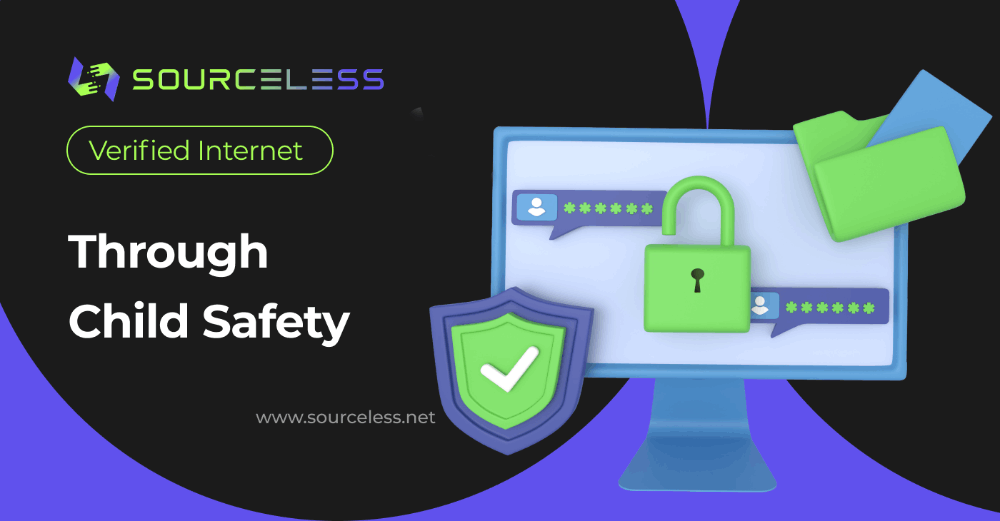
The Verified Internet Is Arriving Through the Child-Safety Door

Call it child protection instead.
That doesn’t make the concern fake. Algorithms dictate what our kids see and often, what they believe.
Children are being shaped by systems designed to hold attention, harvest behavior, recommend harder, scroll longer, and keep emotional life inside a commercial interface. It’s common sense that parents worry and governments are right to ask what responsibility platforms have. Anyone who has watched a child disappear into a feed knows there is a real problem here.
But a real problem does not automatically justify every system and solution built in its name.
Moreover, the problem is not digital technology itself. A screen can be a classroom, a studio, a library, a conversation, a tool for coordination, a way into communities a young person would never reach otherwise. So, the question and focus moved from only how much time children spend online, to the quality of that digital engagement. Creating, learning, speaking to real people, researching, making music, editing video, studying a language is not the same thing as being pulled through an endless feed designed to refresh before attention has time to settle.
The issue is not “screen time” in the crude sense. It is the quality of engagement, the purpose of use, the level of guidance, and the design of the system around the child. Active use can strengthen capacity. Passive, repetitive, consumption driven by algorithms can weaken it.
The UK now plans to block under-16s from certain social media services from Spring 2027, following the Australian model. Australia has already moved first. Platforms such as Instagram, YouTube, TikTok, Snapchat, Facebook, X, Reddit and others are expected to prevent under-16s from holding accounts, with large penalties if they fail to take “reasonable steps.”
A platform facing serious penalties will not rely on a child typing the right birthday. It will look for something reliable like documents and facial age estimation. Or it will go the third-party checks or device-level controls route. In some cases, adults may also need to prove they are old enough to enter the same space. The law may be aimed at children, but the system built to enforce it has to sort everyone.
This is the part that deserves more scrutiny than it is getting.
On one hand, the public argument is straightforward: children should be protected from online systems that are harmful. Very few people would disagree with that. On the other hand, what kind of infrastructure we are willing to normalize in order to enforce that protection?
Because once an access-control layer exists, it rarely stays in one place.
First it is adult content. Then social media and livestreaming. Then it might be AI companions and financial tools and marketplaces. Or even public services. And each of these individual steps can be defended. Because each one comes with a specific harm, a moral urgency or a group that needs protection. But then, after all these steps what we get might be an internet a lot less open and more conditional by default.
And this is no longer only about whether teenagers should be on TikTok.
Social platforms are definitely not just entertainment spaces anymore. They are where people discover news, language, trends, music, communities, political opinions, public arguments, and social belonging. That does not mean children should have unlimited access to everything. But restricting access to these spaces comes with a lot of serious implications.
Besides deciding what children are protected from, a child-safety policy also decides what they are excluded from and who gets to make that decision.
You do not need to believe in some grand conspiracy to see the potential dangers here with this structural shift. And the pressure is already visible. The European Commission has developed an age-verification solution that can prove someone is over 18 without sharing other personal information. It is presented as privacy-preserving and compatible with the coming EU Digital Identity Wallets. There’s a difference there. Selective disclosure is better than handing over a full passport scan to every website that asks.
But the harder privacy question is not only what data is shared in one transaction.
It is how often people will be asked to prove something about themselves in order to move through digital life.
A proof can reveal less and still discipline behavior. A system can be cryptographically elegant and still become socially coercive. If every service can request an attribute, and refusal means exclusion, the user’s choice becomes thin. While you may still hold the credential, the conditions of entry are set elsewhere.
This is where the power shifts. Not to the child, not to the parent, and not really to the individual user. It moves toward whoever defines the conditions of access: the platform, the identity provider, the regulator, the app store or the system set between you and the page you are trying to open.
Privacy is not only data confidentiality but also the ability to read, speak, search, associate, explore, and think without turning every action into a verification step. An anonymous internet does have problems which we need to acknowledge openly. But it also has value. It allows people to search for help before they are ready to be seen. It allows young people to learn outside the boundaries of their immediate environment. And, ultimately, it allows political speech, whistleblowing, recovery, doubt, experimentation, and private thought.
Yes, the current internet can be very exploitative. Platforms built billion-dollar attention machines, then asked society to somehow manage the damage at home. They optimized compulsion and while claiming neutrality, they shaped behavior at the level of architecture.
So yes, intervention is, undoubtedly, necessary. But we should be precise about that intervention.
If the problem is the way platforms keep children scrolling, then the design of those platforms has to be addressed. If recommendation systems push children toward more extreme, addictive, or emotionally charged material, then the recommendation systems need limits. Maybe the danger is contact from unknown adults, then the contact features need to be changed. Or, if minors are being profiled and monetized, then the data economy around minors has to be restricted.
However we look at it, identity verification should not become the default answer to every digital risk. Bad infrastructure becomes acceptable because the first use case sounds reasonable.
There is also the practical problem: age-gating can be bypassed. Children are not passive subjects of technical regulation. They’re smart, they find ways to bypass systems — they can compare loopholes, borrow accounts, use VPNs, use older siblings’ profiles, parents’ devices, or simply move toward spaces that are harder to see. So the result can be a strange split: the compliant web becomes more identity-bound, while the users most determined to avoid the rules move somewhere else.
A system that weakens privacy for everyone and still fails to protect the children it was built for is not a mature solution. Age may need to be proven in some places online. But the devil is in the details: who can ask for proof, what they are allowed to see, how the request is logged, who audits the system, and what stops it from spreading into places where identity should not be required. These details show what kind of digital identity is being built.
This is the SourceLess argument in practical terms. The internet needs better proof, safer access, verifiable credentials, and ways to confirm one fact without exposing the whole person. But identity should stay with the user. It should not become a profile passed between platforms, vendors, state systems, and compliance layers.
Technology should not reduce human agency while claiming to protect it. If identity, access, communication, finance, and participation are becoming part of the same digital layer, then ownership of that layer is absolutely essential. If people cannot inspect it, challenge it, or leave it, convenience is turned into severe dependency.
So the demand has to be more precise: regulate the designs that make platforms compulsive, restrict the data economy around minors, require real accountability from companies that profit from attention, and use privacy-preserving proof only where proof is actually needed.
As a society that cares about children and cares about our privacy as well, we should be careful about rushing into that trade.
And we should ask more from the platforms that created the problem in the first place: less addictive design, stricter limits on the data economy around minors, real accountability for systems built to capture attention, and privacy-preserving proof only where proof is genuinely needed.
Safety should make the internet more accountable, not more dependent on identity checks at every door.
The verified internet is coming through a concern almost everyone understands. That is why it deserves serious scrutiny now, before it becomes part of the background of everyday digital life.
SourceLess starts from the same concern: people need digital identity, communication, and ownership tools that increase their control instead of handing more of it away. Proving something online should not mean exposing the whole person, and connecting online should not mean becoming dependent on another gatekeeper.
To read more about digital identity, ownership, and a different way to connect online, visit SourceLess: https://sourceless.net
Sources:
Children’s Wellbeing and Schools Act 2026;
Online Safety Act 2023 s.214A;
UK Government fact sheet and June 2026 progress statement;
Online Safety Amendment (Social Media Minimum Age) Act 2024 (Australia); eSafety Commissioner regulatory guidance;
European Commission age verification recommendation (April 2026); Regulation (EU) 2024/1183;
EDRi, “The eID Wallet still doesn’t deserve your full trust” (March 2026); K.G.M. v. Meta Platforms, Inc. et al., LA Superior Court verdict (March 25, 2026).