Is Bitcoin's PoW actually fair?


⚒️ Why Bitcoin’s Proof of Work Is Not Fair
When people learn that I created a new algorithm called Fair Proof of Work, one of the most asked follow-up questions I get is:
“How is Bitcoin’s Proof of Work not fair?”
Bitcoin has, what I believe, are several flaws.
These are flaws Satoshi likely didn’t know would come to exist, at least not to the extent that they have.
I believe Bitcoin is unfair in a few different ways.

🖥️ Bitcoin Mining Started Mostly Fair
The most notable issue is the way mining works.
Bitcoin mining started off mostly fair in 2009, when everyone could mine on their PCs or laptops. At that point, the most unfair part of it was who had the better computer, but that was minimally a problem.
After Satoshi left in 2011, however, GPU miners hit the scene.
Instantly, those with GPUs became the powerhouse, and those still using normal computers to mine were left in the dust, almost never finding blocks.
Shortly after that, ASIC miners hit the scene, leaving most GPU miners in the dust.
Today, if you are not using mining hardware that costs $1,000 USD or more, chances are you are not mining blocks.
If you are still mining blocks, it is likely because you joined a mining pool. In that case, you are getting much smaller returns, and it is really the mining pool with the power, not the individual miners.
This makes for unfair mining.
It means the poorest people have almost no chance of really earning mining rewards.

⚡ Why Hashing Power Wins in Bitcoin
Bitcoin mining works by assembling a block and repeatedly changing a value called a nonce.
Each nonce produces a different hash, which is compared against a target value.
The more hashes a miner can compute per second, the greater their chance of finding a valid block and earning the reward.
Bitcoin’s nonce in the block header is a 32-bit number, allowing values from:
0 to 4,294,967,295
Modern ASIC miners can exhaust that entire range many times per second, while a typical PC can only compute a tiny fraction of that number of hashes in the same time.
This enormous difference in hashing power is why ASIC miners are overwhelmingly more likely to find the next block.

⚖️ What Contractless Does Differently
\With the Contractless blockchain, what we did is cap that value at 1 byte.
That means the range of nonce values is only:
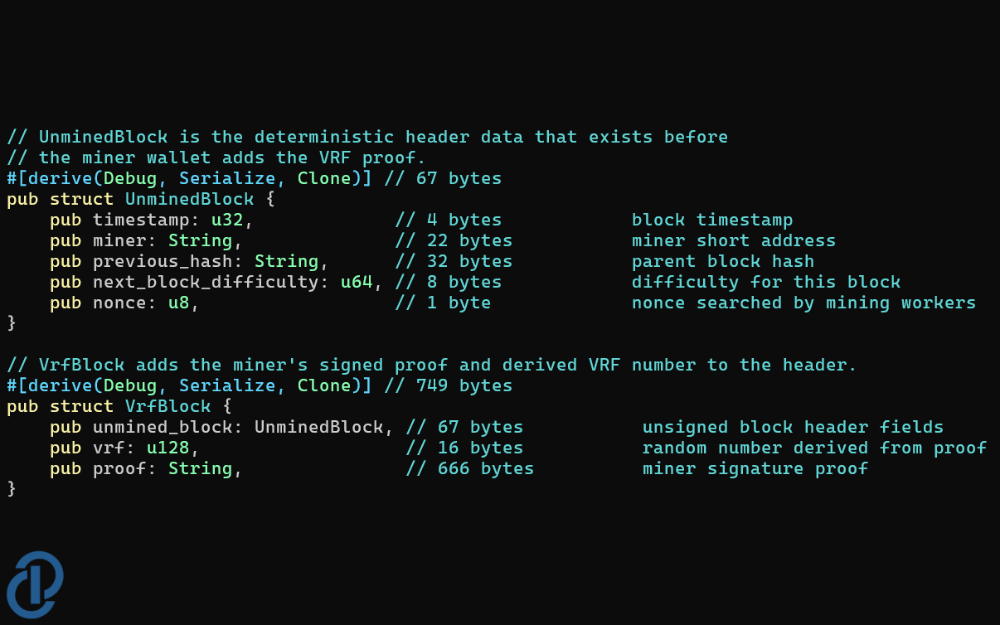
0 to 255
That is something almost all modern hardware can handle.
This makes it more fair because whether you are mining with a CPU, GPU, or ASIC mining hardware, you have the same 256 attempts per second.
This not only makes all hardware equal when mining, it also eliminates the need for mining pools.

🚫 No Mining Pools
We went one step further in that concept and made it so every miner must use their wallet address to sign a mined block.
This means the person who mined the block gets 100% of the reward.
There is no ability to split the task of mining a block between an array of computers, because the signature and wallet address that mined a block are part of the header data that must get signed.
This eliminates the ability to use mining pools.
Even if someone found a way to use a mining pool, there would be no real advantage to it.

🧱 The Fairness Distributor
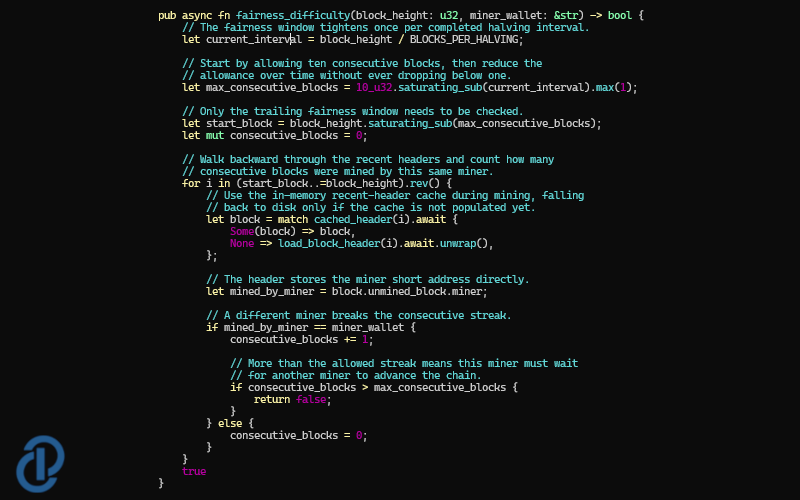
The final thing we did was make something called a fairness distributor.
A fairness distributor is a piece of code that reduces how many blocks a miner is allowed to mine in a row.
This number starts out at 10 blocks, and every halving is reduced by 1, until only 1 block can be mined at a time.
For example, if Miner A mined the last 10 blocks, the 11th block would get rejected by the network.
Another miner must mine the next block.
After 9 halvings, if Miner A mined a block, they cannot mine the next block. Another miner must mine that block.

🌐 One IP, One Mining Unit
We also went to great lengths to prevent multiple miners from being operated from the same IP address.
So a user cannot spin up 10 different nodes on the same IP address.
They would have to buy an IP address for each mining unit they intend to run.
On top of that, each mining unit must mine its first 100 blocks for free.
So if someone wanted to run 100 different mining units, they would need:
- 100 different IP addresses
- 100 different mining nodes
- 10,000 blocks mined without rewards
That is a very different model than simply buying more hashing power.

✅ Why We Call It Fair Proof of Work
All of these reasons combined are why the algorithm for Contractless is named:
Fair Proof of Work
Because mining should not be limited to those who can afford specialized hardware.
Because mining rewards should not be captured by pools.
Because one miner should not be able to dominate block production forever.
And because Proof of Work should be about participation, not just purchasing power.