The Colourful, Chaotic, and Surprisingly Beautiful History of Art on the Blockchain

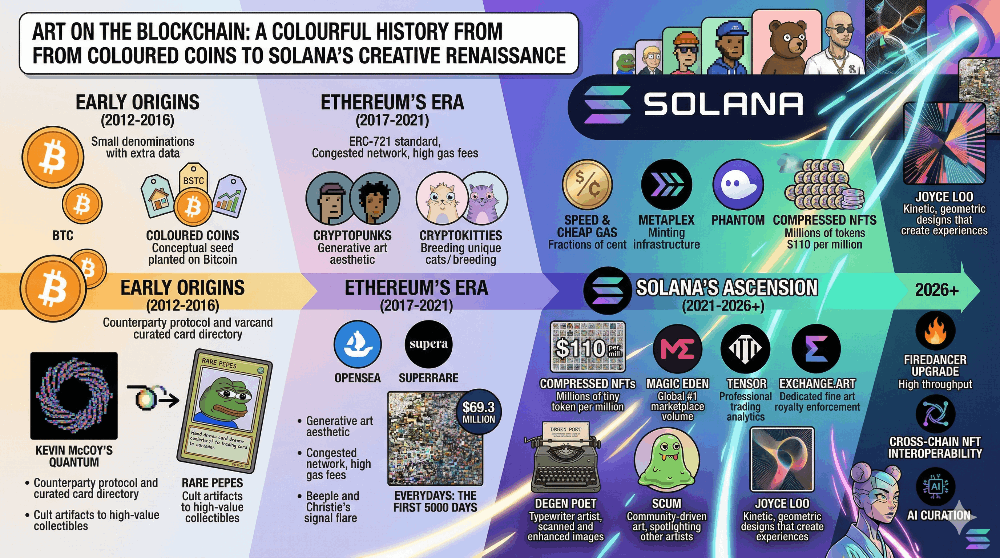
Table of Contents
- The Pre-History: Coloured Coins and Curiosities (2012–2016)
- Ethereum's Golden Age: CryptoPunks to Beeple (2017–2021)
- The Great Bubble and Its Aftermath (2021–2022)
- Solana Emerges: Speed, Cheap Gas, and a New Kind of Artist (2021)
- Solana Grows Up: From PFPs to Fine Art (2022–2023)
- The Marketplace Wars: Magic Eden, Tensor, and Exchange.Art (2023–2024)
- Solana Art in 2025: A Scene Comes of Age
- The Artists Defining Solana's Creative Scene
- What's Next: 2026 and Beyond
- Glossary
- Quick Reference Timeline
1. The Pre-History: Coloured Coins and Curiosities (2012–2016)
The story of art on the blockchain did not begin with million-dollar JPEG sales and celebrity apes. It began, quietly and almost accidentally, on Bitcoin.
In 2012, developers began experimenting with what they called "Coloured Coins" — small denominations of Bitcoin embedded with extra data that could represent real-world assets. They weren't art, exactly, but they planted the conceptual seed: a blockchain entry could stand in for something unique and ownable beyond mere currency.
The first recognisable act of digital art minted to a blockchain came in May 2014, when artist Kevin McCoy and technologist Anil Dash stood at a hackathon and registered a looping video — created by McCoy's wife — onto the Namecoin blockchain. They called it "monetised graphics." The audience laughed. McCoy named the piece Quantum. It sold at Sotheby's in 2021 for $1.47 million.
By 2015, the Ethereum blockchain launched, and with it came Etheria — a grid of 457 virtual land plots that mostly sat unsold for years. In 2016, the crypto-native art community found its first genuine scene on Bitcoin via the Counterparty protocol, where artists contributed hand-drawn cards to a curated directory called Rare Pepes — trading cards built around the Pepe the Frog meme that established the first real crypto art market. They were cult artefacts then; some later sold for hundreds of thousands of dollars on Ethereum after collectors used a bridging tool called Emblem Vault.
These early years belonged to a tiny, obsessive community. The tools were primitive, the audiences minuscule, and the cultural stakes felt low. Nobody outside of cryptocurrency circles had heard any of these names.
2. Ethereum's Golden Age: CryptoPunks to Beeple (2017–2021)
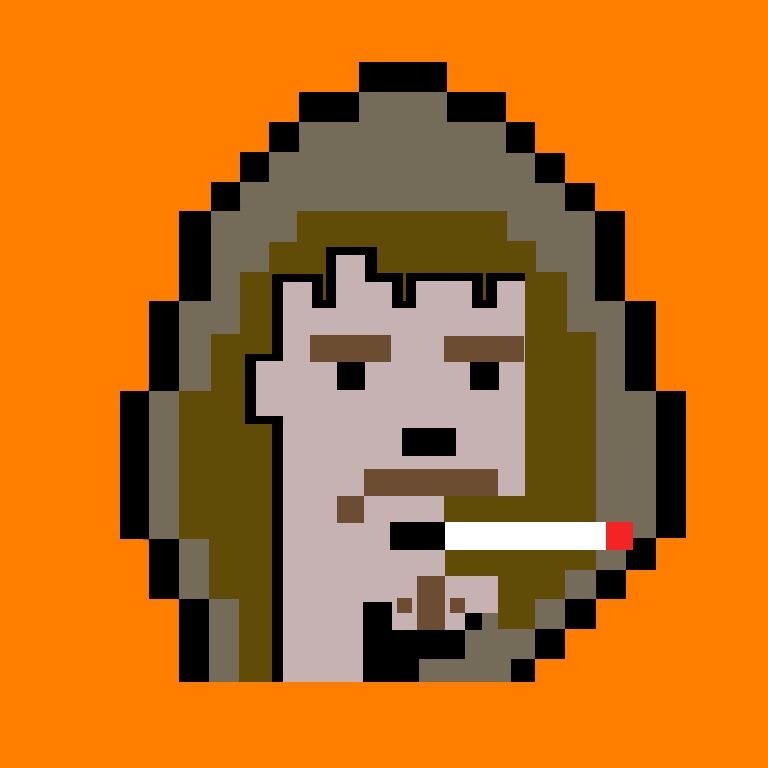
In May 2017, artist Benitic and a small developer team launched CurioCards — widely regarded as Ethereum's first art NFT project, a set of digital trading cards using the then-still-fungible ERC-20 standard. A month later, Larva Labs released CryptoPunks: 10,000 algorithmically generated pixel portraits, originally given away for free, which would go on to define the aesthetic of an entire era and sell for millions of dollars each.
Then came CryptoKitties. Launched in November 2017 by Canadian studio Dapper Labs, it became the first mainstream NFT application — a game where players could purchase, breed, and trade unique digital cats. It was so popular it congested the Ethereum network, drove up gas fees to absurd heights, and coined the very term "NFT" through its adoption of ERC-721: the open token standard that defined how non-fungible ownership works on Ethereum-compatible blockchains.
In 2018, developer John Crain founded SuperRare, inspired directly by CryptoPunks — a curated platform where single-edition digital artworks could be authenticated and traded. SuperRare took only 15% commission versus a gallery's typical 50%, and crucially gave artists a 10% royalty on every subsequent resale — something only blockchain technology made possible. It was a genuine structural revolution in how artists could earn from their work.
The years 2018 and 2019 were a long, cold bear market. Ethereum crashed. The NFT community shrank from tens of thousands to hundreds. But in the background, artists, builders, and collectors were quietly learning: early adopters of Axie Infinity, early CryptoPunks traders, and the first crypto-native fine art community on platforms like SuperRare were laying foundations. NFT sales totalled just $82 million across all of 2020.
Then 2021 happened.
3. The Great Bubble and Its Aftermath (2021–2022)
On 11 March 2021, Christie's auction house sold Beeple's Everydays: The First 5000 Days — a digital collage of 5,000 images created daily for over thirteen years — for $69.3 million. It was not just a record; it was a signal flare. Overnight, "NFT" went from a jargon term to a cultural flashpoint. Collins Dictionary named it Word of the Year 2021.
Total NFT trading volume leapt from $82 million in 2020 to $17 billion in 2021. The Bored Ape Yacht Club launched in April 2021 and became the defining cultural artefact of the boom: 10,000 cartoonish apes that functioned as status symbols, community memberships, and speculative assets simultaneously. Celebrities bought in. Brands salivated. The media couldn't stop writing about it.
And then, in May 2022, the market collapsed. Volume was down over 90% compared to the peak. Many collections became worthless. The hangover was brutal and necessary. What the crash separated was art from speculation: projects built on genuine creative communities and artistic merit showed much greater resilience than those built purely on hype.
The crash also exposed Ethereum's persistent weaknesses for everyday artists and collectors: gas fees that could run to $50–$450 per transaction during periods of congestion, making it economically irrational for anyone but wealthy collectors to participate. That weakness was Solana's opportunity.
4. Solana Emerges: Speed, Cheap Gas, and a New Kind of Artist (2021)
Solana launched its mainnet in March 2020, designed from the ground up for speed and scale — capable of handling up to 65,000 transactions per second, with average transaction costs
of a fraction of a cent. For NFT artists and collectors priced out of Ethereum, this was transformative.
The Solana NFT scene traces its very first steps to early 2021. There is a friendly debate in the community about which collection came first — Kreechures or Solarians — both arriving in March 2021, before the Metaplex token standard had even been created. SolPunks, a Solana-native homage to Ethereum's CryptoPunks, is often cited as the first project to actually mint on the Solana blockchain.
The Phantom wallet launched in beta in April 2021, went public in July, and immediately became the go-to interface for the Solana ecosystem. In August, Solana Monkey Business Gen 2 minted at just 2 SOL — by December 2021, the floor price had risen to 175 SOL, an 87x return for early believers.
On 17 September 2021, Magic Eden was born. Its first day of trading recorded $50,000 in transactions. Within three months, it listed over 1,500 collections and had captured extraordinary momentum.
The early Solana NFT community had a character noticeably different from Ethereum's — younger, more playful, less precious about art world credentials, and fiercely communal. Monthly NFT sales volume on Solana rocketed from $1.2 million in March 2021 to $323 million by February 2022. Active Solana addresses trading NFTs grew from 19,000 in June 2021 to 150,000 by early 2022.
5. Solana Grows Up: From PFPs to Fine Art (2022–2023)
By 2022, Solana had a genuine NFT ecosystem — but it was dominated by profile picture collections rather than what the traditional art world would recognise as art. Okay Bears, minting in April 2022 at 1.5 SOL, became a breakout moment: within a month the floor rose to around 250 SOL and briefly rivalled Ethereum's biggest projects for cultural attention. DeGods launched and, after a rocky start, became one of Solana's signature blue-chip collections, introducing NFT staking and a secondary "DeadGods" layer. The same team later released y00ts, a 15,000-piece collection described as "a love letter to Web3."
But alongside this PFP speculation, something subtler was happening. Artists who had built careers on Ethereum began looking at Solana's near-zero fees and near-instant transactions and saw a different creative possibility. ThankYouX sold his piece Xplore for a then-record 751 SOL in March 2022. Cath Simard sold her 1/1 work Alone, not lonely for 1,300 SOL in June 2022.
The critical infrastructure for a real art market was also taking shape. FormFunction, launched in February 2022, raised $4.7 million in seed funding and became the first dedicated 1/1 NFT marketplace on Solana, hosting over 4,000 creators and becoming the third-largest Solana marketplace by volume during the FTX crisis in November 2022. Its closure in March 2023 sent shockwaves through the Solana art community — but it also cleared space for Exchange.Art, which stepped into the role of Solana's dedicated fine art home, featuring gallery-style presentation, royalty enforcement tools, and 24/7 curatorial support.
The royalty question dominated this period. As Ethereum-side competitors like Blur made creator royalties optional — devastating artist income — Magic Eden introduced its Open Creator Protocol in late 2022, allowing Solana artists to enforce perpetual royalties and restrict their work to royalty-respecting platforms. Exchange.Art went further, offering zero seller fees so artists received 100% of primary sale proceeds.
6. The Marketplace Wars: Magic Eden, Tensor, and Exchange.Art (2023–2024)
By 2023, Solana's NFT marketplace landscape had stratified into distinct layers serving distinct audiences.
Magic Eden remained dominant. Founded in September 2021 by Jack Lu, Sidney Zhang, Zhuoxun Yin, and Zhuojie Zhou — all from Silicon Valley tech firms — it had raised $157 million in total funding including a $130 million Series B at a $1.6 billion valuation. Within months of launching it controlled over 90% of Solana NFT trading volume. When Bitcoin Ordinals launched in early 2023, Magic Eden pivoted fast, capturing over 50% of Ordinals volume within a week of launching its Ordinals marketplace. By March 2024, Magic Eden was the number one NFT marketplace globally by monthly trading volume, recording $734 million in a single month — surpassing both OpenSea and Blur.
Tensor carved out a different niche: the professional trader's platform, with real-time order books, candlestick charts, automated market making pools, and advanced analytics. It grew 300% year-on-year through its innovative tools, rewarding active traders with NFT airdrops and mystery boxes. Where Magic Eden served broad audiences, Tensor served serious flippers and quantitative collectors.
Exchange.Art served the fine art end of the market. Its gallery-like interface, editorial content, artist office hours, and royalty enforcement made it the home for 1/1 and editioned artworks — the equivalent of a curated art fair rather than a trading floor. It also launched Code Canvas, the first and only long-form generative art marketplace on Solana, storing artist code directly on-chain.
Perhaps the most radical experiment of this period was DRiP. Originally spun out of Solana Spaces, a now-closed chain of Solana retail stores, DRiP leveraged compressed NFTs — a Solana innovation that allowed minting of one million NFTs for approximately $110 — to give away free digital art, music, and comics to a growing subscriber base. Think of it as a Substack for artists: creators build channels, drop weekly collectibles, and collectors subscribe. DRiP distributed over 18 million NFTs in this model, onboarding new users to Web3 with zero financial barrier and genuine creative exposure.
7. Solana Art in 2025: A Scene Comes of Age
By mid-2025, Solana's NFT trading volume had grown 278% year-on-year, outperforming Ethereum in several categories. Solana reached price highs of $190–$250, boosting overall market sentiment and NFT activity. The Metaplex Core standard had driven NFT minting costs down to negligible levels, making the network even more attractive to individual artists and independent developers.
The Solana developer ecosystem was on fire: according to the 2024 Crypto Developer Report, Solana was the number one ecosystem for new developers in 2024, growing 83% year-on-year. New wallets, new tooling, and new artist-facing infrastructure kept arriving.
The artist community matured in a parallel direction. Where 2021 Solana was dominated by speculation and profile picture flipping, 2025 Solana had a recognisable fine art culture — one with its own aesthetics, its own collector communities, its own critical conversations. Collectors on Exchange.Art and DRiP were not primarily motivated by floor prices; they were motivated by the art itself. As artist Sleepr noted in a widely-shared reflection, Solana had become "an invisible infrastructure layer" — the technology working so smoothly that the conversation could finally be about the art again.
Mad Lads, created by the team behind the Backpack wallet and exchange, emerged as one of the most prominent Solana NFT projects in 2025 — notable not just for its art but for the depth of its integration with Solana's financial ecosystem, bridging collectibles with DeFi participation and exchange access.
The meme coin supercycle of late 2024 and early 2025 — with Solana as the primary launchpad for viral tokens — brought massive new liquidity and user onboarding to the Solana ecosystem generally, with some of that energy and capital spilling into NFTs and digital art as participants sought higher-conviction, longer-duration bets.
AI-generated art became a serious category. Nearly 48% of creators were utilising AI tools to generate NFT assets by 2025, contributing to a production increase of over 37% in AI-generated collections. On Solana, this intersected with the generative art tradition on Code Canvas, with artists blending algorithmic outputs with human editorial judgment rather than treating AI as a replacement for authorship.
The environmental conversation that had dogged Ethereum-based NFT art — rooted in its energy-intensive proof-of-work consensus — largely bypassed Solana, whose proof-of-stake design consumed orders of magnitude less energy per transaction. Artists who cared about ecological footprint found Solana a natural home.
8. The Artists Defining Solana's Creative Scene
The Solana art scene is defined less by individual stars than by the quality of its community — but several artists have broken through to significant recognition and sales volume.
Degen Poet is perhaps the most singular figure: a self-described typewriter artist who physically types images on a vintage mechanical typewriter, scans them, and enhances them with watercolour, marker, and animation. The result is an art style that weds the analogue past to the digital present in a way impossible to fake or replicate algorithmically. Degen Poet accumulated nearly $1.9 million in total sales volume on Solana.
SCUM created Slimes, a 1/1 PFP project inspired by Xicano and Mexican history and mythology — accumulating over $550,000 in volume and building the project explicitly as a community platform rather than a speculative collection, using it to spotlight and support other Solana artists through the Slimes Family Collection.
John Lê, coming from the comic book industry, became one of the most prominent independent artists on Solana in 2021 and used his platform to help establish the art scene's early cultural identity. Artists like Mical Noelson, whose abstract work draws from paint, pencils, canvas, computer screens, and dirt, alongside Sleepr and Laura El, represented the kind of boundary-pushing abstract and figurative practice that gave Solana collectors something genuinely distinct from what they could find on Ethereum.
Joyce Loo, a Taiwanese artist whose geometric, kinetic designs are described by collectors as works you don't look at but experience, became one of the most admired names in the ecosystem. Zen0 built a reputation for pixel art that tells stories in minimal resolution, contributing to projects including Solana Monkey Business, Famous Fox Federation, and Tensor itself.
What these artists share is an emphasis on genuine artistic vision over market mechanics, and a community ethos forged in a relatively small ecosystem where artists know and support each other personally. As Laura El put it: "The community was what sold me on Solana before I even created my first wallet and tried the tech. I had never met a more welcoming group of people."
9. What's Next: 2026 and Beyond
As of early 2026, Solana's NFT art ecosystem is entering a new phase of consolidation and institutional maturity.
Magic Eden made a decisive pivot in February 2026, announcing the closure of its Bitcoin Ordinals, Runes, and EVM marketplaces to refocus entirely on Solana and a new crypto iGaming platform called Dicey. The rationale was stark: Solana accounted for over 85% of Magic Eden's revenue. The multi-chain experiment was a strategic detour; the core business was always Solana.
The Firedancer upgrade — a new independent validator client from Jump Crypto — promises to dramatically increase Solana's throughput and resilience, reinforcing its position as the performance blockchain for high-frequency creative applications.
Cross-chain NFT interoperability is arriving. Bridges like Wormhole and LayerZero increasingly allow NFTs to move between Solana, Ethereum, and other chains, opening the possibility of a Solana-minted piece trading on multiple marketplaces across ecosystems without artists losing provenance or royalty entitlements.
The broader NFT market is maturing away from pure speculation toward utility: over 63% of NFTs issued in 2024 already offered functional benefits like membership access, loyalty perks, or governance rights alongside aesthetic value. For artists, this creates new models — not just selling a beautiful object, but selling a relationship, an access key, a community membership, a piece of ongoing creative dialogue.
The separation of art from speculation — the key structural question of the 2021–2022 boom-bust cycle — has largely happened. What remains on Solana in 2026 is leaner, more committed, and genuinely more creative than what came before. The artists who stayed through the crash are building something durable. The infrastructure to support them — low fees, fast settlement, expressive token standards, dedicated fine art platforms, and free-entry onboarding via DRiP — is better than it has ever been.
The blockchain is now, finally, an invisible layer. What's visible is the art.
Glossary of Key Terms
NFT — Non-fungible token: a unique blockchain-based record certifying ownership of a digital or physical asset.
ERC-721 — The Ethereum token standard that formally defined NFTs, pioneered by CryptoKitties in 2017.
Metaplex — Solana's primary NFT token standard and minting infrastructure.
PFP — Profile picture NFT: a collection-based avatar used as social media identity.
1/1 — A one-of-one unique artwork, as opposed to a large edition or collection.
Compressed NFTs — A Solana innovation enabling mass minting at extremely low cost, approximately $110 per million NFTs.
Gas fees — Transaction costs on a blockchain network.
Floor price — The lowest listed price of any NFT in a given collection.
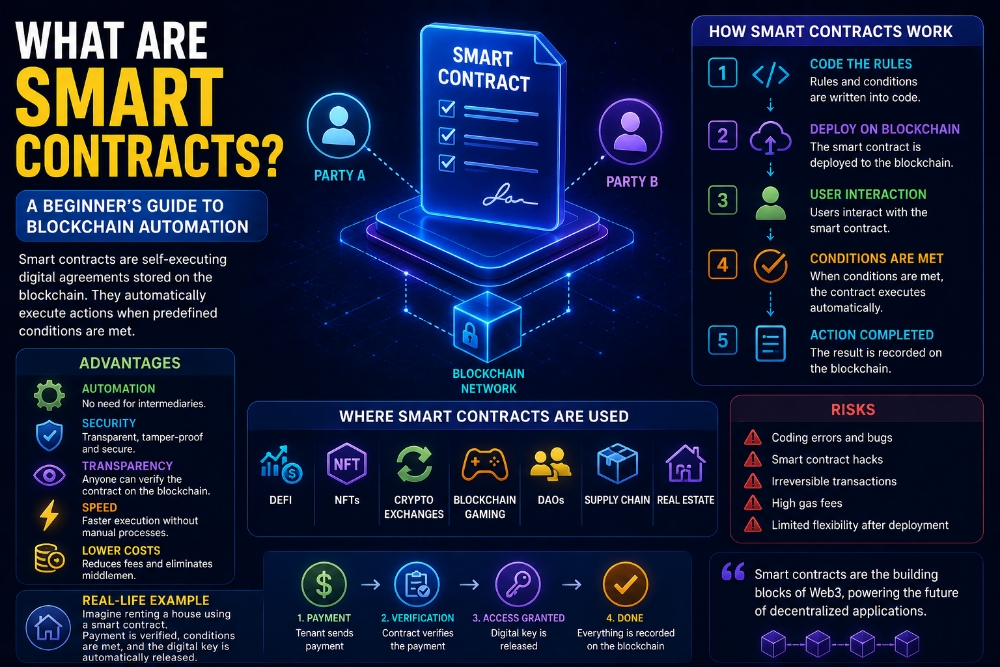
Royalties — A percentage of secondary sales paid automatically to the original creator via smart contract.
Generative art — Artwork created using algorithmic code, often with randomised traits.
Ordinals — A protocol enabling NFT-like inscriptions directly on the Bitcoin blockchain, launched January 2023.