Blockchain for Beginners: Understanding the Technology Behind the Hype

Blockchain is one of those technologies that almost everyone has heard of, but far fewer people actually understand.
Bitcoin, Ethereum, cryptocurrency, NFTs, DeFi — these terms have become increasingly common over the past few years. But behind all of them lies a surprisingly interesting engineering problem:
How can thousands of people who don't trust each other agree on the same version of the truth, without putting one person or organisation in charge?
I’ll be exploring this question in an upcoming talk I’m holding, Blockchain for Beginners.
It All Starts With Trust
Imagine Alice wants to send $50 to Bob.
Normally, a bank or payment provider acts as the middleman. It keeps track of everyone's balances, verifies the transaction, and updates its records accordingly.
This works because everyone agrees to trust the middleman.
But what happens if we remove it?
One approach would be to let one person maintain a notebook containing everyone's transactions. But now everyone has to trust that person not to cheat, lose the notebook, or secretly modify previous records.
What if everyone keeps their own notebook instead? That removes the single owner, but creates another problem: what happens when everyone's copies disagree?
This is the fundamental problem that blockchain attempts to solve: allowing parties who don't necessarily trust one another to agree on one shared ledger without having a central authority in charge.
Building a Chain of Blocks
A blockchain is essentially a ledger organised into blocks that are linked together.
Instead of keeping the ledger in one central location, copies can exist across many different computers, or nodes, on the network. New records are appended to the chain rather than quietly replacing old ones, and cryptographic hashes connect the blocks together.
If someone attempts to modify an old block, its hash changes, breaking the links with the blocks that follow it. This makes tampering with historical records detectable.
But having a shared ledger introduces another question:
How do we know that the person sending a transaction is actually authorised to do so?
Proving Who You Are Without a Password
This is where public and private keys come in.
A private key can be thought of as your personal digital signature pen. It is a secret value that only you should possess. Your public key, on the other hand, can be distributed freely and used as part of verifying your signature.
When a transaction is created, the private key can be used to produce a digital signature. Other participants can then verify the transaction without ever needing access to the private key itself.
For Bitcoin, verification doesn't stop there. The network also needs to determine whether the sender actually owns Bitcoin that can be spent. This is where concepts such as the UTXO (Unspent Transaction Output) model become important.
This creates one of the interesting characteristics of public blockchains: transactions can be publicly visible, while the ability to spend the assets associated with an address remains protected by the corresponding private key.
But Who Decides What Gets Added?
Even if we can verify individual transactions, there is still a much bigger problem.
If thousands of computers maintain copies of the blockchain, how do they agree on what the next block should be?
In the talk, I'll introduce this through the Byzantine Generals Problem — a classic way of thinking about how independent participants can reach agreement even when some participants may be dishonest.
The blockchain equivalent is straightforward to describe but difficult to solve: thousands of computers need to agree on one shared ledger, even when they cannot simply trust everyone else participating in the network.
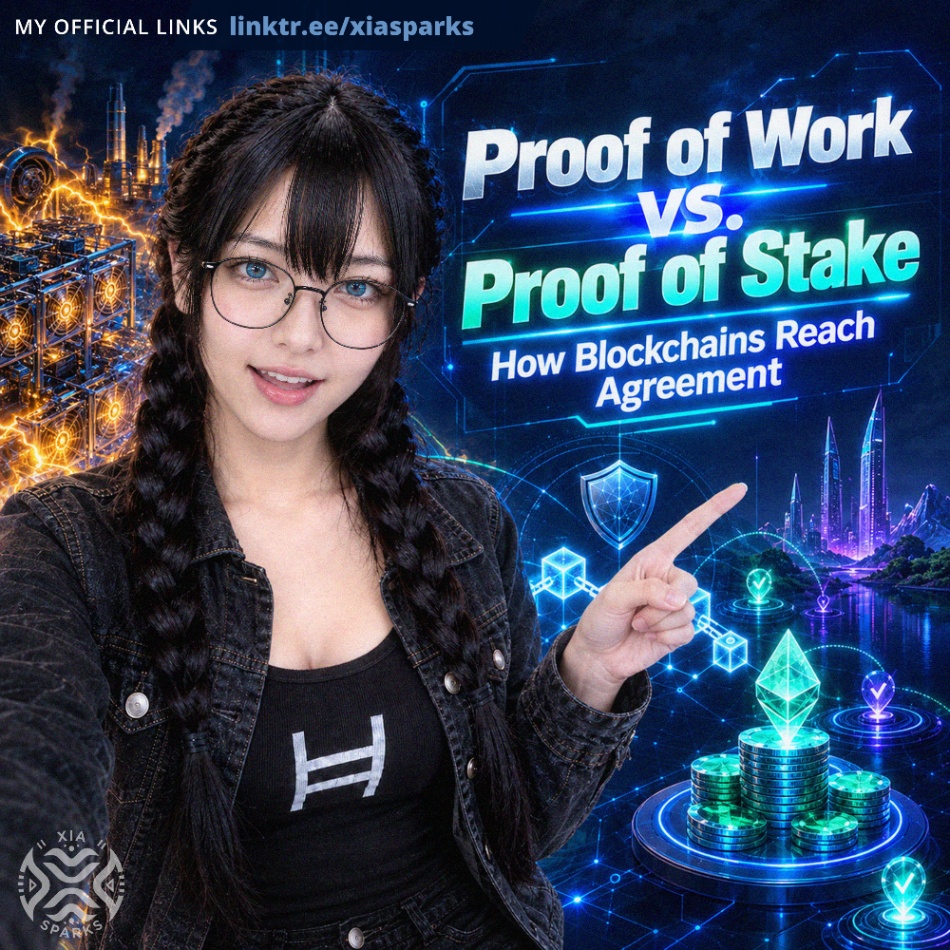
From there, I'll explore two well-known approaches to blockchain consensus: Proof of Work and Proof of Stake.
Proof of Work makes producing blocks computationally expensive, while Proof of Stake instead requires participants to put assets at stake as collateral. They approach the problem differently, but both attempt to provide a mechanism through which a distributed network can agree on the state of the blockchain.
Beyond Cryptocurrency
Once these foundations are in place, it becomes much easier to understand where the rest of the blockchain ecosystem comes from.
Cryptocurrency is the most obvious application, but blockchain technology has also enabled smart contracts, decentralised finance (DeFi), and NFTs.
Understanding the underlying technology also makes it easier to look past the terminology and hype and ask a more useful question:
Does this problem actually need a blockchain?
Blockchain Isn't Magic
One thing I want to emphasise in the talk is that blockchain isn't automatically better simply because it is decentralised.
There are real trade-offs.
Blockchain systems can face scalability and network-usage challenges compared with centralised systems. Some Proof of Stake systems can raise concerns around wealth concentration. Transactions may not have the familiar "undo" button that centralised services can provide, and losing a private key can mean losing access entirely.
Understanding blockchain therefore isn't just about understanding what it can do. It's equally important to understand what it can't do well.
That's ultimately what I want to explore with Blockchain for Beginners: starting from the simple problem of trust, then gradually unpacking the cryptography, transactions and consensus mechanisms that allow a blockchain to work.
Blockchain isn't the right tool for every problem. But as an engineering solution for getting strangers to agree on a shared truth without relying on a middleman, it's a genuinely fascinating idea.