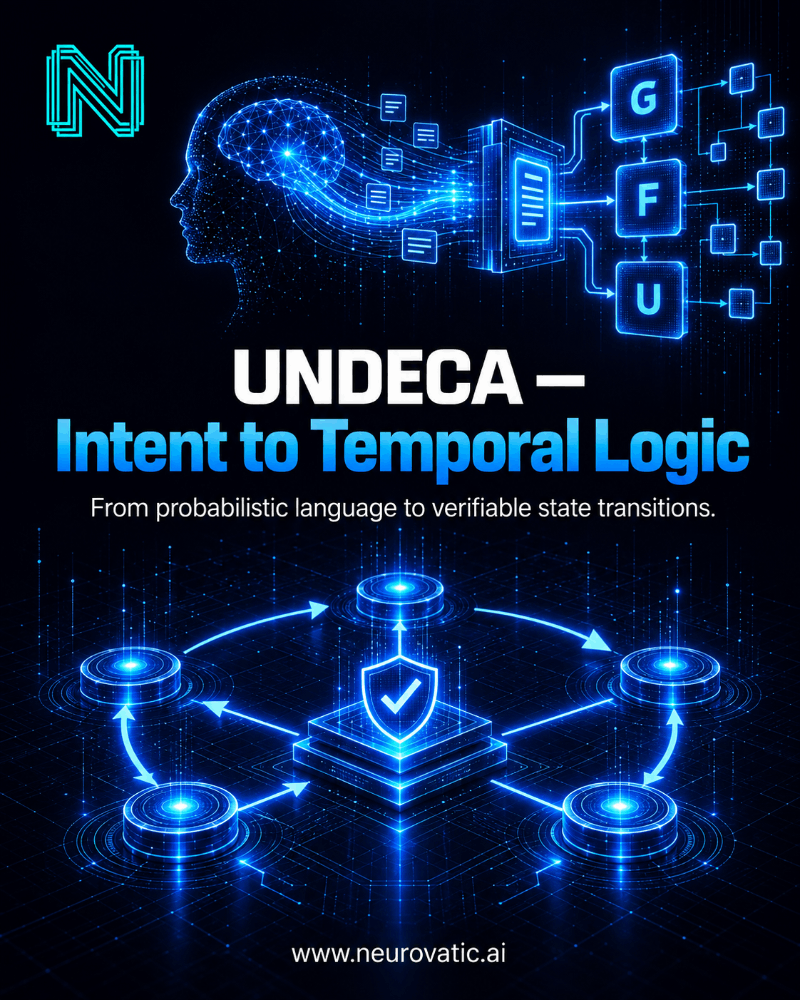
How AI intent is translated into temporHow AI intent is translated into temporal logic inside UNDECA

Turning probabilistic language into a deterministic verification problem
A formal verifier cannot check that sentence directly. It needs explicit state variables, actors, resources, permissions, transition rules, and temporal properties.
UNDECA’s architectural role is to construct that bridge without pretending that an embedding vector is already a formal specification.
1. Canonical intent and ontology grounding
The pipeline begins by converting the proposed plan into a canonical intent record:
- subject: which agent or operator is requesting action;
- resource: which data, service, device, or account is affected;
- action: the requested operation;
- preconditions: what must already be true;
- effects: what may change;
- forbidden effects: what must never change;
- authority: which policy or human approval is required;
- completion condition: what counts as success;
- failure condition: what requires containment or escalation.
An ontology maps domain terms to controlled predicates. Ambiguous concepts remain unresolved rather than being silently converted into false precision.
2. State variables and atomic propositions
The grounded intent can then be expressed through variables and propositions such as:
Authorized
ConnectionEncrypted
BackupVerified
ExternalWrite
UpdateComplete
GoalReached
The system also defines a transition relation: which next states are allowed from the current state and which actions can cause them.
3. Temporal properties
Different requirements become different temporal formulas:
G(ExternalWrite → Authorized)
An external write is always preceded by valid authority.
G(UpdateComplete → BackupVerified)
An update is never considered complete unless its backup has been verified.
G(BackupRequired → (¬UpdateComplete U BackupVerified))
When a backup is required, completion remains false until verification occurs.
F(GoalReached)
The system is expected eventually to reach the declared goal, assuming the modeled fairness and environmental conditions hold.
G means globally/always, F means eventually, X means next, and U means until.
4. Consistency and realizability checks
Before a plan reaches governance, UNDECA checks whether its obligations contradict each other or depend on an impossible state.
Boolean fragments can be tested with SAT/SMT techniques. Temporal obligations require temporal satisfiability, automata-based analysis, or model checking. A contradiction such as Authorized ∧ ¬Authorized is simple; a plan that can never satisfy both its liveness objective and its resource constraints requires state-space analysis.
The output is not merely “false.” A useful verification record identifies the failed assumption, property, state, or counterexample trace so the planner can be corrected.
5. From LTL to automata and runtime monitors
For model checking, an LTL property can be translated into a generalized Büchi automaton. A common verification method builds an automaton for the negated property and searches the product of that automaton with the system model for an accepting cycle. If such a cycle exists, it represents a counterexample to the desired property.
Runtime monitoring requires an important distinction:
- safety violations — such as an unauthorized write — can often be detected immediately from a finite trace;
- unbounded liveness violations — such as “the goal never occurs” — cannot generally be proven from a finite prefix alone;
- operational systems therefore use bounded deadlines, obligation monitors, or finite-trace semantics when an immediate runtime verdict is required.
This is more precise than claiming that a full Büchi-automaton emptiness check runs after every machine instruction.
6. Noise, uncertainty, and probabilistic models
When inputs are uncertain, deterministic logic and probabilistic evidence should remain distinguishable.
- PCTL is appropriate for properties over discrete-time Markov chains and Markov decision processes;
- CSL is the corresponding family commonly used for continuous-time Markov chains;
- Bayesian updates can estimate whether anomalous telemetry is consistent with noise or a persistent fault;
- the resulting probability becomes evidence for governance — it does not rewrite a constitutional invariant into a suggestion.
An implementation may summarize this evidence through a bounded risk score, for example:
Rₜ = clamp(Σᵢ wᵢ · (1 − Pₜ(φᵢ)) · cᵢ · uᵢ, 0, 1)
where wᵢ represents policy importance, Pₜ(φᵢ) the estimated probability that property φᵢ holds over the declared horizon, cᵢ consequence severity, and uᵢ uncertainty. This is an architectural scoring pattern, not a universal theorem or a substitute for validating the model behind each term.
7. The output: a verification-ready decision record
The completed translation binds:
- the original intent;
- the canonical predicates;
- the transition model;
- the applicable temporal properties;
- unresolved ambiguity;
- satisfiability or model-checking results;
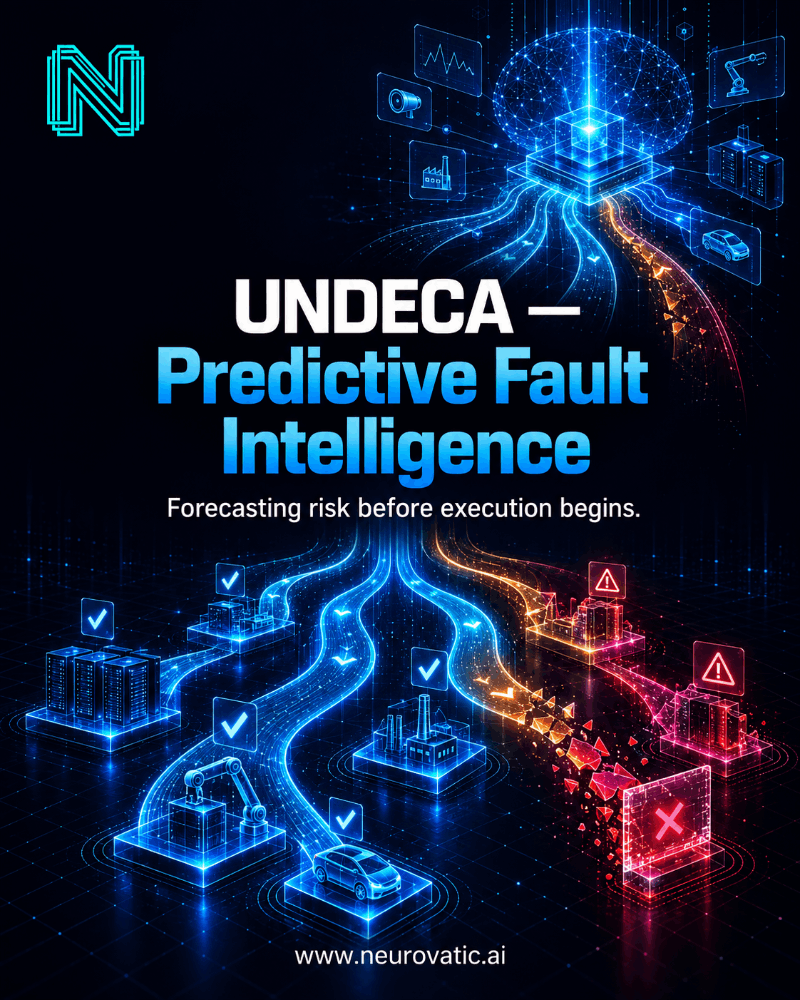
- counterexamples and risk evidence;
- the versions of every ontology, policy, and verifier involved.
UNDECA therefore does more than “explain” an AI plan. It transforms the plan into an object that can be challenged mathematically, governed constitutionally, and reconstructed later.
Learn more: neurovatic.ai/undeca
— —
This post, including all associated text and visuals, has been generated and assisted by artificial intelligence under the regulatory requirements of the EU AI Act. Powered by NEUROVATIC AI systems.