How UNDECA forecasts runtime faults before they occur.

From reactive error handling to anticipatory decision intelligence
Most software discovers a dangerous plan only when the plan collides with reality. By then, an external write may have occurred, a transaction may be partially complete, or a physical system may already be moving.
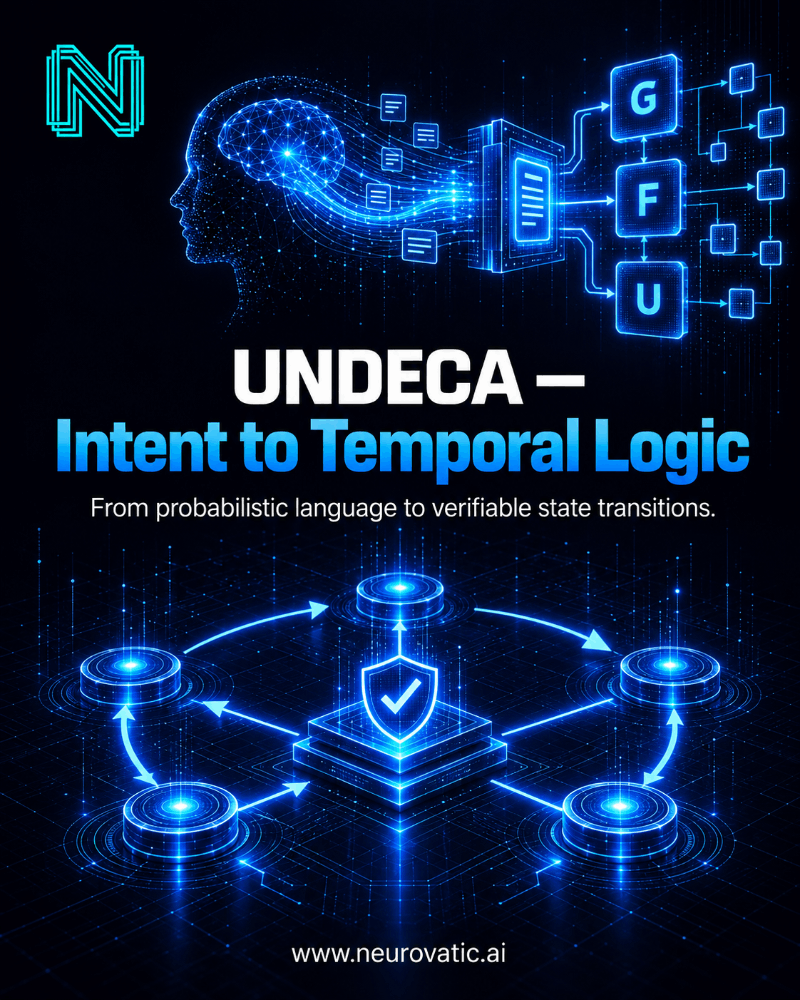
UNDECA is designed to move risk analysis upstream. Before an action reaches the NV-GRL7 governance boundary or SIGMA execution orchestration, UNDECA evaluates the proposed trajectory: what assumptions it depends on, how those assumptions may fail, and which future states become reachable if the environment changes.
It does not promise omniscience or “zero error.” Its purpose is more rigorous: make foreseeable failure modes explicit before execution authority is granted.
1. Counterfactual state exploration
UNDECA represents the proposed plan as a sequence of state transitions and explores alternatives around it:
- What if a dependency becomes unavailable?
- What if a response is delayed or duplicated?
- What if a sensor becomes uncertain?
- What if a resource budget is exhausted?
- What if an intermediate step succeeds but the next step fails?
- What if an apparently local change creates downstream coupling?
The result is not one predicted future. It is a structured set of plausible trajectories, each carrying assumptions, risk factors, and observable failure conditions.
2. Temporal-horizon analysis
Some actions are safe in isolation but dangerous in sequence. A configuration update may preserve every immediate invariant while gradually removing redundancy or creating a future deadlock.
UNDECA can express safety, ordering, and liveness obligations over a multi-step horizon using temporal logic and state-machine models. This enables the architecture to detect patterns such as:
- an authorization that expires before execution completes;
- a backup that must be verified before an update becomes final;
- a resource that must remain available until compensation is possible;
- a sequence that eventually reaches a forbidden state even though each local step appears valid.
Formal methods do not predict the world. They determine what follows from the modeled assumptions — and expose where those assumptions are incomplete.
3. Semantic variance and intent drift
Natural-language intent is probabilistic and often underspecified. Operational interfaces require discrete subjects, resources, actions, limits, and effects.
UNDECA tracks the distance between the original intent, the structured plan, and each proposed execution step. A widening distance can indicate that the plan is drifting away from the evidence or goal that justified it.
Rather than converting embedding variance directly into a safety verdict, the architecture treats semantic uncertainty as evidence that can:
- lower confidence in the plan;
- trigger clarification or replanning;
- narrow the permitted action space;
- require human review;
- prevent the plan from reaching NV-GRL7 as execution-ready.
4. Environmental-volatility assessment
Even a sound plan can become unsafe in a changing environment. UNDECA incorporates the quality and volatility of relevant telemetry — latency, sensor integrity, resource pressure, thermal state, network stability, or domain-specific risk indicators — into the decision evidence.
As uncertainty rises, the acceptable corridor can contract. A plan permitted under stable NOMINAL conditions may be deferred, simplified, or escalated when the system can no longer establish the same assumptions.
5. Prediction and enforcement remain separate
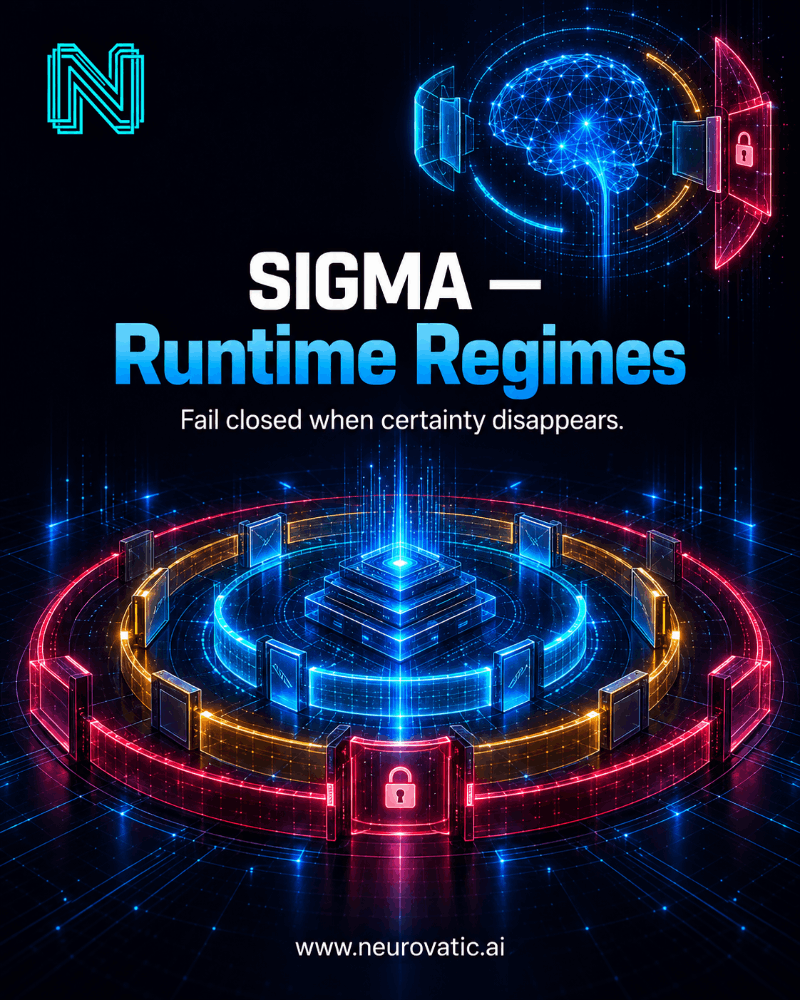
UNDECA produces structured reasoning, candidate trajectories, and risk evidence. NV-GRL7 decides whether the proposed action satisfies constitutional governance. SIGMA orchestrates only the authority that survives that boundary.
[AI Intent]
↓
[UNDECA: reason, challenge, forecast]
↓
[NV-GRL7: govern and authorize]
↓
[SIGMA: orchestrate and monitor]
That separation prevents a forecasting engine from quietly becoming an execution engine. UNDECA can discover that a path is dangerous, but it cannot grant itself permission to act.
The strategic shift is profound: from reacting to failure after external effects occur to making failure trajectories part of the decision before action begins.
Learn more: neurovatic.ai/undeca
— —
This post, including all associated text and visuals, has been generated and assisted by artificial intelligence under the regulatory requirements of the EU AI Act. Powered by NEUROVATIC AI systems.