Token Facts Change: Who Updates the Search-Facing Pages?

A project approves a new token description, but its public pages still carry the earlier wording. The documentation owner assumes marketing will update them. Marketing assumes the source revision has not taken effect. Both teams can point to a reasonable task boundary while readers encounter conflicting descriptions of the same project.
The missing deliverable is a fact change register that connects an approved statement to every page that needs it. TopClick's entity and brand facts service describes a provenance register with effective dates and correction owners. That is a useful starting scope for a Web3 team: separate who approves a fact, who implements it on each surface and who verifies the published result.
The example below is a proposed workflow for fictional records. It performs no token lookup, contract call or production page update. Its purpose is to make a handover inspectable. It does not assess a token, predict returns or claim that an edited page will change an AI answer.
Start with the disputed statement, not a general cleanup
Write down the sentence that prompted the review. A request to make the project's information consistent is too broad to accept without interpretation. One person may correct a display name while another rewrites a product capability. A precise old statement lets the source owner confirm which fact is changing and which surrounding claims are outside the request.
Attach that statement to a defined entity. A ticker or display name can help a reader recognize a token, but it does not by itself establish a unique technical identity. Record the approved network and contract reference when the subject requires them. In a purely editorial exercise, use an explicitly fictional identifier rather than supplying a plausible live address that nobody has verified.
Also distinguish the project from its token and from a particular release. A revised protocol description does not automatically rename a contract, change governance rights or establish a new issuer. Each of those would be a different claim with different evidence. Keeping the subject and field narrow prevents a copy edit from quietly expanding into a statement about control or product behavior.
For an actual record, name the authoritative source for that field. A release specification may support a supported-network statement. An approved company record may support an organization name. A token-interface response may support an observed metadata value under stated conditions. None of these sources should be promoted into authority over every other field simply because it is the easiest one to access.
Separate source approval from the date a fact becomes current
An approved document can describe a future release.
Its approval date does not establish that the release is already available. Keep three dates distinct: when the replacement was approved, when it becomes effective and when a particular public page was observed. Those dates answer different questions and should remain separate even when a small project happens to use the same day for all three.
A future effective date creates a dependency, rather than an immediate correction mandate. A page describing the current release may still be accurate. The receiving owner needs to know whether to prepare a draft, publish a clearly labeled future announcement or wait for a release condition. Updating every present-tense statement immediately could introduce an error while appearing to improve consistency.
Google Search Central states: "Provide up-to-date information." Its general structured data guidelines place that instruction in the context of structured-data quality. The practical application here is to keep visible content and any related markup aligned with the facts that are actually effective. The instruction does not supply a model-refresh timetable or guarantee a particular search presentation.
If the effective date is unknown, leave it unknown and return the question to the source owner. Do not derive it from a file modification time, a public announcement draft or an agency delivery deadline. A useful register can remain open with a named dependency. A confidently populated date with no supporting decision would make later publication checks harder to interpret.
Give the register enough fields to survive a handover
The record should preserve the old wording, the approved replacement and the evidence connecting them. Add the entity reference, field name and source revision so another reviewer can inspect the same claim. Keep a source passage or an authorized evidence reference, rather than a homepage link that forces the receiver to guess which sentence supplied the approval.
List affected surfaces separately. The project About page, token reference and documentation introduction can carry the same fact in different contexts. A structured-data field or social preview can carry it again. A row that says website updated does not establish which of those representations was examined, which owner implemented it or whether the captured page was the published version.
Assign three responsibilities explicitly. The fact owner approves the meaning of the statement. The page owner implements the approved wording on a specified surface. The verifier checks the published representation against the acceptance condition. One person may hold several roles, but the record should still distinguish the decisions. An implementation screenshot is not a substitute for source approval.
Add a disposition and a return condition. A pending release, inaccessible source or third-party correction request should remain visible instead of being grouped with completed owned-page edits. State what evidence would move each record forward. This makes the register usable when a new teammate takes over without access to the conversations that originally defined the task.
Work through fictional change C-41
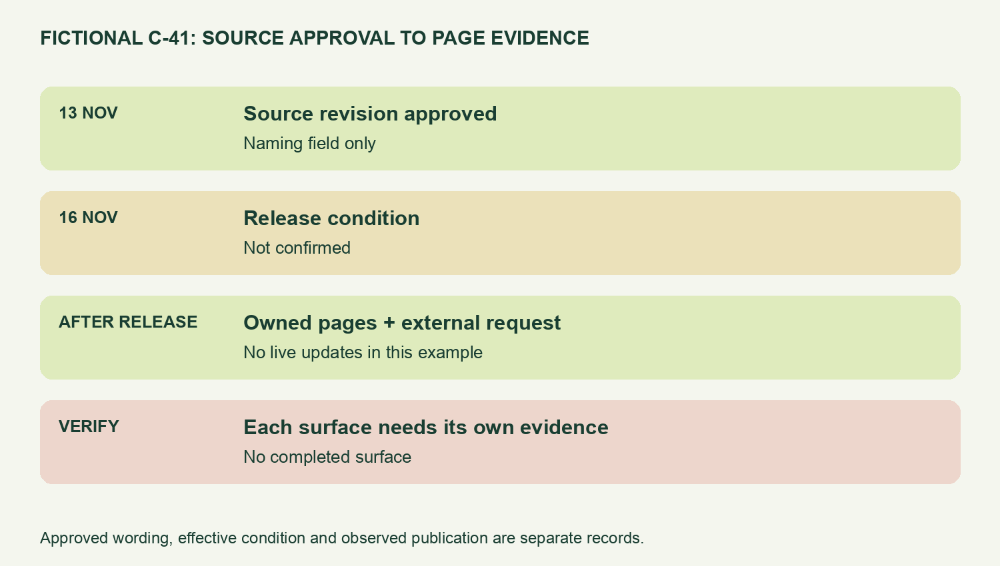
Example Protocol uses the fictional subject reference fixture:protocol:P41/token:T41. On November 13, its documentation owner approves a display-name change scheduled for November 16. The old project description uses X41 Project Token. The replacement uses X41 Coordination Token. These invented labels describe the project's editorial naming decision; they do not refer to an operating token or establish any token rights.
The supplied scenario has one approved documentation revision and three affected surfaces. Two are owned pages: the project About page and a token reference page. The third is an external directory profile. The source approval exists only as a fictional premise. No draft, deployment or directory submission has actually been performed for this walkthrough.
Change reference: C-41. Subject fixture:protocol:P41/token:T41. Field: project-approved display label. The technical identifier is unchanged in the scenario.
Old statement: The project calls T41 the X41 Project Token. Preserve this wording in the record even after a later page changes, so the reviewer can recover what was replaced.
Replacement statement: The project calls T41 the X41 Coordination Token. Limit the replacement to that label; do not add a supported-network, governance or availability claim.
Source evidence: Fictional DOC-P41-v2, naming section, approved November 13. The documentation owner is the fact owner. In a real record, the permitted revision and relevant passage would need to be accessible to the receiving reviewer.
Effective condition: November 16 release confirmation. Until that condition is met, keep the current public description and prepare the owned-page changes as drafts. Proposed disposition: WAIT_FOR_RELEASE_CONDITION. Preparing the drafts is the next action, with no claim that a draft already exists.
Owned-page work: The About-page owner prepares the revised sentence. The token-reference owner checks its heading, body and any repeated metadata. Each owner returns a published URL and observed version only after the effective condition is satisfied.
External-profile work: The profile correction owner identifies the authorized request route and prepares a bounded request. The directory's eventual acceptance remains outside the team's direct control. Do not mark the profile corrected merely because a request was submitted.
Verification condition: A verifier compares the published statement with the approved replacement and records the observation date for each surface. Release confirmation, page captures and directory acceptance remain missing in this fictional record. No surface is complete.
This record can be copied into a worksheet without turning a proposal into an execution claim. It contains the old and replacement wording, authority and missing conditions. Its value is the visible separation between approved meaning, effective timing and evidence that a particular surface actually changed.
Keep each public surface attached to its own result
A page update can be correct while another representation remains stale. If the token reference repeats the label in its title and body, verify both. If the page also contains relevant structured data, compare that field with the visible text under the applicable markup contract. Do not treat a successful CMS save as proof that every reader-facing representation has been published.
The About page may need different surrounding prose. Preserve the approved fact while adapting the sentence to that context. A verifier should compare meaning and entity scope, rather than requiring identical paragraphs across all pages. Consistent facts do not require duplicated copy. Record the approved local wording when an adaptation is necessary so the receiver can distinguish a deliberate variation from an accidental contradiction.
A translated page needs an accountable language owner. A literal name may remain unchanged while the surrounding explanation changes meaning. Keep that language-specific approval visible. The English page's completion cannot establish that a translated statement says the same thing, especially when terminology implies a different product capability or responsibility.
External profiles need their own status trail. Record the submitted request, the evidence supplied and the response when one arrives. If the directory declines the change or offers no correction route, preserve that result. An owned-page correction remains useful, but it does not make an uncontrolled profile accurate or authorize the team to claim that every source has been aligned.
Treat token metadata as evidence with a specific scope
The ERC-20 specification distinguishes token interface methods from broader project claims. Its name, symbol and decimals methods are optional in that standard. A content workflow should therefore avoid assuming that every token exposes every display value through the same interface. The standard does not appoint a marketing page as authority over a deployed implementation.
An observed metadata value would need its network, contract and observation context. A project-approved display label may be a separate editorial fact. If those values differ, record the difference rather than silently rewriting one to match the other. The appropriate action could be to explain the relationship on the reference page, request a technical review or leave the discrepancy unresolved pending evidence.
A naming change does not establish an upgrade transaction.
The C-41 scenario keeps the fictional technical identifier unchanged and says nothing about a contract update. A reader should not infer that the new label appears in a wallet, explorer or interface response. Those are additional surfaces with their own owners and observations, outside the example's completed evidence.
Keep capability and authority claims out of a display-name correction. A token label cannot demonstrate who may upgrade a contract, which networks a connector supports or whether a governance process has taken effect. When a proposed edit includes one of those claims, split it into another fact record with the appropriate evidence owner. The small extra record prevents unrelated assumptions from inheriting the naming approval.
Resolve six boundaries before calling the work complete
Future wording versus current facts. An approved future name should not silently replace the current name on a page presented as current. Identify the release condition and decide which surfaces are drafts, announcements or current references. For C-41, November 13 approval leaves November 16 activation unresolved. The correct next action is preparation with a dependency, rather than a claim of completed public correction.
Two official sources disagree. A recent web page and an older approved specification may describe different releases. Compare their entity scope and effective conditions before choosing a winner. If they truly conflict about the same current fact, return the issue to the accountable fact owner. Publication recency alone does not establish which source has authority to approve that field.
The replacement adds a capability. A sentence that changes a display label and adds support for another network contains two decisions. Keep the naming change narrow and give the network claim its own evidence requirement. A receiving editor should not have to infer that approving one clause authorized every additional promise in the paragraph.
An alias looks like a second entity. Preserve the relationship between the earlier and current approved names when that relationship is supported. Do not merge distinct projects because they share a ticker, and do not create a new entity record merely because a label changed. The fact owner must establish the identity relationship that the page will describe.
A directory has not accepted the request. A submission receipt establishes that a request was sent through the recorded route. It does not establish that the directory changed its public profile. Keep submission and acceptance separate, with a named follow-up owner. An unresolved external record should not prevent honest reporting that the team's own pages have been verified.
An AI answer still uses the old label. Preserve the answer capture and its context if checking it is within scope. An uncited recollection does not establish which page supplied the statement. Avoid claiming that another source edit will necessarily repair the answer. Report the observed mismatch separately from the completed page work and keep any later monitoring decision explicit.
Return evidence that answers the original acceptance question
For each owned surface, request a public URL, the observed statement and its capture date. State which representation was checked: visible page, title, metadata or another declared field. The receiver should be able to identify the entity and approved replacement without opening an unrelated collection of screenshots. Keep permitted evidence references together with the result rather than copying private source material into a public article.
A verification result should identify its remaining limits. A page may have changed in one language while another language remains pending. The visible text may be correct while a social preview has not refreshed. Close the specific verified surface and leave the other work open. A qualified completion record is more useful than a global done label whose meaning changes between teams.
Retain the earlier statement and capture when correcting an error. A later reviewer may need to understand what users could have seen before the change. Preserve the reason for correction, the source used and the date of the new observation. Replacing the old entry with today's wording would remove the evidence needed to explain the discrepancy that started the review.
If the replacement is withdrawn before activation, record the withdrawal instead of deleting the proposed change. The prepared draft, dependency and decision history remain relevant to the people who might otherwise publish the canceled wording. A rollback after publication similarly needs a new observation and an approved replacement condition. Reopening the old value is a controlled editorial decision, with its own evidence.
Keep the fact revision separate from page delivery
One fact change can produce several implementation tasks. Give the approved replacement its own stable reference, then let each page task point to that reference. Otherwise, a copy of the fact in every task can drift before publication. The About-page editor may receive an earlier sentence while the token-reference editor receives a later revision. A shared reference makes that disagreement visible without forcing both pages to use identical prose. If approval changes, the record should identify which page tasks still depend on the superseded revision.
A page task needs a specific acceptance field. For a heading change, name the heading. For an introductory sentence, retain the relevant passage. For related markup, identify the field that should represent the same fact. This is more precise than a screenshot showing that the page exists. The verifier can then compare the approved claim with the exact representation assigned to the task. Changes to adjacent prices, technical instructions or account links remain outside the acceptance unless they were separately included and approved.
Store a page's current observation separately from its planned replacement. A record can state that the current About page still uses the earlier label and that a future draft is required. Those statements are compatible. A reporting view that displays only the proposed label would hide the current condition and encourage someone to announce completion too early. For C-41, the current observation is not supplied at all. The scenario names the affected surfaces, but a real implementation would still need the authorized baseline capture before making a historical comparison.
The same distinction helps after a partial release. Suppose the About-page result is verified but the token reference remains pending. Update the delivery status of the About task while retaining the fact revision as the shared approved reference. Do not close the whole change merely because its first page passed. A receiving manager should see the remaining page, its owner and the condition that would close it. That view exposes delivery work without changing what the underlying approved fact means.
Use return states that preserve missing evidence
A task returned as source unclear should name the conflict that prevents approval. Include the two statements and their references, then identify the person authorized to resolve that field. The page implementer should not be forced to choose between sources just to complete a task on time. A temporary hold is an honest result when the scope lacks a current authoritative statement. It also makes the next action smaller: resolve that one conflict, rather than restarting a broad content review.
A task returned as access unavailable needs a different response. The source may be approved, yet the implementer cannot reach the required CMS section or the verifier cannot inspect the published representation. Record the access dependency without publishing credentials or private links in an open register. Name the authorized receiver who can supply a permitted observation. Lack of access is not evidence that the fact is false, and it is not evidence that a requested edit has been performed.
A task returned as published but not verified should retain its implementation evidence and request the missing comparison. The fact owner does not need to approve the same unchanged wording again, while the verifier still needs to establish that the published surface expresses it correctly. This separation prevents repeated approval conversations from substituting for delivery evidence. It also stops a deployment notification from being promoted into a conclusion about what readers can currently see.
A complete result should remain scoped to a source revision, page representation and observation time. It is not a permanent guarantee that the surface will stay correct. A later release can introduce a new fact, another editor can restore old wording or an external profile can change independently. Define the handover's continuing owner and the event that should trigger a new review. That is an operating responsibility attached to the register, rather than an invented promise that every future inconsistency will be detected automatically.
Make ownership explicit in the next content scope
Bring a small set of disputed facts to the next review. Include the exact statements and the sources currently believed to support them. Ask who can approve each field, who can edit each affected surface and who will verify the public result. That conversation produces a concrete scope faster than asking one supplier to make all information accurate everywhere.
When the accepted fact requires CMS or markup work, TopClick's technical SEO implementation review provides a context for agreeing specifications and verification responsibilities. The implementation route still needs to be named in writing. A service description establishes an offered scope; it does not prove that anyone has inspected C-41 or updated a real project's pages.
For the fictional change, leave the three surfaces open until their individual conditions are met. Preserve the unchanged technical identifier and the November 16 release dependency. Give the directory request its own receiving owner. The resulting register should let the next reviewer tell which fact was approved, which page was changed and which piece of evidence supports each completion claim.
More insights to read
- AI Visibility Baseline: Keep Mentions and Citations Apart
- Technical SEO Fixes: Name the Implementer Before Accepting the Audit
- Technical SEO Release Gates for JavaScript Sites: Compare Source and Rendered HTML
- A Cited URL Needs Its Own Evidence: Redirects and Canonical Targets
- SEO, GEO and AEO: Defining the scope of work
About the author

Written by Dmytro Nasyrov PhD, software architect with 24 years of production experience. Dmytro is the CEO of TopClick.