Digital Currency Payment Gateway: Evaluating Vendor Lock-In Before You Commit
The short answer
A Digital Currency Payment Gateway creates vendor lock-in through proprietary API structures that don't transfer to other providers, data and transaction history that doesn't export cleanly, custom features built specifically around one platform's capabilities, and contractual terms that make switching costly or slow. Digital Currency Payment Gateway: Evaluating Vendor Lock-In Before You Commit means actively checking for these specific lock-in mechanisms before you sign up, not discovering them only once you're trying to leave.
Why lock-in is rarely obvious at the point of signing up
Vendor lock-in almost never announces itself clearly during onboarding, no provider markets how difficult they make it to eventually leave. Instead, lock-in accumulates gradually, through integration work built specifically around their API, data that only lives cleanly in their system, and institutional knowledge your team builds around their specific dashboard and processes. Digital Currency Payment Gateway: Evaluating Vendor Lock-In Before You Commit requires actively looking for these accumulating dependencies upfront, since they're invisible at signup and only become apparent once switching is actually on the table.
Why proprietary API design is the most common lock-in mechanism
Every payment provider has its own specific API structure, and the more deeply your own systems integrate with a provider's particular, non-standard endpoints and data formats, the more rebuilding work a future switch actually requires. A provider using more standard, widely recognized API patterns and data structures creates comparatively less lock-in than one with a highly proprietary, unique approach that only makes sense within their own ecosystem. Digital Currency Payment Gateway: Evaluating Vendor Lock-In Before You Commit should specifically evaluate how standard versus proprietary a provider's actual technical approach is.
Why data portability deserves real scrutiny before committing
Ask directly and specifically whether your full transaction history, customer records, and reporting data can actually be exported in a usable, standard format, not just viewed within their own dashboard. A provider that makes data export difficult, limited, or simply unavailable is creating a real form of lock-in, since losing access to your own historical records is a genuinely serious cost of switching that goes well beyond rebuilding a technical integration.
Why custom features built around one platform increase your exposure
If you've built custom functionality specifically leveraging a particular provider's unique capabilities, a specific webhook behavior, a particular reporting feature, an automation built around their specific API quirks, switching means losing or completely rebuilding that functionality rather than simply reconfiguring settings on a new platform. Digital Currency Payment Gateway: Evaluating Vendor Lock-In Before You Commit means being deliberate about how much custom work you build specifically around any single provider's particular implementation details.
Why contract terms matter just as much as technical considerations
Beyond the purely technical side, actual contractual terms, minimum commitment periods, early termination penalties, data retention policies after account closure, directly affect how much real lock-in exists. A provider with no minimum commitment and clear, favorable terms around data access after closing an account represents meaningfully less lock-in risk than one with long commitment periods and unclear post-termination data policies, regardless of how similar their actual payment technology looks on the surface.
Why team knowledge and process dependency is an often-overlooked form of lock-in
Beyond data and technical integration, your team builds real, practical knowledge around a specific provider's dashboard, terminology, and day-to-day processes over time, and this institutional knowledge has genuine value that's lost, at least temporarily, during any switch. Digital Currency Payment Gateway: Evaluating Vendor Lock-In Before You Commit should account for this human factor too, not just the technical and contractual dimensions, since retraining time is a real cost of switching providers.
How to actually evaluate lock-in risk before you sign up
Before committing to any provider, specifically ask about data export capabilities and formats, review the actual contract terms around commitment periods and termination, assess how standard versus proprietary their core API and integration approach actually is, and honestly consider how much custom work you're likely to build specifically around their unique features over time. Digital Currency Payment Gateway: Evaluating Vendor Lock-In Before You Commit is best handled through this kind of deliberate upfront evaluation, not an afterthought addressed only once switching actually becomes necessary.
Why some lock-in is reasonable, and the goal isn't avoiding it entirely
It's worth being realistic that some degree of integration investment and resulting lock-in is a normal, reasonable part of adopting any payment infrastructure, no provider relationship is completely frictionless to leave, and that's not inherently a red flag. The goal isn't finding a provider with zero lock-in, it's understanding realistically how much lock-in you're accepting and ensuring it's proportionate to the actual value and reliability the provider delivers in return.
Building switching flexibility into your setup from the start
Where practical, favoring more standard integration patterns, maintaining your own independent copies of transaction data rather than relying solely on a provider's dashboard, and avoiding excessive custom functionality built around one provider's unique quirks all help preserve genuine switching flexibility, even if you never actually end up needing to use it.
A practical checklist for evaluating vendor lock-in before committing
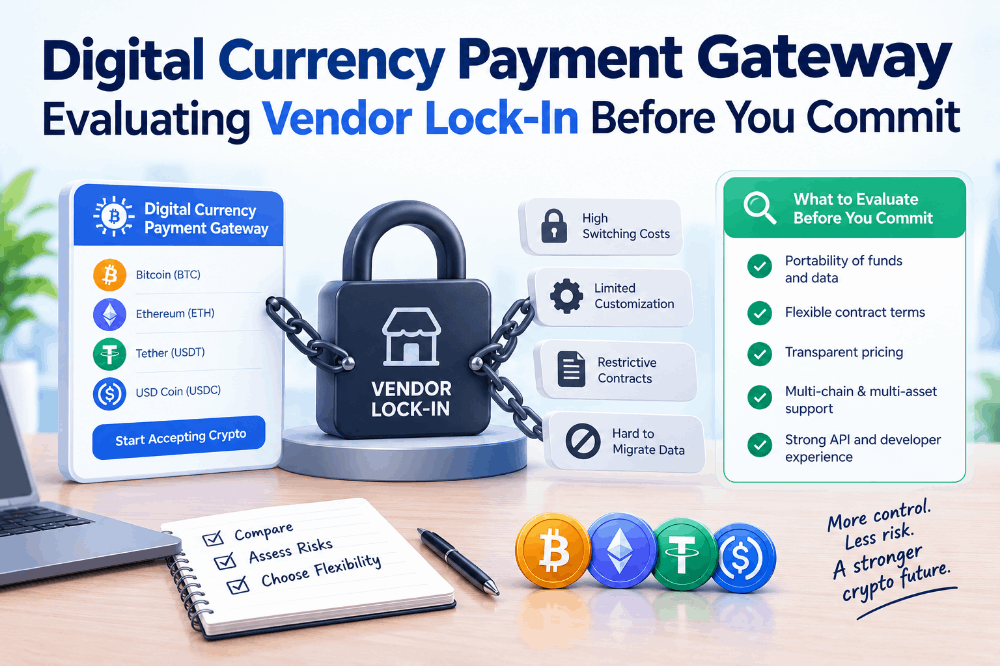
- Confirm whether transaction history and customer data can be exported in a standard, usable format.
- Assess how proprietary versus standard the provider's core API and integration approach actually is.
- Review actual contract terms around commitment periods, termination penalties, and post-closure data access.
- Be deliberate about how much custom functionality you build specifically around one provider's unique features.
- Factor in realistic team retraining time as a genuine cost of any future switch.
- Accept that some lock-in is normal, while ensuring it stays proportionate to the value you're actually getting.
Where FaradPay fits
FaradPay is a crypto payment provider, so ask it directly what data export options exist, how standard versus proprietary its API and integration approach is, and what its actual contract terms look like around commitment periods and data access after account closure. Those specific answers are the real test behind Digital Currency Payment Gateway: Evaluating Vendor Lock-In Before You Commit for any business choosing a long-term payment infrastructure partner.
FAQ on Digital Currency Payment Gateway: Evaluating Vendor Lock-In Before You Commit
Is vendor lock-in always a bad sign in a payment provider? Not necessarily. Some integration investment is normal, the key is ensuring lock-in stays proportionate to the actual value the provider delivers.
What's the most common source of lock-in with crypto payment gateways? Proprietary API design is often the biggest factor, since deep integration with non-standard endpoints makes future switching require significant rebuild work.
Why does data export capability matter so much? Because losing access to your own transaction history and customer records is a genuinely serious cost of switching, beyond just technical integration work.
Does building custom features around a provider increase lock-in risk? Yes. Custom functionality leveraging a provider's unique capabilities typically needs to be rebuilt or lost entirely if you later switch providers.
Should contract terms factor into evaluating lock-in? Absolutely. Minimum commitment periods, termination penalties, and post-closure data policies directly affect how costly switching actually becomes.
Is team retraining a real cost of switching providers? Yes. Institutional knowledge built around a specific dashboard and process is genuinely lost, at least temporarily, during any provider transition.
Final thoughts
Digital Currency Payment Gateway: Evaluating Vendor Lock-In Before You Commit comes down to checking data portability, API standardization, contract terms, and realistic custom-feature dependency before signing up, not after you're already deep into a relationship that's hard to leave. Evaluate these factors honestly upfront, and you'll choose a provider relationship with lock-in that's proportionate and manageable, rather than discovering the real cost of switching only when you actually need to.