How a Water Level Monitoring System Improves Water Management

Water is one of the most valuable natural resources, yet managing it efficiently remains a challenge for households, farms, industries, and municipalities. As water demand continues to increase across the world, monitoring water usage and storage has become essential for sustainable management. Traditional methods of checking water levels manually are often unreliable, inefficient, and time-consuming. Modern monitoring technologies have introduced smarter solutions that allow continuous tracking of water levels in tanks, reservoirs, wells, and distribution systems.
A water level monitoring system helps organizations and individuals monitor water levels accurately and make better decisions about water storage, consumption, and conservation. These systems use advanced sensors, wireless communication, and cloud platforms to collect and analyze water data in real time.
With growing concerns about water scarcity, infrastructure failures, and inefficient water usage, smart monitoring technologies are becoming an important tool in modern water management strategies.
Understanding Water Monitoring Technology
What Is a Water Level Monitoring System?
A water level monitoring system is a technology designed to measure and track water levels automatically in tanks, reservoirs, wells, or other water storage structures. The system typically consists of sensors that detect water levels and transmit that data to a digital platform where it can be monitored and analyzed.
Instead of manual inspections, these systems provide real-time information about water levels, helping users detect changes quickly and take corrective action when necessary. This technology is widely used in water management infrastructure, irrigation systems, industrial processes, and municipal water supply networks.
Core Components of a Water Monitoring System
Most monitoring solutions include several essential components that work together to provide accurate data.
Sensors
Sensors are installed inside tanks, reservoirs, or wells to measure the height or pressure of water.
Data Transmission Modules
Communication modules transmit the collected data through wireless networks such as cellular or IoT communication systems.
Cloud Monitoring Platform
Data from sensors is stored and analyzed in cloud platforms where users can access information through dashboards.
Alerts and Notifications
Modern monitoring systems generate alerts when water levels become too high or too low, helping prevent operational issues.
These components create a connected monitoring environment that provides continuous visibility into water systems.
Why Accurate Water Monitoring Matters
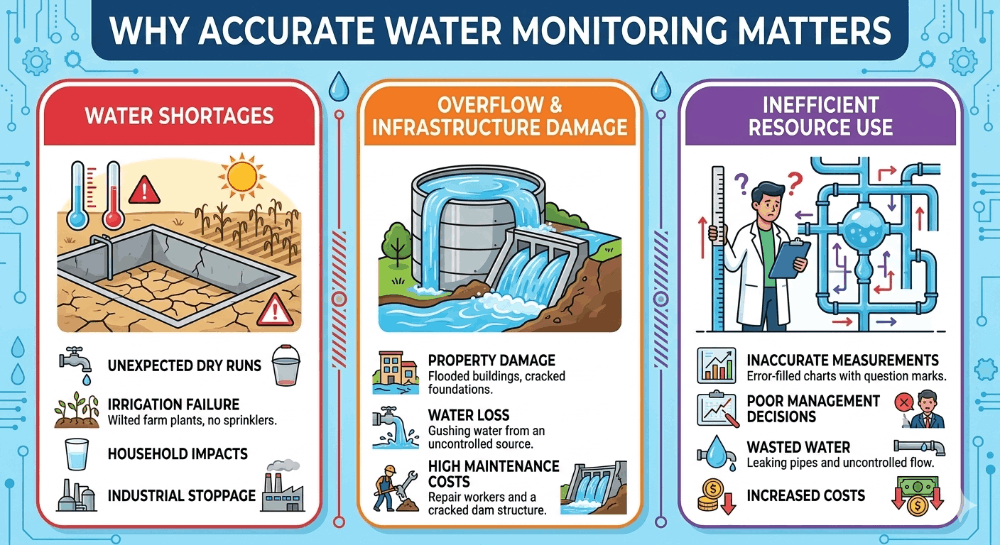
Water systems are critical for many sectors including agriculture, industry, environmental monitoring, and municipal infrastructure. Without proper monitoring, several problems can occur.
Water Shortages
When water storage levels are not monitored properly, systems can run dry unexpectedly, affecting households, irrigation systems, or industrial processes.
Overflow and Infrastructure Damage
Overfilled tanks or reservoirs can cause overflow, leading to property damage, water loss, and increased maintenance costs.
Inefficient Resource Use
Manual monitoring often results in inaccurate measurements, leading to poor water management decisions.
A water level monitor helps solve these issues by providing continuous monitoring and precise measurements, enabling operators to manage water resources more effectively.
Key Ways Water Monitoring Systems Improve Water Management
1. Real-Time Visibility of Water Levels
One of the biggest advantages of modern monitoring systems is the ability to track water levels in real time. Sensors installed in water storage facilities continuously measure water levels and send updates to digital dashboards.
This allows operators to understand current storage conditions instantly and respond quickly to unexpected changes. Real-time monitoring also helps detect abnormal fluctuations that may indicate leaks, equipment failures, or excessive consumption.
2. Preventing Water Loss and Overflow
Water loss is a major issue in both residential and industrial environments. Overflowing tanks or unnoticed leaks can waste large amounts of water.
Automated monitoring systems help prevent these problems by sending alerts when water levels exceed predefined thresholds. Early warnings allow operators to adjust pumps, valves, or distribution systems before water loss occurs.
This proactive approach reduces operational risks and helps maintain a stable water supply.
3. Improving Operational Efficiency
Managing water infrastructure often requires regular inspections and manual measurements. These tasks can be time-consuming and costly, especially for facilities with multiple tanks or remote installations.
Smart monitoring systems automate the entire process by collecting data continuously and displaying it on centralized dashboards. Operators can access this information from computers or mobile devices without visiting each location.
In recent years, monitoring platforms developed by companies such as NightOwl Monitoring have demonstrated how connected sensor systems and cloud-based dashboards can simplify water infrastructure management for municipalities, agricultural operations, and industrial facilities.
This improved efficiency reduces operational costs while increasing the reliability of water management systems.
4. Enabling Data-Driven Decision Making
Another major advantage of digital monitoring is the ability to analyze historical data. Monitoring platforms store water level data over time, allowing organizations to identify usage patterns and seasonal trends.
By analyzing these patterns, water managers can make better decisions regarding storage capacity, pump scheduling, and water distribution strategies.
Data-driven insights help improve long-term planning and ensure that water systems remain efficient and sustainable.
The Role of Remote Monitoring in Modern Water Systems
Smart Connectivity and Remote Monitoring
Technological advancements have introduced remote water level monitoring, which allows users to track water levels from virtually anywhere. Sensors transmit data through wireless communication networks to cloud-based platforms where it can be viewed remotely.
Remote monitoring is particularly useful for large infrastructure systems such as:
- Agricultural irrigation networks
- Municipal water storage reservoirs
- Industrial water processing facilities
- Groundwater wells and pumping stations
Instead of sending staff to inspect water levels physically, operators can access real-time data through mobile devices or web dashboards.
Benefits of Remote Monitoring
Faster Response to Issues
Operators receive instant alerts when water levels reach critical limits.
Reduced Maintenance Costs
Remote access eliminates the need for frequent manual inspections.
Improved Resource Allocation
Managers can prioritize maintenance and water distribution based on real-time system data.
Remote monitoring technology has transformed water management by making it more efficient, responsive, and scalable.
Applications of Water Monitoring Systems
Water monitoring technologies are used in many sectors where accurate water data is essential.
Agriculture and Irrigation
Farmers rely on monitoring systems to manage irrigation water efficiently and ensure crops receive the right amount of water.
Municipal Water Infrastructure
Cities and towns use monitoring systems to track water levels in reservoirs and distribution networks, ensuring a stable supply for communities.
Industrial Facilities
Manufacturing plants often require water for cooling, processing, and cleaning. Monitoring systems help maintain safe water levels and prevent operational disruptions.
Environmental Monitoring
Government agencies and environmental organizations use monitoring systems to track river levels, groundwater resources, and flood risks.
These applications demonstrate how monitoring technologies support both operational efficiency and environmental protection.
Future of Smart Water Management
Water monitoring technologies are evolving rapidly as digital infrastructure and IoT systems become more advanced. Smart cities and modern industrial facilities increasingly rely on connected monitoring systems to manage resources efficiently.
Artificial intelligence and predictive analytics are also being integrated into monitoring platforms. These technologies can analyze water data and predict potential issues before they occur.
As global water demand continues to rise, intelligent monitoring systems will play a key role in ensuring sustainable water management for future generations.
Conclusion
Efficient water management is essential for sustaining communities, industries, and ecosystems. Traditional methods of monitoring water levels often lack accuracy and efficiency, making it difficult to manage water resources effectively.
Modern monitoring technologies provide a smarter approach by delivering real-time insights into water systems. Through connected sensors, cloud platforms, and automated alerts, these systems help organizations monitor water levels continuously and respond quickly to potential issues.
As digital infrastructure continues to advance, smart monitoring solutions will play an increasingly important role in ensuring reliable and sustainable water management across the world.
Frequently Asked Questions (FAQs)
What is a water level monitoring system?
A water level monitoring system is a technology that measures and tracks water levels in tanks, reservoirs, wells, or other water storage structures using sensors and digital monitoring platforms.
How does remote water level monitoring work?
Remote monitoring systems use sensors that send water level data through wireless communication networks to cloud platforms where users can access real-time information through dashboards or mobile applications.
Why is water level monitoring important?
Monitoring water levels helps prevent overflow, detect water shortages, improve water distribution, and ensure efficient use of water resources.
Where are water monitoring systems commonly used?
These systems are widely used in agriculture, municipal water supply networks, industrial facilities, environmental monitoring projects, and residential water storage systems.