The Next Crypto User Won’t Be Human

For years, crypto has been built around one assumption:
**There is a human on the other side of the wallet.**
A human clicks *Buy*.
A human signs a transaction.
A human pays for a service.
A human moves money from one place to another.
But what happens when that assumption disappears?
What happens when the next major wave of blockchain users isn't made of people…
but **AI agents?**
This may sound futuristic.
But the infrastructure for it is already being built.
Ethereum is now explicitly exploring AI agents that can control wallets, execute transactions, pay for data and computing, and even interact economically with other agents. Standards such as ERC-8004 are being developed around agent identity, reputation and validation.
And that changes the question I think we should be asking about crypto.
Not:
**“Which AI token will pump?”**
But:
**“What infrastructure will an AI economy actually need?”**
---
## **AI doesn't just need intelligence. It needs an economy.**
An AI model can generate text.
It can analyze markets.
It can write code.
It can control software.
But eventually, if we move from AI assistants toward truly autonomous agents, intelligence alone won't be enough.
An agent may need to:
→ hold a wallet
→ receive payments
→ buy computing power
→ purchase data
→ access APIs
→ pay another agent
→ hire a human
→ execute transactions
→ interact with smart contracts
→ operate continuously without waiting for someone to click a button
And suddenly, the problem becomes much bigger than artificial intelligence.
It becomes an **economic problem**.
An autonomous machine needs a way to **store value, move value, verify identity, access resources and settle transactions.**
That is where blockchain becomes interesting.
Ethereum's x402 payment standard, for example, is designed to allow AI agents to make automated payments for data, APIs and other digital resources using stablecoins.
Imagine an AI agent that needs 30 seconds of GPU compute.
Instead of asking you for permission:
**“Can I buy this?”**
it could simply pay for the resource according to rules you already approved.
Machine → machine.
Service → payment.
Data → value.
No human interface required.
---
## **The really interesting part isn't the chatbot.**
We've spent years watching AI become better at conversation.
That was only the beginning.
The more important transition may be:
**AI that can act.**
On September 29, OpenAI announced its “dots” autonomous agents, designed to pursue goals across applications and operate continuously in enterprise environments.
At the same time, BlackRock has highlighted a related possibility: autonomous AI agents could become significant users of stablecoins and digital assets as they begin purchasing data, computing resources and other services. The same analysis also notes that tokenized markets for computing capacity are still at an early stage.
That last part is important.
**This is not a finished revolution.**
It is an emerging architecture.
And early infrastructure is usually where the most interesting questions begin.
---
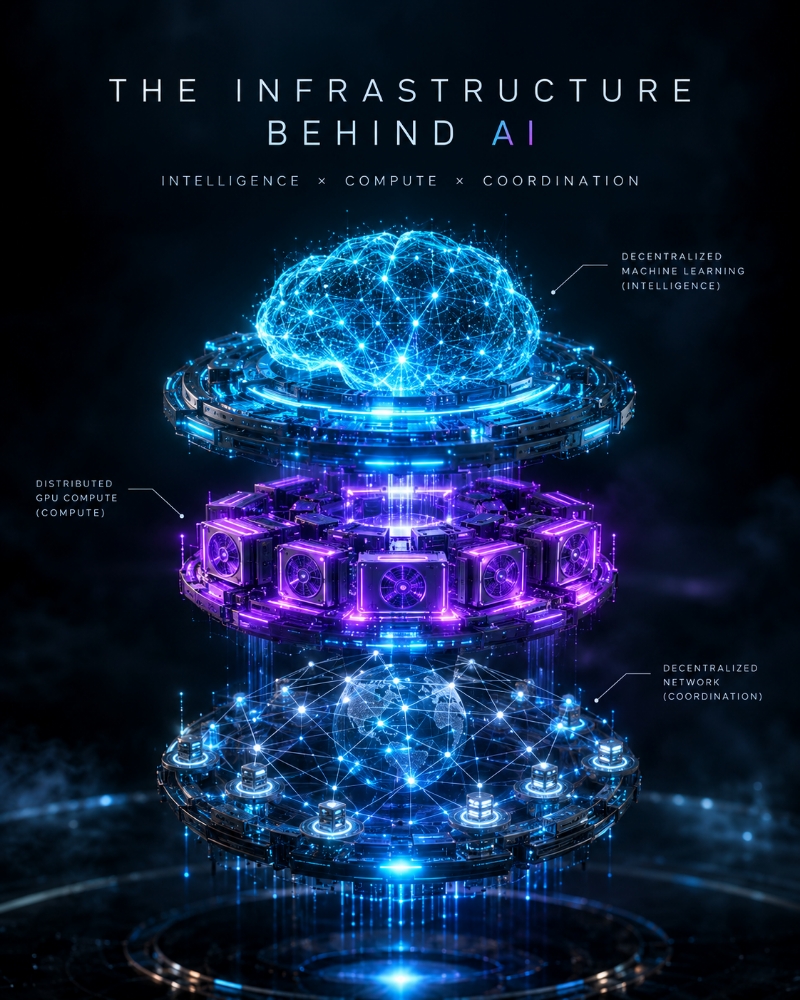
# **Think about the stack.**
If AI agents become economic actors, they will need multiple layers.
### 🧠 Intelligence
Models capable of reasoning, planning and making decisions.
### ⚡ Compute
GPUs and distributed computing to actually run those models.
### 🌐 Connectivity
Networks that allow agents, applications and blockchains to communicate.
### 💰 Payments
Stablecoins and programmable money for machine-to-machine transactions.
### 🔐 Identity
A way to know *which agent* is acting.
### 🛡️ Verification
A way to determine whether an agent is trustworthy and whether an action followed the rules.
### 📊 Data
Reliable information that agents can purchase, verify and use.
### ⛓️ Settlement
A neutral infrastructure where transactions can actually happen.
Look at that list again.
It starts to look less like a crypto narrative…
and more like an **economic operating system for machines.**
---
## **And this is where I think the conversation gets misunderstood.**
People often look at AI + crypto and immediately ask:
**“Which AI coin is going to 10x?”**
That's the easiest question.
But perhaps the more interesting question is:
**“Which networks will still be useful if millions of autonomous agents start transacting?”**
Because an AI agent doesn't care about hype.
It doesn't care about a beautiful logo.
It doesn't care about your favorite crypto influencer.
It needs:
**speed.
liquidity.
reliability.
security.
data.
compute.
identity.
settlement.**
And potentially, it needs all of those things **24/7.**
That changes the way I look at AI, DePIN, stablecoins, interoperability and blockchain infrastructure.
Instead of seeing them as completely separate narratives, you can start seeing them as pieces of the same system.
**Intelligence needs compute.
Compute needs infrastructure.
Agents need data.
Agents need identity.
Agents need payments.
Payments need settlement.**
And if those components eventually connect…
we could see something very different from the crypto economy we know today.
---
# **The next user might not have a face.**
Imagine waking up in 2030.
Your AI agent has already:
→ analyzed thousands of data sources overnight
→ rented compute when demand was low
→ purchased the information it needed
→ negotiated with another agent
→ executed a transaction
→ paid for a service
→ updated its strategy
→ and reported the results to you in the morning.
You didn't manually approve every step.
You simply gave it **rules, permissions and capital.**
That is a fundamentally different relationship with money.
And it raises an even bigger question:
**What happens when there are not millions of AI agents… but billions?**
Billions of autonomous economic actors don't just need better models.
They need infrastructure.
---
## **The biggest opportunity may not be the AI itself.**
Maybe the most important layer won't be the model generating the smartest answer.
Maybe it will be the infrastructure underneath it.
The networks carrying the transactions.
The GPUs providing the compute.
The protocols providing liquidity.
The systems providing identity.
The blockchains providing settlement.
The stablecoins providing programmable money.
The protocols connecting everything together.
That's why I'm increasingly interested in the intersection of:
**AI × DePIN × Crypto × Infrastructure.**
Not because every project in these sectors will succeed.
They won't.
Many experiments will disappear.
Some narratives will be completely overhyped.
And some projects will never find meaningful product-market fit.
But the underlying question is becoming harder to ignore:
**If machines become economic actors, what kind of financial infrastructure will they use?**
Because if that future arrives…
the next generation of crypto users may not be humans sitting behind screens.
They may be **machines with wallets.**
And perhaps the most important transaction of the next decade won't be:
**Human → Blockchain**
but:
**Machine → Machine.**
**Value → Value.**
**Without a human touching the screen.**
— **OrionAria**
**Would you trust an AI agent to hold and spend your money without asking you first?** 🤖💰