Weather Balloons Are Talking: Here's How To Listen

Every day, twice a day, weather balloons take a cheap radio payload aloft and send telemetry back to ground stations, helping us to understand and predict weather cycles. These systems operate far overhead, often reaching 30km or more in altitude.
Once they complete their mission, these systems are considered disposable. They are not collected, nor are they reused.
If you can get your hands on one, you have a great beacon for your test lab, or alternatively, you now have a system that can be taken aloft on your own weather balloon.
Let’s take a look and see what we need to know.
What Is A Radiosonde?
A radiosonde is the instrument package taken aloft below a weather balloon. It’s a lightweight plastic box, roughly the size of a large paperback book, containing temperature, humidity/pressure sensors, a GPS receiver, and a radio transmitter, all managed by a small microcontroller. Its sole job is to measure the atmosphere on the way up and broadcast what it finds.
National meteorological agencies worldwide operate coordinated launch networks that release sondes at 00:00 and 12:00 UTC every day, from hundreds of stations simultaneously.
When it hits its peak (typically around 25–35 km altitude), a small parachute slows the descent. The sonde lands somewhere, usually in a field or forest, and is rarely recovered by the agency. Which means it’s out there. Still transmitting all the way down, and waiting to be found.
From our perspective, a radio hacker’s perspective, this is a gift. You have a known transmitter, a known frequency band, open (or reverse-engineered) protocols, and recoverable hardware. Overall, it’s one of the best passive learning targets in the hobby, covering several fundamental topics.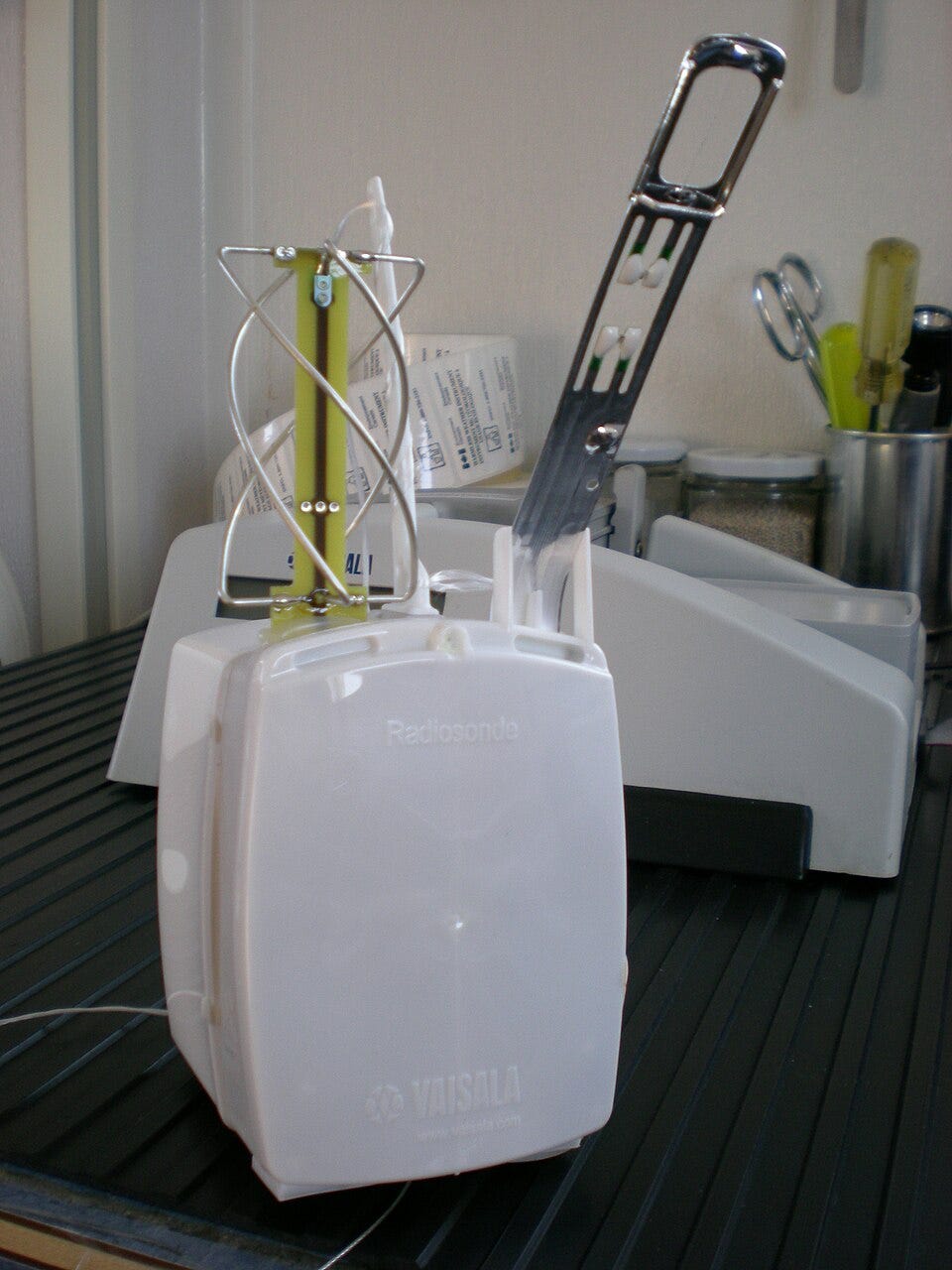
The RF Stack
Due to weight constraints, Radiosondes will typically use a lightweight but powerful stack.
Transmitting in the 400MHz allocation for meteorological aids, antennas can be small, simple, yet highly effective.
To make the most of the available power, most Radiosondes will use a form of Frequency Shift Keying (FSK). With FSK, the transmitter rapidly alternates between two frequencies to encode binary data. Think of it as a very fast version of Morse code where frequency, not timing, carries the information.
Transmitter output is low, somewhere between 100 to 250mw. For ground-based systems, this would provide minimal range, but when attached to a balloon and carried aloft, the transmitter has the ultimate high ground.
As it reaches the peak of its flight, we can expect a realistic footprint of hundreds of kilometres using nothing more than a simple 1/4 wave antenna.
Hardware For Tracking & Decoding
The narrow chunk of spectrum that is assigned to meteorological operations makes it super easy to track and decode Sondes that might be in your area. While the RTL-SDR is capable of monitoring a single downlink frequency, more expensive hardware like the Airspy or SDRPlay can monitor the entire chunk of spectrum.
Tracking and receiving telemetry is extremely simple. Our hardware equipment list is:
- Software Defined Radio Dongle (rtl-sdr, airspy etc)
- Antenna cut to 1/4 wave @ 403Mhz (roughly 17.5cm of wire)
- Linux Computer for the Software Stack( Pi 4, Laptop etc)
We can look at the addition of preamps or more complex antennas later on to refine the system, but for now, this is all we need to get started.
Pro Tip: If you don’t have an RTL-SDR, get one from Open Source SDR Labs. Use the code “radiohackers” for an extra discount on checkout.
Software
On the Software side, we’ll use the open-source radiosonde_auto_rx software package to run on Linux. This is freely available on GitHub. To install it, we’ll use the command line. If you aren’t comfortable with the command line, fear not, as the software has an install script that should automate most of the process.
To clone the software onto our machine and then run the install script, we’ll use the following commands in sequence. Make sure you install it into your home directory to keep things simple.
git clone https://github.com/projecthorus/radiosonde_auto_rx.git

then

cd radiosonde_auto_rx/auto_rx

then

./install.sh
The installer should handle dependencies for your system. Once this is done, we’ll then need to add the station callsign, altitude and location in Lat/Long format. We can do this by editing the station .cfg file.
nano station.cfg

add details

ctrl o + ctrl x to write out and exit
When this is done, we can test that everything is operating correctly
python3 auto_rx.py
If everything is working correctly, a web interface should be available. If it’s receiving Sonde data, it should be showing live decodes, frequency, SNR, and a map of the Sonde's current position. Visit the web interface to take a look.
http://localhost:5000
While the data packets vary slightly between manufacturers, you’ll typically see frames that appear in the following format.
2025–05–12 00:15:32 | RS41-SGP | 403.000 MHz
Serial: R1234567
Lat: 35.7123
Lon: 139.8456
Alt: 14823.4 m
Speed: 22.3 m/s
Heading: 287.1°
Temp: -54.3°C
Humidity: 2.1%
Pressure: 136.2 hPa
Battery: 2.8V
While the telemetry data looks pretty basic, it does, in fact, tell a reasonably detailed story.
Heading & Speed give us a general idea of where it will end up, while the Temp & Altitude can help us identify where in the upper atmosphere the Sonde is currently at.
Pro Tip: If you’re comfortable with Linux, you can tune the scan parameters in station.cfg to eliminate unnecessary frequencies and focus on your local agencies
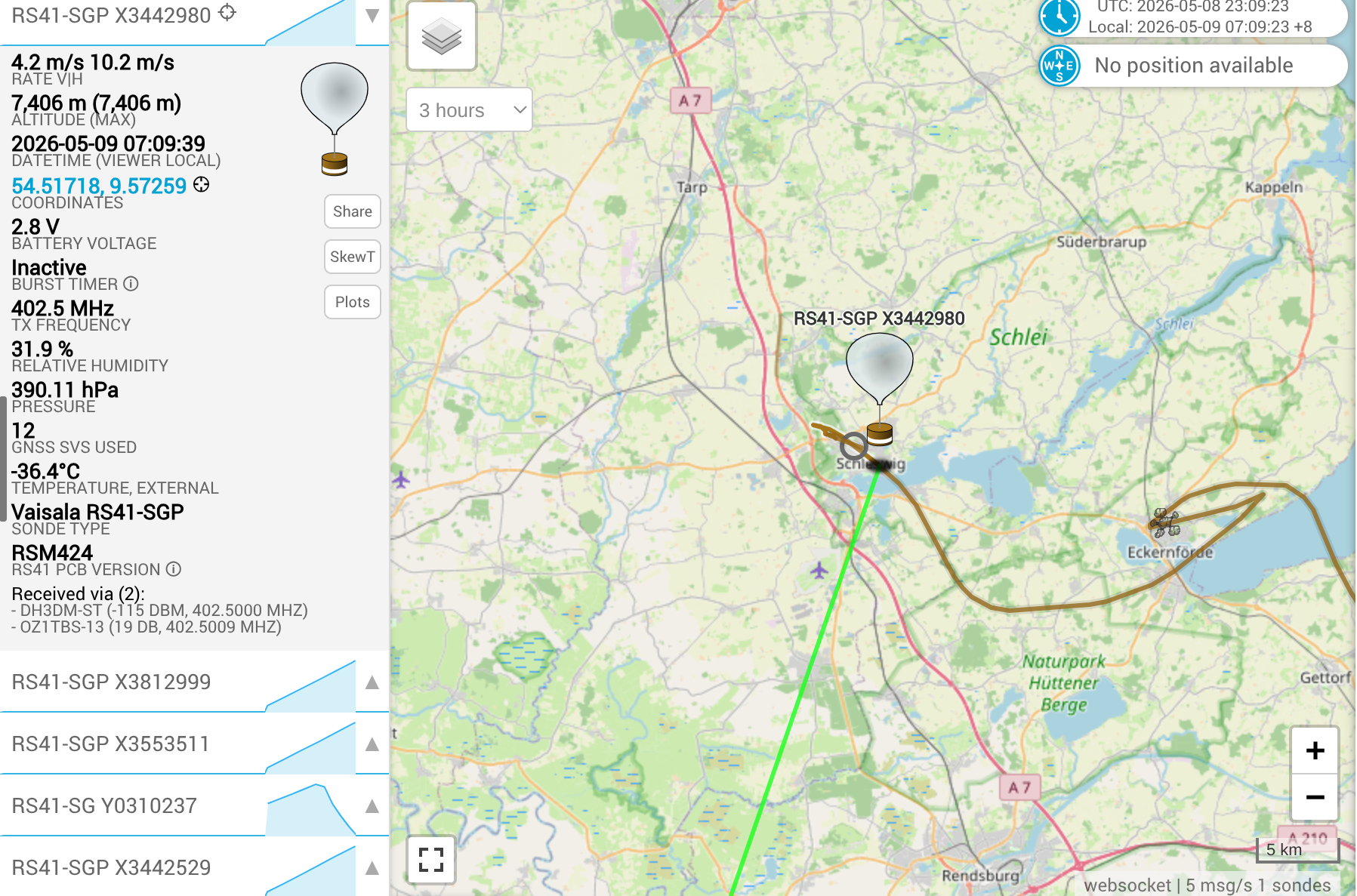
Sondehub
This is the Radio Hackers publication, so naturally, we’re looking at ways to locate and intercept Radiosondes using their own transmissions. However, the addition of crowdsourced data via websites like Sondehub can still give us plenty of useful information to help us along the way.
An aggregation website, Sondehub uses crowd-sourced data from a global network of ground stations to track launches and flights across the globe in real-time.
This is a goldmine of information that can help you before you even switch on a receiver.
Sondehub can allow you to confirm launch times and locations, the type of Sondes that are being used in your area and frequency information.
Better still, if the aim is to track and recover a Radiosonde post-flight, the website includes some pretty detailed prediction metrics that will help you to better understand where balloon flights tend to travel according to the conditions in your area.
Like most hunts, setting the odds in your favour from the start tends to help with the overall outcome.
Pro Tip: Smart hunters can use the predict feature to get a general idea of where a flight terminates according to current conditions. This allows you to be downrange, ready to go. Use a directional antenna for the final part of the hunt.
Digging Deeper
A freshly recovered RS41 is far more interesting than it looks at the surface level. The onboard hardware includes:
- An STM32F100 microcontroller running at 24 MHz
- A Si4032 FSK transmitter chip
- A U-blox MAX GPS module
- A custom sensor board with calibrated temperature and humidity sensors
The community has also fully reverse-engineered the RS41. Hardware hackers and amateur radio operators can reflash the firmware via the standard SWD debug header and repurpose the hardware as an APRS tracker, a LoRa node, or a custom beacon.
The open-source RS41ng firmware project also provides a fully-featured alternative firmware that supports multiple radio modes, including APRS, CW, RTTY, and 4FSK and can provide plenty of fun.
There’s a lot of ground to cover between decoding your first overhead flight and launching hardware of your own, but the entry point is, most things considered, pretty low.
A dongle, a length of wire, and an afternoon with the install script is all it takes to pull live data from the stratosphere. Start there, and the rest follows naturally.
Recovered a sonde? Drop your finds in the comments.
Investigator515 explores the RF spectrum, cybersecurity, and the hidden tech behind modern espionage.
Follow for new content weekly
Bluesky • X • Substack
You might also like,
- OSINT Investigators Guide to Self Care & Resilience
- Spies In The Mud: The RF-111 Aardvark
- What The Tech?! Space Shuttles