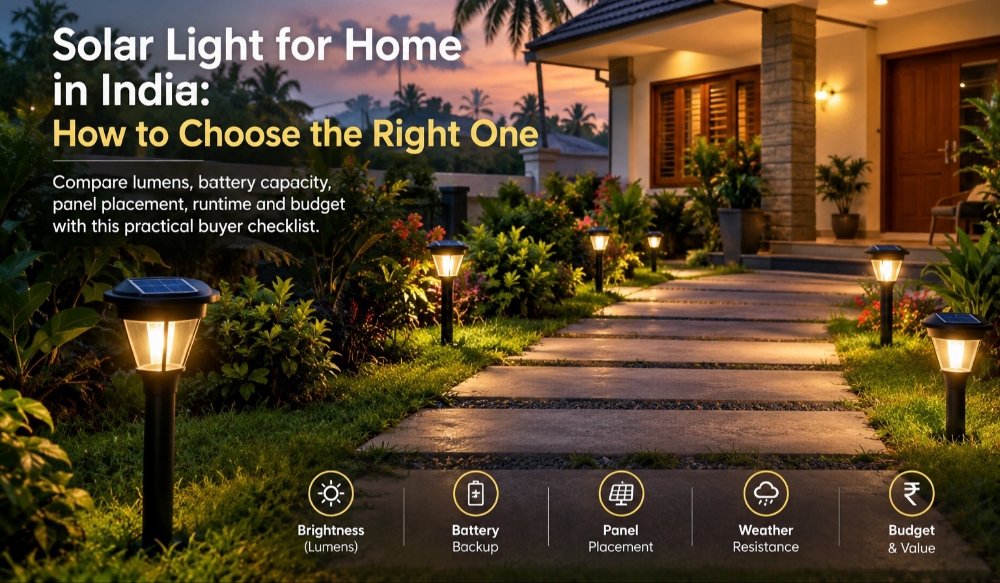
Solar Light for Home in India: How to Choose the Right One
Solar Light for Home in India: How to Choose the Right One
Choosing a solar light for your home is not just about brightness or price. You also need to consider battery backup, sunlight exposure, weather resistance and how you plan to use the light.
For homes in Kerala and other parts of India, these details matter because cloudy weather and long periods of rain can affect charging. A light that works well beside a sunny garden path may not perform the same way under a shaded entrance.
This guide explains what to check before buying a solar light for your home, along with a practical checklist to help you compare different models.
1. Start by Deciding Where You Need the Light
Before comparing products, think about the area you want to illuminate.
-Garden paths: Look for comfortable, evenly distributed light that helps people see where they are walking.
-Gates and entrances: Choose a light that illuminates the entrance, lock and surrounding area.
-Compound walls: Solar wall or pillar lights can provide practical lighting while improving the appearance of the property.
-Driveways and open yards: These areas may need a wider beam and more light than a small decorative fixture can provide.
-Security lighting: Motion-sensor models can brighten an area when someone approaches, helping conserve battery power when the area is empty.
Also check whether the solar panel will receive enough sunlight. A light installed in a shaded location may struggle to charge fully, even if its specifications look impressive.
2. Compare Brightness in Lumens, Not Just Wattage
Lumens measure the amount of visible light a fixture produces. Wattage describes electrical power, but the wattage printed in a solar-light product name does not always tell you how bright the light will be.
For this reason, compare the manufacturer's stated lumen output whenever it is available. Also consider the beam angle, mounting height and area you need to illuminate.
As a rough starting point:
-Garden paths: Around 50-150 lumens per light may be sufficient for gentle pathway lighting.
-Decorative garden areas: Approximately 50-200 lumens may suit accent lighting, depending on the design.
-Gates and entrances: Brighter fixtures may be needed to illuminate the approach and surrounding space.
-Driveways and larger outdoor areas: Consider higher-output lighting with a suitable beam spread.
These are general examples, not fixed requirements. The best choice depends on spacing, surrounding darkness and the purpose of the light.
A fixture with a high lumen rating may still be unsuitable if its beam is too narrow or the light is mounted in the wrong position.
3. Understand Battery Capacity and Nightly Runtime
The battery stores the energy collected by the solar panel during the day. Its capacity and the light's power consumption both affect how long the light can operate after sunset.
Battery capacity may be listed in milliampere-hours (mAh) or watt-hours (Wh). Watt-hours are particularly useful when comparing stored energy because they account for voltage.
For example, a battery storing 10 Wh of energy powering a 5 W light would theoretically provide about two hours of operation before accounting for losses. Actual runtime depends on battery efficiency, operating conditions and the light's power settings.
Before choosing a model, check:
- The battery type and stated capacity.
- The manufacturer's estimated runtime and the conditions behind that estimate.
- Whether the light operates at full brightness throughout the night.
- Whether it offers motion-sensor or dimming modes.
- Whether replacement batteries are available, if needed.
Battery chemistry is another consideration. LiFePO4 (lithium iron phosphate) batteries generally offer good cycle life and thermal stability compared with many conventional lithium-ion battery designs. However, actual performance depends on cell quality, charging controls, temperature and usage.
Do not compare batteries using capacity alone. A larger battery does not automatically guarantee longer runtime if the light consumes considerably more power.
4. Place the Solar Panel Where It Can Receive Sunlight
Solar panel placement has a direct effect on charging performance.
Whenever possible, position the panel where it receives several hours of direct sunlight and has a clear view of the sky. Avoid locations where trees, walls, roof overhangs or water tanks create persistent shadows.
For homes in Kerala, unobstructed sunlight is generally more important than trying to achieve an exact panel angle. If the panel can be adjusted, its orientation and tilt should suit the location and installation.
Keep the panel surface clean as well. Dust, leaves and other deposits can reduce the amount of sunlight reaching the cells.
If the light has a separate solar panel connected by a cable, you may be able to position the lamp in a shaded area while placing the panel in a sunnier location. Check the cable length and installation requirements before buying.
Remember that good panel placement cannot eliminate the effects of prolonged cloudy weather, but it can help the system collect as much available solar energy as possible.
5. Choose a Solar Light Suitable for Kerala's Monsoon
Outdoor solar lights must cope with rain, humidity and changing weather conditions. This makes the product's Ingress Protection (IP) rating worth checking before you buy.
For example, an IP65 rating indicates protection against dust ingress and water jets under specified test conditions. It does not mean the fixture can be submerged in water.
IP67 has additional protection against temporary immersion under specified testing conditions, but this still does not make every installation suitable for flooding or prolonged water exposure.
When comparing outdoor lights, check:
- The IP rating stated on the specific product.
- Whether the rating applies to the complete fixture and its installation.
- Whether the panel, cable connections and mounting points are protected as required.
- Whether the installation location is prone to waterlogging.
- Whether the manufacturer's instructions specify any additional precautions.
Solar lights can continue charging during cloudy weather, but charging is generally slower when less sunlight reaches the panel. During prolonged overcast periods, a light may run for fewer hours or reduce its brightness.
A suitable battery capacity, efficient lighting modes and good panel placement can help, but no particular battery size guarantees uninterrupted operation through every monsoon spell.
6. Compare the Total Cost, Not Just the Purchase Price
A low purchase price can be attractive, but it is only one part of the decision.
Consider the expected service life, warranty, battery replacement options and suitability for the job. A decorative garden light and a security light have different requirements, so the cheapest option may not be the most practical one.
Before purchasing, compare:
-Brightness: Does the stated lumen output suit your intended use?
-Battery: Is the type and capacity clearly specified?
-Runtime: Is the estimated operating time suitable for your needs?
-Solar panel: Can you install it in a location with adequate sunlight?
-Weather protection: Is the IP rating appropriate for the installation?
-Warranty: What is covered, for how long, and are batteries included?
-Maintenance: Are replacement batteries or other service parts available?
-Installation: Are the required brackets, poles, cables or mounting accessories included?
Warranty terms can vary significantly between models, even within the same product category. Always check the individual product listing rather than assuming that every solar light carries the same warranty.
7. A Practical Buyer Checklist
Before choosing a solar light for your home, work through this checklist:
- The light is suitable for the intended area.
- The lumen output and beam spread meet your needs.
- The battery type and capacity are stated clearly.
- The estimated runtime suits your nightly schedule.
- The solar panel can receive adequate sunlight.
- The IP rating is appropriate for outdoor exposure.
- Motion-sensor or dimming modes are available if needed.
- The warranty and its exclusions are clear.
- Replacement parts and maintenance options have been considered.
- The total cost makes sense for the expected use.
Comparing these points across two or three models can help you make a more informed decision than choosing by wattage or price alone.
Frequently Asked Questions
How many lumens do I need for a garden path?
Around 50-150 lumens per fixture can be a useful starting point for gentle pathway lighting. The right output depends on the spacing between lights, beam angle and the amount of surrounding light.
Do solar lights work during Kerala's monsoon?
Yes, solar lights can still charge during cloudy weather, but charging may be slower and runtime can decrease during prolonged periods of low sunlight. Choose an appropriate weather rating and install the panel where it receives as much available sunlight as possible.
How long should a solar light run at night?
Runtime depends on stored battery energy, power consumption and operating mode. Check the manufacturer's estimate and the conditions under which it was measured. Motion-sensor and dimming modes can extend operating time.
Are all solar lights waterproof?
No. Check the IP rating of the specific model and follow its installation instructions. IP65-rated equipment is designed to resist dust and water jets under specified conditions, not immersion.
Is a higher-wattage solar light always brighter?
Not necessarily. Product wattage alone is not a reliable way to compare brightness. Look for stated lumen output, beam angle and the intended application.
Final Thoughts
Choosing the right solar light for your home comes down to matching the light to its purpose, understanding its battery and runtime, providing adequate sunlight for charging, and checking its suitability for local weather conditions.
Take time to compare the specifications, warranty and expected maintenance costs of the models you are considering. A well-matched solar light can provide useful outdoor illumination without requiring a conventional electrical connection at the fixture.
The buyer checklist above is a good place to start when comparing options for your garden, gate, pathway or entrance.
Blog: https://www.hardollenterprises.com/blogs/blog/best-solar-lights-for-indian-homes-2026