AI Agents in DeFi: Can Autonomous Systems Manage Crypto Portfolios?
But handing real money to software raises a serious question: can autonomous systems actually manage crypto portfolios, and should they? The honest answer is "partly, and only with strong guardrails." Let's look at why.
What Are AI Agents in DeFi?
An AI agent is software that can observe information, make decisions and take actions on its own. In DeFi, those actions happen on a blockchain through a wallet: swapping tokens, depositing into lending pools, providing liquidity or voting on proposals.
DeFi is a natural home for agents. Everything is open, programmable and available around the clock. An agent does not need a bank account or a broker. It just needs a wallet and permission to act.
What Can AI Agents Do With a Crypto Portfolio?
1. Yield Optimisation
Yields across lending platforms and liquidity pools change constantly. An agent can compare rates, check fees and move funds to better opportunities faster than a person could.
2. Automatic Rebalancing
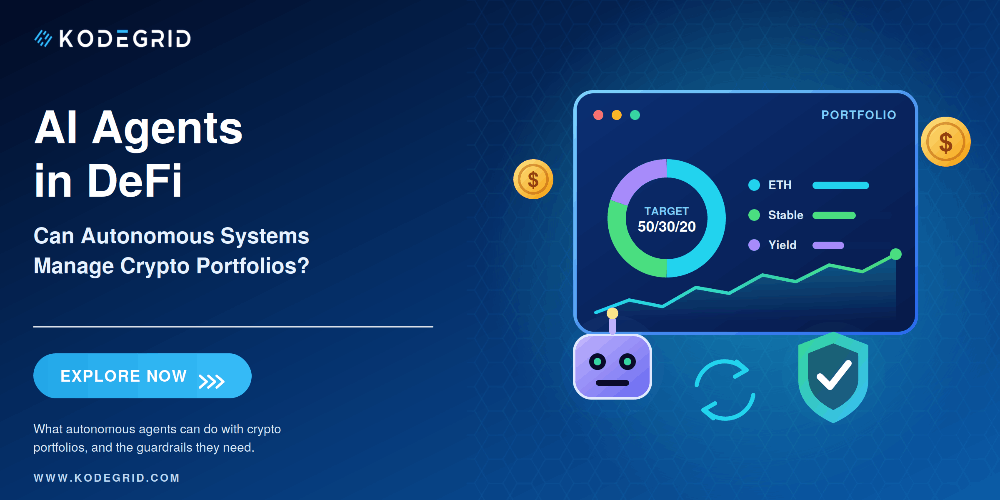
Suppose you want a portfolio split 50% ETH, 30% stablecoins and 20% other assets. As prices move, the mix drifts. An agent can bring it back to target by making small trades when needed.
3. Risk Monitoring
Agents can watch for warning signs, such as a stablecoin drifting from its peg, a sudden drop in a pool's liquidity or a loan nearing liquidation, and react quickly.
4. Liquidity Management
Providing liquidity in some pools needs active management of price ranges. Agents can adjust positions as markets move.
5. Governance Participation
An agent can read proposals, summarise them and vote according to rules you set, which helps busy token holders stay involved.
6. Reporting and Record-Keeping
Agents can log every transaction and produce clear summaries, which makes tracking and tax preparation easier.
Example: A user sets a rule: "Keep at least 40% in stablecoins, never put more than 10% in one protocol, and do not trade more than $500 per day." The agent works inside those limits, rebalances weekly and sends a daily report.
The Case for Autonomous Portfolio Management
- Speed: markets move in seconds, and agents react just as fast
- Consistency: agents follow rules without fear or excitement
- Always on: no gaps overnight or on weekends
- Scale: one agent can watch many protocols and chains at once
- Lower effort: routine tasks run in the background
The Case for Caution
Speed cuts both ways. A mistake made quickly can be costly.
Prompt Injection and Manipulated Inputs
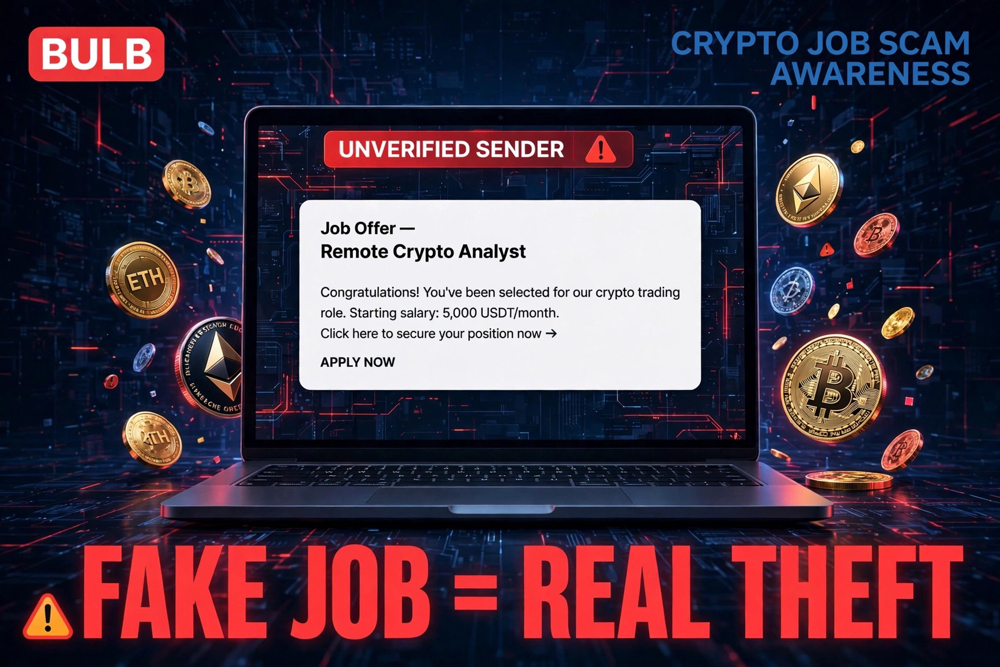
Agents read news, social posts and web pages. A malicious page can hide instructions meant to trick the agent into sending funds somewhere unsafe. Treat all outside content as untrusted.
Wrong or Overconfident Decisions
AI models can misread data or act confidently on bad information. They also have no real understanding of a user's life, goals or comfort with risk.
Smart Contract Risk
Even a perfect agent is only as safe as the protocols it uses. A bug in a lending pool or a failed stablecoin can cause losses no matter how smart the agent is.
Market and Liquidation Risk
Crypto is volatile. Leverage and thin liquidity can lead to forced sales. An agent that chases high yields may take on hidden risks.
Price Feed and Trading Risks
Agents depend on data sources. If a price feed is manipulated, or other traders jump ahead of a transaction, results can suffer.
Key Custody
An agent needs signing power. If its keys are poorly protected, someone else could control the portfolio.
Accountability and Regulation
Who is responsible when an agent loses money? Rules around managing other people's assets differ by country, and automated systems add new questions. Seek qualified legal advice before offering agent-managed services to others.
This article is for general information and is not financial or legal advice. Crypto assets are volatile and you can lose money.
So, Can Agents Manage Portfolios?
The practical answer is that agents work best as tireless assistants inside strict boundaries, not as unsupervised fund managers. Think of three levels:
- Advisory: the agent suggests actions and a human approves every one
- Semi-autonomous: the agent acts alone on small, low-risk tasks and asks for approval on bigger moves
- Fully autonomous: the agent acts alone within hard-coded limits
Most teams are wise to start at level one, move to level two as trust grows and treat level three as something for narrow, well-tested strategies.
Guardrails Every DeFi Agent Needs
- Smart contract wallets with spending rules: per-trade caps, daily budgets and expiry times enforced in code
- Allowlists: the agent may only use approved protocols, tokens and addresses
- Transaction simulation: test each action before signing to see what it will actually do
- Human approval for large moves, plus a kill switch that pauses everything instantly
- Separate wallets: keep agent funds apart from long-term holdings
- Real-time monitoring and alerts for unusual activity
- Independent audits of any custom contracts the agent relies on
- Testing first: run strategies on test networks and with tiny amounts before scaling
These controls matter more than the cleverness of the AI. A mediocre agent with strong limits is safer than a brilliant agent with none.
Building the Foundation With a Crypto Token Development Company
If you are creating an agent-based DeFi product, you will likely need more than AI. You may need a token for rewards or governance, vault and permission contracts, wallets with safe spending rules and a secure way to settle payments. These are blockchain engineering tasks, and mistakes can be hard to undo.
A reliable crypto token development company can design the token economy, build and test the smart contracts and prepare the system for audits and launch. If you are building a product that holds user funds or runs automated strategies, professional crypto token development services can help you build safety in from the start. Many DeFi tokens follow the ERC-20 standard, so it is also worth working with a team that has proven experience on Ethereum and its Layer 2 networks.
Conclusion
AI agents are changing how people interact with DeFi. They can optimise yield, rebalance portfolios, watch for risk and keep clear records, often faster and more consistently than humans. But they also bring new dangers, from manipulated inputs to smart contract failures.
So can autonomous systems manage crypto portfolios? Yes, within limits. Keep humans in the loop for big decisions, enforce rules in smart contracts, test thoroughly and never let convenience beat caution. If you plan to build in this space, start small, audit everything and work with an experienced crypto token development company that treats security as a core feature.