AI in Trading: How to Tell a Real Adaptive Tool From Marketing Hype
Open the TradingView indicator marketplace and search "AI," and you'll get hundreds of results. Most of them are standard technical indicators with the letters "AI" added to the title. That's not necessarily dishonest — it's just that "AI" became a label slapped onto almost anything in the last few years, and traders are left with no easy way to tell which tools actually do something different.
Here's a complete, practical way to check for yourself, without needing a data science background — including the specific techniques that are legitimately used in this space, the red flags that show up again and again, and a worked example of applying the checklist to a hypothetical product description.

The One-Sentence Test
Ask this about any tool claiming to use AI: does it behave differently in different market conditions, or does it apply the exact same formula every time regardless of what the market is doing?
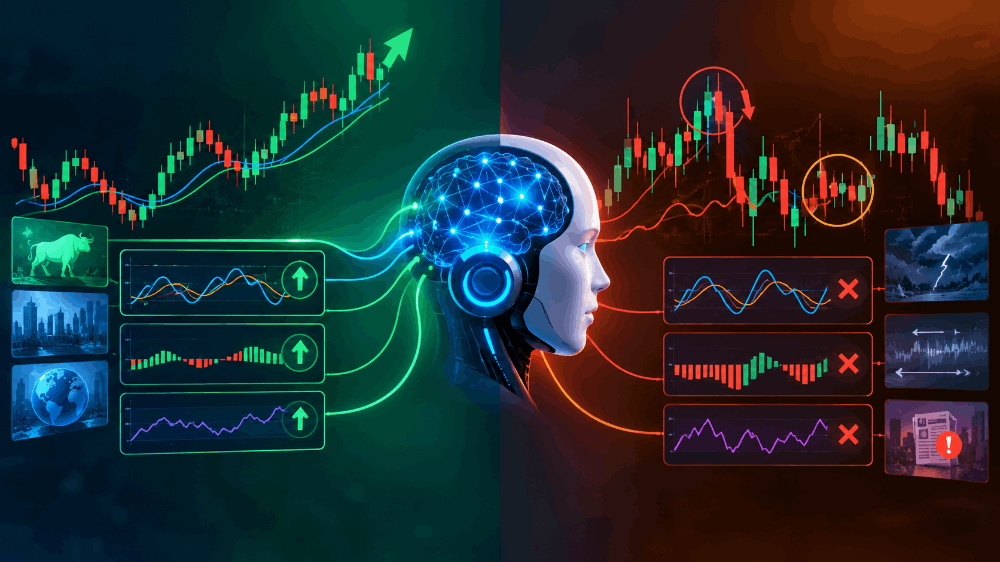
A genuinely adaptive tool should treat a quiet, range-bound Tuesday differently than a volatile, trending Friday — adjusting its sensitivity, its thresholds, or its signal frequency based on current conditions. A static tool runs the same fixed formula no matter what, even if it's dressed up with AI-sounding language in the description.
This single question filters out a surprising amount of marketing noise. If you can't find a clear answer to how the tool actually changes its behavior, that's itself useful information.
What "AI" Actually Means in This Context — a Short Primer
Before you can judge a claim, it helps to know what the legitimate techniques underneath it actually are. None of these require a computer science degree to understand at a conceptual level:
- Clustering: Grouping historical market states (combinations of volatility, volume, and price behavior) into buckets of "similar" conditions, so the tool can recognize "this looks like the kind of day where X usually happens" rather than treating every day identically.
- Regime detection: Classifying the market into a small number of states — typically trending versus ranging, or high-volatility versus low-volatility — and changing indicator behavior (sensitivity, thresholds, which signals to trust) depending on which regime is currently active.
- Adaptive parameter tuning: Automatically adjusting a lookback period or multiplier based on recent volatility, rather than using a fixed number set once by the developer. A moving average that shortens its own lookback during fast markets and lengthens it during quiet markets is a simple example.
- Machine learning classification/regression: A model trained on historical data to predict a specific outcome (direction, volatility expansion, or similar), which is the closest to what most people picture when they hear "AI," but is also the least commonly implemented well in retail indicator products, because it requires rigorous out-of-sample testing to avoid simply memorizing historical noise.
All four of these are legitimate, explainable techniques that have existed in quantitative finance for a long time. The key distinction a buyer needs to make isn't "is AI real" — it's "which of these, if any, is this specific product actually using, and can they explain it."
Common Red Flags
- Vague language with no mechanism. Phrases like "powered by advanced algorithms" or "proprietary AI engine" that never explain what the underlying technique actually is. Legitimate adaptive tools are usually specific — mentioning the actual method, like clustering, regression, or a named classification approach — because there's no reason to hide it if it's real.
- Identical signals across wildly different conditions. If the same tool fires signals at roughly the same frequency whether the market is calm or chaotic, it's likely not actually adapting to anything.
- No mention of repainting status. This is unrelated to AI specifically, but it's a strong signal of how rigorously a product was tested. A tool whose developer hasn't addressed repainting directly often hasn't scrutinized their own signals very closely either.
- Marketing that leans entirely on testimonials rather than mechanism. Reviews and screenshots of profitable trades say nothing about whether a method is sound — they say a trade happened to work out once.
- Claims of a specific, oddly precise win rate with no visible methodology. A claim like "87.3% accuracy" without any explanation of the test period, sample size, or whether costs were included is a number designed to impress rather than inform.
- No distinction between backtested and live/forward performance. Products that only ever show backtested results, without separately reporting how the same approach performed once it was actually live, are withholding the single most important piece of evidence about whether it holds up outside of hindsight.
Green Flags Worth Looking For
- A specific, named technique. Clustering (grouping similar market states together), regime detection (identifying trending vs. ranging conditions), or adaptive parameter tuning (adjusting lookback periods based on recent volatility) are all legitimate, explainable approaches — and developers using them tend to say so plainly.
- Documented behavior differences by market condition. If a product shows you how its output changes between a trending period and a ranging period, that's evidence of actual adaptation, not just a claim of it.
- Clear non-repainting confirmation. Signals that are locked in once a bar closes, rather than shifting retroactively as new data arrives, suggest the developer has actually stress-tested their own tool.
- Willingness to show unfavorable results. A product that only ever shows cherry-picked winning periods is giving you marketing, not evidence. One that shows where its approach struggles is giving you something closer to real information.
- A described training/testing split, if machine learning is actually involved. If a product claims to use a trained model, a credible description should mention separating the data used to build the model from the data used to evaluate it — without that separation, a reported performance number is close to meaningless.
Why This Confusion Happened in the First Place
"AI" became trading-industry shorthand around the same time generative AI tools went mainstream, and it stuck for the same reason it did everywhere else — it sounds impressive and is hard for a casual buyer to verify. The underlying techniques that power genuinely adaptive trading tools (clustering, regime classification, adaptive smoothing) have existed in quantitative finance for a long time. What changed wasn't the math — it was the marketing vocabulary wrapped around it.
That doesn't mean every AI claim is false. It means the burden is on the product to explain its mechanism clearly, and the burden is on you, as a buyer, to actually ask.
A Worked Example: Applying the Checklist
Imagine a hypothetical product description that reads: "Our proprietary AI engine uses deep learning to adapt to any market condition and deliver 90%+ accurate signals." Running this through the checklist above:
- Specific technique named? No — "deep learning" is mentioned but nothing about what it's predicting, what data it's trained on, or how it was validated.
- Documented behavior difference by condition? No evidence shown, just the claim that it "adapts to any market condition."
- Repainting addressed? Not mentioned at all in this hypothetical description.
- Honest discussion of weaknesses? No — only a single, oddly precise accuracy figure with no context.
- Would the claim survive without the word "AI"? Stripped of the AI language, this description says almost nothing concrete about what the tool actually does.
This hypothetical example fails nearly every check — not because deep learning techniques don't exist or can't be legitimately applied to markets, but because this particular description gives a buyer no way to verify anything behind the claim. Compare that to a description that instead says something like: "Classifies each session into one of three volatility regimes using a rolling 20-day lookback, and adjusts signal threshold sensitivity accordingly; backtested 2019-2024 with a separate 2025 out-of-sample validation period; signals are non-repainting and confirmed on bar close." That second version names a specific technique, describes the validation approach, and addresses repainting directly — regardless of how well the underlying strategy actually performs, the description itself gives you something concrete to evaluate.
How Regime Detection Actually Works, Step by Step
Since regime detection is one of the most commonly (and legitimately) used techniques behind adaptive indicators, it's worth walking through a simplified version of how it actually operates, so the concept stops feeling like a black box.
- Define the features that describe a market state. Common choices include recent volatility (an ATR reading), directional strength (an ADX reading), and perhaps volume relative to its recent average. These are ordinary, well-understood inputs — nothing exotic.
- Set thresholds or let a clustering process find natural groupings. A simple version might just say "ADX above 25 is trending, below 20 is ranging, and the zone between is ambiguous." A more sophisticated version might run a clustering algorithm across historical data to find groupings that aren't based on a single hand-picked threshold.
- Tag each historical period with its detected regime. This produces a labeled history: this stretch was "trending," this stretch was "ranging," this stretch was "high volatility," and so on.
- Change the indicator's behavior based on the currently detected regime. For example, widening a SuperTrend-style multiplier automatically when the high-volatility regime is active, or suppressing momentum signals entirely while the ranging regime is detected.
- Validate that this actually improved results out-of-sample. This is the step that's often skipped or glossed over in marketing material, and it's the step that actually separates a well-built adaptive tool from one that merely sounds adaptive.
None of these five steps require anything beyond concepts most traders already use informally — most experienced traders already "regime detect" in their head by glancing at a chart and thinking "this looks choppy, I should be more careful today." What a coded regime-detection tool adds is consistency and the ability to backtest that judgment systematically, rather than relying on a trader's in-the-moment read, which can vary day to day even for the same person.
Questions Worth Asking a Seller Directly
If you're seriously considering a paid product that markets itself as AI-powered, these are reasonable, specific questions to ask before subscribing — and the quality of the answers tells you a lot:
- "What specific technique does this use — clustering, regime classification, a trained model, or something else?"
- "How was it validated — is there a separate out-of-sample test period, and what does performance look like there specifically, separate from the in-sample backtest?"
- "Does the signal repaint, and how was that tested?"
- "Can you show an example of the tool behaving differently in a trending period versus a ranging period, on the same chart?"
- "What are the known conditions where this approach underperforms?"
A seller who can answer these specifically and without defensiveness is giving you useful signal. A seller who responds only with more marketing language, a louder repetition of the original claim, or redirects to testimonials instead of mechanism, is itself a data point worth weighing heavily.
A Brief Note on Survivorship in Marketing Examples
One subtle pattern worth watching for: a product's marketing material, even when it includes real charts rather than fabricated ones, naturally tends to showcase the periods and instruments where the tool performed best, because that's what gets selected for a sales page. This is true even for honest sellers — it's a selection bias built into how marketing works, not necessarily a deliberate deception.
The practical implication is that even a completely genuine example chart on a sales page tells you the tool can work under some conditions, not that it reliably works under most conditions. The only way to get a fuller picture is independent testing on a date range and instrument you choose yourself, rather than relying solely on examples the seller selected.
A Quick Checklist Before You Trust an "AI" Claim
- Can I find a specific named technique, or just buzzwords?
- Does the product show different behavior across different market conditions, with evidence?
- Is repainting addressed directly and clearly?
- Is there any honest discussion of where the approach underperforms?
- Is there a described separation between the data used to build the approach and the data used to test it?
- Would the claim survive if I removed the word "AI" from the description — does the actual functionality still sound useful on its own merits?
Why Genuinely Adaptive Tools Still Aren't Magic
It's worth being clear about something even a well-built, genuinely adaptive tool can't do: guarantee future performance. Regime detection and clustering can make a tool more consistent across different market conditions than a fixed-formula indicator, but markets can and do produce entirely new conditions that don't resemble anything in a model's historical training data. A tool being legitimately adaptive is a meaningfully different claim from a tool being reliably profitable — the first is a question of engineering honesty, the second is a question that no amount of sophisticated technique can fully answer in advance.
This distinction matters because it reframes what you should actually be shopping for. You're not trying to find a tool that predicts the market perfectly — nothing does. You're trying to find a tool whose developer has been honest and specific about what it does, how it was tested, and where it tends to struggle, because that honesty is itself a reasonably good proxy for how carefully the whole product was built.
If you want to see this evaluation framework applied directly to a range of specific products currently marketed as AI-powered on TradingView, there's a detailed walkthrough in Quantzee's guide to AI trading indicators that goes through each of these checks product by product.
How This Differs From Evaluating a Non-AI Indicator
It's worth noting that most of this checklist — mechanism clarity, repainting checks, honest performance reporting, out-of-sample validation — applies just as well to a completely ordinary, non-AI indicator. The reason AI claims specifically need this extra scrutiny is that the label itself tends to suppress the normal skepticism a trader would otherwise apply. A product described plainly as "a moving average with a volatility filter" invites a trader to ask how well that combination actually performs. A product described as "an advanced AI trading engine" can short-circuit that same instinct, because the label implies sophistication that the buyer may feel unqualified to question. The checklist above exists mainly to restore that normal level of scrutiny, not to apply some unusually harsh new standard reserved only for AI-branded products.
FAQ
Is every "AI" trading indicator fake?
No. Some genuinely use adaptive techniques like clustering or regime detection. The issue is that the label itself has become unreliable as a signal, so it has to be verified rather than taken at face value.
What's the easiest way to check if a tool is really adaptive?
Look for whether it behaves differently across different market conditions, with some evidence shown for that difference. A fixed formula applied identically every time isn't adaptive, regardless of what it's called.
Does "AI-powered" always mean machine learning?
No. The term is often used loosely to describe anything from a simple weighted average to an actual trained model. Ask what specific technique is being used rather than accepting the label alone.
Is a higher claimed accuracy percentage a good sign?
Not by itself. An oddly precise accuracy figure with no described methodology, sample size, or test period is more often a marketing number than a meaningful statistic. A credible performance claim usually comes with context about how it was measured.
Can a genuinely adaptive tool still lose money?
Yes. Being adaptive describes how the tool adjusts to conditions it recognizes — it doesn't guarantee the market won't produce a condition the tool hasn't seen before, or that its underlying approach is profitable after real trading costs.
Should I avoid any product that uses the word "AI" at all?
Not necessarily — plenty of legitimate quantitative techniques get described this way now. The useful move is to treat the word as a prompt to ask for specifics, not as a reason to dismiss or trust the product on its own.
Does a product need to use machine learning to be legitimately described as adaptive?
No. Regime detection and adaptive parameter tuning can both be built with straightforward statistical rules rather than a trained machine learning model, and still meaningfully adapt to changing market conditions. Machine learning is one way to build an adaptive tool, not the only way, and its presence or absence doesn't by itself determine whether a product is well built.
Why do so many sales pages show only winning examples?
Partly ordinary selection bias rather than deliberate dishonesty — marketing material naturally highlights the periods and instruments where a tool performed well, because that's what makes for a persuasive page. It's still worth remembering that a favorable example chart shows the tool can work under some conditions, not that it reliably works under most.
What's the single most useful question to ask before trusting an AI trading claim?
Asking for the specific technique behind the claim — clustering, regime detection, adaptive tuning, or a trained model — tends to be the most revealing single question, because a seller who can answer specifically and without defensiveness is giving you real information, while one who only repeats marketing language is itself telling you something.
Ultimately, the word "AI" in a trading product's name or description isn't information on its own — it's a prompt to ask the same questions you'd ask of any technical claim: what exactly does this do, how was it tested, and where does it fall short. Products built on real, explainable techniques tend to answer these questions plainly, because there's nothing to hide. Products relying mainly on the word itself to carry the sale tend to struggle with the same questions, and that struggle is itself the most useful signal a buyer can get before spending money.
That restored skepticism is the entire point of running through this checklist — not to reject every product that mentions AI, and not to assume the term is automatically meaningless, but to put AI-branded claims back on the same footing as any other technical claim you'd evaluate before trusting it with real trading decisions.
This article is for educational purposes only and is not investment advice. Evaluate any trading tool's claims independently before relying on it.