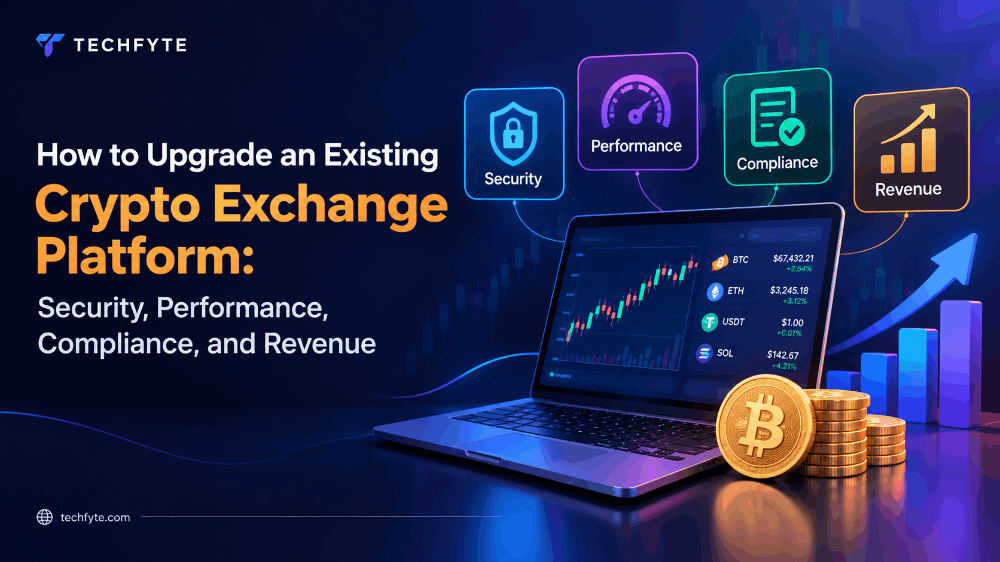
How to Upgrade an Existing Crypto Exchange Platform: Security, Performance, Compliance, and Revenue

Introduction
Launching a crypto exchange is only the beginning. As the number of users, transactions, trading pairs, wallets, and regulatory requirements increases, an exchange that worked well during its early stage can begin to show serious weaknesses.
Users may experience slow order execution, delayed deposits and withdrawals, wallet errors, downtime, poor mobile performance, or an outdated interface. At the same time, exchange operators face growing security threats, compliance obligations, liquidity challenges, infrastructure costs, and pressure from competitors offering more advanced trading features.
The solution is not always to rebuild the entire platform from scratch. In many cases, a structured modernization program can improve the existing exchange while preserving valuable components such as user accounts, trading history, liquidity relationships, wallet infrastructure, and brand equity.
Upgrading an existing crypto exchange platform can help businesses:
- Improve security and protect user funds
- Increase transaction speed and platform reliability
- Support more users and trading volume
- Strengthen KYC, AML, and transaction monitoring
- Improve user experience and conversion rates
- Add new markets, trading products, and payment options
- Create additional revenue streams
- Prepare the platform for future regulatory and technology changes
This guide explains the most important areas to evaluate before upgrading an existing crypto exchange and how businesses can approach the process strategically.
Compliance note: Crypto-asset regulations vary by country and product type. This article provides general technology information and should not replace legal, licensing, tax, or compliance advice.
Why Existing Crypto Exchanges Need Regular Upgrades
Crypto exchange technology changes quickly. New blockchain networks, custody models, payment systems, security standards, trading products, and compliance expectations continuously affect how exchanges operate.
A platform may require modernization when:
- The matching engine cannot handle peak trading activity
- Deposits and withdrawals are processed slowly
- The exchange experiences frequent downtime
- Wallet infrastructure is difficult to maintain
- The platform depends on outdated libraries or frameworks
- Users report failed transactions or delayed confirmations
- The mobile experience is poor
- New assets or networks are difficult to integrate
- KYC and AML processes are mostly manual
- Liquidity is fragmented across multiple providers
- The exchange cannot support new markets or revenue models
- The current architecture makes future development expensive
An upgrade should begin with a complete technical and business audit. Replacing isolated features without understanding the wider architecture can create new security risks and integration failures.
Step 1: Conduct a Complete Crypto Exchange Platform Audit
Before making changes, exchange operators should establish a clear picture of the platform’s current condition.
A professional audit should review the following layers.
Technical architecture
The audit should assess the frontend, backend services, databases, APIs, message queues, caching systems, cloud infrastructure, and third-party integrations.
Important questions include:
- Is the architecture modular or tightly coupled?
- Can individual services be upgraded without disrupting trading?
- Are critical services deployed redundantly?
- Is there a documented disaster recovery process?
- Are production and testing environments properly separated?
- Are system dependencies updated and supported?
Trading infrastructure
The trading layer should be reviewed for order-processing speed, matching-engine performance, market-data latency, order-book reliability, and failure recovery.
The audit should measure:
- Order-matching latency
- API response time
- Market-data delivery speed
- Maximum orders per second
- Queue and database performance
- Handling of cancelled or partially filled orders
- System performance during market volatility
Techfyte provides order matching engine development for exchanges that require low-latency execution, high throughput, fault tolerance, and support for spot or derivatives markets.
Wallet and custody infrastructure
Wallet operations should be assessed across hot wallets, cold storage, MPC custody, key management, withdrawal approvals, blockchain nodes, and transaction monitoring.
The audit should verify:
- How private keys are generated and stored
- Whether withdrawals require multiple approvals
- How hot-wallet balances are controlled
- Whether cold-storage procedures are documented
- How wallet addresses are screened
- How failed blockchain transactions are handled
- Whether wallet balances reconcile correctly with the internal ledger
Security controls
Security review should cover authentication, authorization, encryption, session management, access controls, secrets management, logging, monitoring, and incident response.
The OWASP Application Security Verification Standard provides a useful framework for evaluating application security controls.
Compliance operations
The audit should review identity verification, risk scoring, sanctions screening, suspicious-activity monitoring, transaction records, reporting workflows, data retention, and user consent.
The exact requirements depend on the exchange’s jurisdiction, customer location, products, custody model, and licensing status.
Step 2: Strengthen Crypto Exchange Security
Security should be treated as a continuous operating function rather than a one-time development task. Exchanges manage valuable assets and sensitive customer information, making them targets for account takeovers, phishing, malware, insider threats, API abuse, and infrastructure attacks.
Improve account security
A modern exchange should offer:
- Multi-factor authentication
- Passkeys or hardware-security-key support
- Login alerts
- Device and session management
- Withdrawal address allowlisting
- Withdrawal time locks
- Separate trading and withdrawal permissions
- Password-reset protection
- Risk-based login verification
High-value or unusual transactions should trigger additional verification.
Protect wallets and private keys
Wallet security improvements may include:
- Multi-party computation custody
- Hardware security modules
- Multi-signature approvals
- Segmented hot and cold wallets
- Automated wallet-balance limits
- Withdrawal velocity controls
- Dual-operator approval for sensitive actions
- Offline backup procedures
- Key-rotation policies
The exchange should also maintain a clear separation between customer-facing application systems and key-management infrastructure.
Add real-time fraud monitoring
A fraud-monitoring system can identify:
- Unusual login locations
- Rapid device changes
- Abnormal withdrawal patterns
- Account takeover indicators
- API abuse
- Multiple accounts controlled by one actor
- Suspicious deposit and withdrawal relationships
- Sanctions or high-risk wallet exposure
Blockchain analytics providers can be integrated to screen addresses and trace transaction risk. The exchange should define an internal escalation process for freezing, reviewing, and releasing suspicious transactions.
Secure APIs and administrative systems
API security should include:
- API-key permissions
- IP allowlisting
- Rate limits
- Signed requests
- Short-lived authentication tokens
- Key expiration and rotation
- Separate read and trading permissions
- Detailed audit logs
Administrative panels require particularly strict controls. Every sensitive action should be logged with the administrator’s identity, timestamp, IP address, device information, and affected account or transaction.
Test the platform continuously
Security testing should include:
- Vulnerability scanning
- Penetration testing
- Smart-contract audits where applicable
- Dependency scanning
- Cloud-configuration reviews
- Access-control testing
- Disaster-recovery exercises
- Incident-response simulations
NIST’s Cybersecurity Framework 2.0 provides a recognized structure for identifying, protecting, detecting, responding to, and recovering from cybersecurity incidents.
Step 3: Improve Exchange Performance and Scalability
Performance affects trust, trading activity, and revenue. During periods of high volatility, users expect the exchange to remain available and execute orders accurately.
Upgrade the matching engine
The matching engine is one of the most important components of an exchange. It determines how buy and sell orders are prioritized and executed.
An upgraded matching engine should support:
- Price-time priority
- Market, limit, stop, and conditional orders
- Partial fills
- Order cancellation
- High order throughput
- Low and predictable latency
- Market isolation
- Fault recovery
- Detailed execution records
The architecture should prevent a problem in one trading pair from affecting the entire exchange.
Use scalable infrastructure
A scalable architecture may include:
- Containerized services
- Horizontal scaling
- Load balancing
- Auto-scaling policies
- Distributed caching
- Read replicas
- Database partitioning
- Message queues
- Content delivery networks
- Multi-region failover
- Real-time observability
Not every exchange requires a multi-region deployment immediately. Infrastructure should be matched to trading volume, risk tolerance, user locations, and business objectives.
Improve blockchain connectivity
Blockchain integrations can become a source of delays when nodes are unreliable or poorly monitored.
A stronger integration layer should provide:
- Multiple node providers
- Private or dedicated nodes for important networks
- Confirmation monitoring
- Reorganization handling
- Gas-fee estimation
- Failed-transaction recovery
- Deposit-address management
- Blockchain event indexing
- Automated reconciliation
Reduce downtime
A resilient exchange should define recovery targets for critical services:
- Recovery time objective
- Recovery point objective
- Maximum acceptable downtime
- Backup frequency
- Failover process
- Communication plan during incidents
Status monitoring should detect failures before users report them.
Step 4: Modernize the User Experience
Security and performance improvements are essential, but they must be presented through a simple and reliable user experience.
Improve onboarding
The onboarding process should make it easy for users to:
- Create an account
- Complete identity verification
- Understand verification requirements
- Deposit funds
- Find a trading pair
- Place an order
- Track order status
- Withdraw assets safely
A progress indicator, clear error messages, multilingual support, and mobile-friendly forms can reduce abandonment.
Simplify the trading interface
The platform may offer separate interfaces for beginners and professional traders.
A beginner interface can focus on:
- Simple buy and sell actions
- Portfolio value
- Recurring purchases
- Market summaries
- Educational explanations
An advanced interface can include:
- Depth charts
- Advanced order types
- Trading indicators
- Real-time order books
- API tools
- Margin or derivatives controls, where legally permitted
Improve mobile performance
Many users access exchanges from mobile devices. The exchange should evaluate:
- Mobile page-load time
- App startup time
- Chart performance
- Authentication flow
- Push notifications
- Deposit and withdrawal screens
- Error recovery
- Biometric authentication
A mobile application can be developed as a dedicated product or as part of a broader platform modernization project.
Step 5: Improve KYC, AML, and Regulatory Readiness
Compliance should be built into the platform’s architecture. A manual process may work with a small user base but becomes expensive and inconsistent as the exchange grows.
Build a risk-based onboarding workflow
A compliance-ready onboarding system can include:
- Identity-document verification
- Liveness checks
- Address verification
- Sanctions screening
- Politically exposed person screening
- Geographic-risk checks
- Source-of-funds questions
- Beneficial-ownership checks for businesses
- Risk-based review queues
Not every user should necessarily receive the same level of review. Risk-based workflows help compliance teams focus attention where it is most needed.
Add transaction monitoring
Transaction monitoring should identify activity such as:
- Rapid movement of funds
- Structuring or transaction splitting
- Unusual account behavior
- High-risk wallet exposure
- Chain-hopping patterns
- Dormant-account activation
- Unusual peer-to-peer activity
- Transactions involving restricted jurisdictions
The system should create cases for compliance officers, preserve an audit trail, and support regulatory reporting where required.
Maintain accurate records
The exchange should retain reliable records of:
- User identity and verification status
- Orders and executions
- Deposits and withdrawals
- Wallet addresses
- Compliance decisions
- Customer communications
- Risk-score changes
- Administrative activity
For businesses serving customers in the European Union, the European Commission’s MiCA framework is an important regulatory reference. In the United States, businesses should review applicable FinCEN requirements and other federal and state obligations. FinCEN explains registration and AML obligations for businesses that qualify as money services businesses in its MSB registration guidance.
Regulations change frequently, so technical implementation should be coordinated with qualified legal and compliance professionals.
Step 6: Improve Liquidity and Trading Execution
Liquidity affects spreads, slippage, order execution, and user confidence.
An exchange can improve liquidity through:
- Multiple liquidity-provider integrations
- Market-maker programs
- Liquidity aggregation
- Internal market-making tools
- Better order-book management
- More useful trading pairs
- Regional fiat support
- OTC trading services
- Institutional trading tools
Techfyte’s crypto spot exchange development services support liquidity integration, multiple trading pairs, and execution infrastructure.
For businesses serving peer-to-peer markets, P2P crypto exchange development can support escrow, payment-method management, dispute handling, merchant tools, and regional trading workflows.
Step 7: Add New Revenue Opportunities
A platform upgrade should improve the exchange’s business model as well as its technology.
Trading fees
Exchanges can create structured fee tiers based on:
- Trading volume
- Maker and taker activity
- VIP status
- Institutional accounts
- Token-based discounts
- Regional pricing
Fees should be displayed transparently to improve trust.
Advanced trading products
Depending on licensing and regulatory permissions, exchanges may consider:
- Margin trading
- Futures
- Perpetual contracts
- Options
- OTC trading
- Recurring purchases
- Copy trading
- Algorithmic trading tools
- Institutional execution services
Derivatives require strong risk engines, liquidation controls, margin calculations, and compliance oversight. Techfyte provides crypto derivatives exchange development for businesses planning advanced trading infrastructure.
Staking and earn products
Potential products may include:
- Staking
- Delegation
- Savings products
- Yield products
- Liquidity participation
These products can create additional revenue, but they also introduce custody, disclosure, smart-contract, counterparty, and regulatory considerations.
Institutional services
Institutional customers may require:
- Sub-accounts
- Trading limits
- Dedicated support
- RFQ workflows
- Custody integrations
- Advanced reporting
- API access
- Treasury tools
- Lower-latency execution
White-label and B2B infrastructure
An exchange with strong infrastructure may offer white-label exchange technology to brokers, fintech businesses, payment companies, or regional financial platforms.
Techfyte offers white-label crypto exchange development for businesses that want to launch branded exchange infrastructure with customizable features.
Step 8: Decide Between Modernization and Complete Rebuilding
Not every platform requires a full rebuild.
Upgrade the existing platform when:
- The core architecture is stable
- The codebase is maintainable
- The ledger and trading history are reliable
- Security issues can be isolated and corrected
- The exchange has valuable existing integrations
- The business wants to reduce migration risk
Consider rebuilding when:
- The platform has serious security vulnerabilities
- The architecture cannot scale
- The ledger is unreliable
- Critical components are unsupported
- The codebase cannot be maintained
- New requirements conflict with the existing design
- The cost of repeated fixes exceeds the cost of modernization
A hybrid migration is often practical. The exchange can replace high-risk or high-load services gradually while keeping user accounts and business operations active.
A Practical Crypto Exchange Upgrade Roadmap
Phase 1: Discovery and audit
- Review business objectives
- Map platform architecture
- Analyze performance and security
- Review compliance workflows
- Identify technical debt
- Prioritize urgent risks
Phase 2: Architecture and upgrade planning
- Define target architecture
- Select infrastructure strategy
- Plan migration and rollback
- Establish security controls
- Define compliance requirements
- Create delivery milestones
Phase 3: Core infrastructure upgrades
- Improve APIs
- Upgrade databases and caching
- Modernize wallet services
- Improve blockchain connectivity
- Upgrade matching-engine components
- Add monitoring and alerting
Phase 4: Security and compliance implementation
- Add stronger authentication
- Improve custody controls
- Integrate KYC and AML tools
- Add transaction monitoring
- Implement audit logs
- Test incident-response procedures
Phase 5: User experience and product expansion
- Improve onboarding
- Modernize the trading interface
- Upgrade mobile experiences
- Add trading pairs and payment methods
- Launch approved revenue features
Phase 6: Testing and controlled release
- Conduct functional testing
- Perform load testing
- Complete security testing
- Test disaster recovery
- Use staged deployment
- Monitor performance after release
Phase 7: Continuous optimization
- Review user behavior
- Monitor trading performance
- Track conversion and retention
- Improve liquidity
- Update compliance rules
- Schedule regular security reviews
How to Measure the Success of an Exchange Upgrade
The upgrade should be evaluated using measurable indicators.
Technical KPIs
- API response time
- Order-matching latency
- Successful transaction rate
- Platform uptime
- Withdrawal-processing time
- Blockchain confirmation time
- Error rate
- Recovery time after incidents
Security KPIs
- Account-takeover attempts
- Blocked suspicious transactions
- Failed authentication events
- Withdrawal-review rate
- Vulnerability-remediation time
- Security-incident response time
Business KPIs
- Active traders
- Trading volume
- User-retention rate
- First-deposit conversion
- Average revenue per user
- Fee revenue
- Liquidity and spread quality
- Support-ticket volume
- Institutional-account growth
Compliance KPIs
- KYC completion time
- Manual-review percentage
- False-positive rate
- Suspicious-activity case resolution time
- Screening coverage
- Audit completeness
Why Choose Techfyte for Crypto Exchange Modernization?
Techfyte works with businesses building and upgrading blockchain and Web3 platforms. Its exchange-focused capabilities include:
- Centralized exchange development
- Decentralized exchange development
- Spot exchange infrastructure
- P2P exchange platforms
- Derivatives exchange development
- White-label exchange solutions
- Matching-engine development
- Wallet and custody infrastructure
- Liquidity integration
- Blockchain integration
- KYC and AML workflow implementation
- Admin dashboards
- API and payment integrations
- Cloud and DevOps architecture
- Security-focused platform engineering
Techfyte’s blockchain development services support custom blockchain infrastructure, integrations, smart contracts, and scalable Web3 systems. Businesses can also explore its broader Web3 development services for exchange, wallet, DeFi, and decentralized application requirements.
For a platform audit or modernization discussion, contact Techfyte’s blockchain and Web3 team.
Frequently Asked Questions
1. How much does it cost to upgrade an existing crypto exchange?
The cost depends on the platform’s current architecture, number of supported assets, custody model, compliance requirements, trading products, mobile applications, integrations, and security condition. A technical audit is required before providing a reliable estimate.
2. Can an existing crypto exchange be upgraded without downtime?
Many upgrades can be released through staged deployment, blue-green deployment, feature flags, maintenance windows, or service-by-service migration. However, certain ledger, wallet, or database changes may require carefully planned downtime.
3. How long does crypto exchange modernization take?
A limited upgrade may take several weeks, while a major modernization program can require several months. The timeline depends on the number of services being replaced and the required testing, migration, compliance, and security work.
4. Should an exchange build a new matching engine?
A new matching engine may be appropriate when the existing engine cannot deliver the required speed, reliability, order types, or scalability. In other cases, optimization and infrastructure improvements may be more efficient.
5. What security standards should a crypto exchange follow?
The platform should use a risk-based security program covering authentication, key management, access control, encryption, monitoring, secure development, penetration testing, incident response, and disaster recovery. OWASP and NIST provide useful security frameworks.
6. Does upgrading technology make a crypto exchange legally compliant?
No. Technology can support KYC, AML, monitoring, recordkeeping, and reporting, but legal compliance depends on the exchange’s jurisdiction, licenses, products, users, and operating model. Qualified legal and compliance professionals should review the business.
7. Can new trading features be added to an existing exchange?
Yes, subject to the platform’s architecture and regulatory permissions. Common additions include advanced orders, staking, OTC trading, copy trading, margin, derivatives, institutional tools, and new payment methods.
Conclusion
An existing crypto exchange does not always need to be abandoned and rebuilt. With the right audit and modernization plan, businesses can improve security, trading performance, scalability, compliance operations, user experience, liquidity, and revenue potential while protecting their existing investment.
The most effective approach begins with a technical and compliance assessment. From there, the exchange can prioritize high-risk weaknesses, upgrade critical infrastructure, strengthen custody and monitoring, improve user journeys, and introduce new products in a controlled way.
The goal is to create an exchange that is faster, safer, easier to operate, and prepared for future market and regulatory requirements.
If your exchange is experiencing performance problems, security concerns, liquidity challenges, or outdated technology, explore Techfyte’s crypto exchange development solutions or contact the team for a platform assessment.