Monitor the EL-CL Seam, Not Just Two Healthy Processes


Two green process checks can sit above a broken Ethereum node. The execution client is running, the consensus client is running and both exporters answer. Between them, an authenticated request fails. A backend continues displaying an old head because its dashboard measures availability of components rather than cooperation between them.
Consider a fictional operator observation called P-42. The consensus process has restarted with an outdated authentication-secret mount. Its execution counterpart remains available. Host checks stay green, but the pair no longer completes the exchange needed by the deployment. This is an illustrative failure scenario, not a report of a customer outage or a test performed for this article.
The useful monitoring object is the relationship: which execution instance serves which consensus instance, what they exchanged and whether the resulting observations still satisfy the consumer's policy. A process restart does not establish that relationship. An HTTP success does not establish execution validity. A recent scrape does not establish that the value inside it is recent.
Build the dashboard around a pair-bound observation record and an explicit hold/reopen decision. That record should explain a failed exchange without exposing its credentials. The proposed design below covers observation and operator response. It does not prescribe validator signing, move keys, authorize transactions or promise that one healthy local pair proves network-wide consensus health.
Identify the pair before measuring its health
A label such as production-node hides too much when containers restart or services route to multiple backends. Give the logical pair a stable identifier and retain the actual instance identities beneath it. Include the intended network, deployment revision and the configuration relationship between the clients. A record from yesterday's execution instance must not silently complete today's pair.
Keep logical identity separate from process lifetime. A replacement process can inherit an operational role while beginning a new observation generation. Record when that generation started and what changed. Otherwise a dashboard can combine an old authenticated success with a new consensus instance and show a relationship that has never actually been observed working.
For each generation, retain the execution-client release, consensus-client release, selected network and expected Engine API route. Record configuration references rather than secret contents. The operator should be able to distinguish a mistaken service destination from a protocol incompatibility without opening a token-bearing log in a shared channel.
The record also needs a consumer. A historical analytics job and a current-state API may tolerate different delays. A validator-facing component has additional operational obligations outside this article's scope. Name the dependent function and its hold behavior instead of assigning one healthy label to every possible use of the node.
This relationship inventory is not an argument for high-cardinality metric labels. Instance identifiers can live in bounded operational records while metrics use a controlled pair label. Preserve the ability to trace an alert to the affected generation without putting payload hashes, user addresses or arbitrary error strings into a time-series label.
Observe the authenticated exchange
Geth's connection guide gives a concrete boundary condition:
The RPC connection must be authenticated using a jwtsecret file.
The go-ethereum Authors, Geth documentation maintainers, "Connecting to Consensus Clients," go-ethereum, last edited June 25, 2024. Original source.
The relevant consequence is operational: a reachable socket is weaker evidence than an authenticated exchange from the intended peer. The guide also requires consistent secret configuration between the clients. In P-42, restarting both services without correcting the mounted configuration would leave the cause untouched.
Distinguish route resolution, connection establishment, authentication and method processing. A refused connection is not an invalid payload. An authentication rejection is not evidence that the chain reorganized. A method error after authentication is not the same failure as a response deadline expiring before any application result arrives.
Prefer observations from the clients' normal interaction path. Do not add an external health check that sends arbitrary Engine API mutations merely to make a dashboard turn green. If an active diagnostic is necessary, document its exact method, environment, authorization and possible side effects before using it. A monitoring design is not permission to operate a production control interface.
Protect this boundary while investigating it. Do not expose the authenticated endpoint publicly, disable authentication or broaden network access as a troubleshooting shortcut. Evidence can contain a redacted route identifier, configuration revision and classified authentication result. It should not contain the shared secret, authorization header or an account-specific access token.
Separate exchange success from useful progress
An exchange can succeed while the node remains unable to satisfy its consumer. Observe progress independently of transport. Retain when the local head changed, the relevant consensus position and the execution state associated with that observation. A moving counter alone does not explain whether the deployment is following the intended network or serving the expected chain context.
Do not compare a consensus slot number directly with an execution block number as if they were interchangeable counters. Their meanings differ. Use each within its own domain, then connect observations through the corresponding block information or client-supported relationship. State which mapping the dashboard uses and what it cannot infer when that mapping is unavailable.
Compare freshness with a declared reference, not an unnamed number called network head. The reference might be a separately operated observation or an explicitly selected service. Record its identity, age and trust assumptions. A disagreement between two sources is evidence to investigate, not automatic proof that the local pair is wrong.
Finalized progress deserves its own view. Local head advancement and a stalled finalized observation describe a different condition from an entirely stalled local node. A wider network event can affect both. Keep local-pair diagnosis separate from the network-level explanation until independent evidence supports that explanation.
A consumer may continue using explicitly historical data while current-state work is held. Label that behavior. Returning an old observation as current converts an availability problem into a correctness problem that an ordinary uptime chart will not reveal.
Read status fields in their actual scope
The Beacon API syncing definition exposes distinct fields including head_slot, sync_distance, is_syncing, is_optimistic and el_offline. Preserve their separate meanings in the adapter. Do not flatten all of them into one Boolean named up or assume a successful API response makes every field favorable.
Optimistic tracking is not the same claim as completed execution validation. Likewise, a reported execution-client-offline condition identifies an observation made by the reporting client. It does not prove that every execution process in the environment has stopped. The configured route could be wrong while an unrelated process answers another health endpoint.
Engine API outcomes also need method and version context. The Paris Engine API specification provides the baseline payload-status definitions. It is not a declaration that its original method versions are sufficient for every later network fork. Bind monitoring interpretation to the versions actually negotiated and supported by the deployed clients.
For payload submission, distinguish a validated result from an accepted-but-not-yet-validated result and from a synchronization response. Do not turn ACCEPTED or SYNCING into a generic validation success. Conversely, a temporary synchronization response during expected startup is not automatically an incident requiring a restart.
Interpret forkchoice responses under that method's own contract. Do not assume every status in a shared payload-status structure can be returned by every method. Retain the request family, actual version, payload identity where available and returned outcome in the evidence record. Metric names differ across clients and releases, so verify the installed exporter's mapping rather than copying an unversioned dashboard expression.
Design an observation record with an expiry
Use one proposed seam record per logical pair and observation generation. Keep at least these fields together:
- Pair scope: network, logical pair and actual execution/consensus instance identities.
- Configuration context: deployment revision, expected route and non-secret authentication-configuration reference.
- Exchange observation: method family/version, completion time, latency and classified transport or application outcome.
- Progress context: local positions, corresponding block identity when available and the independent reference used.
- Validation context: supported optimism/offline indicators and relevant payload-processing outcome.
- Evidence quality: collection time, source-observation time, missing fields and adapter revision.
- Consumer decision: eligible, held or unknown, with reason, owner and next review boundary.
This is an application-level record design, not a new Ethereum protocol object. Some clients will expose only part of it directly. Document every derived field and the source observations used to calculate it. A missing field should remain missing rather than receiving an optimistic default.
Give the decision an expiry. The last eligible record should not keep a consumer open indefinitely after the collector stops. At expiry, transition according to the consumer's declared degraded-mode policy. For a decision that requires current validated state, an unknown observation cannot substitute for affirmative evidence simply because the last known value was favorable.
Define how records join before implementing that expiry. A collector observing a replacement consensus instance should not join its fresh scrape to an execution observation from an unbounded earlier window. Require a compatible generation and bounded observation skew. If either cannot be established, retain the separate samples for diagnosis but withhold the combined eligibility result.
Clock quality matters to that calculation. A host clock moving backward can make an old observation appear younger, while delayed delivery can make a fresh observation arrive after its useful window. Use an appropriate monotonic clock for local elapsed durations and preserve wall-clock timestamps for cross-system correlation. Document uncertainty when observations come from different machines; timestamp formatting alone does not synchronize them.
Preserve historical records when eligibility changes. Overwriting the previous result with healthy destroys the explanation for an earlier hold. Keep the record that supported the decision, the correction that superseded it and the consumer generation that used it.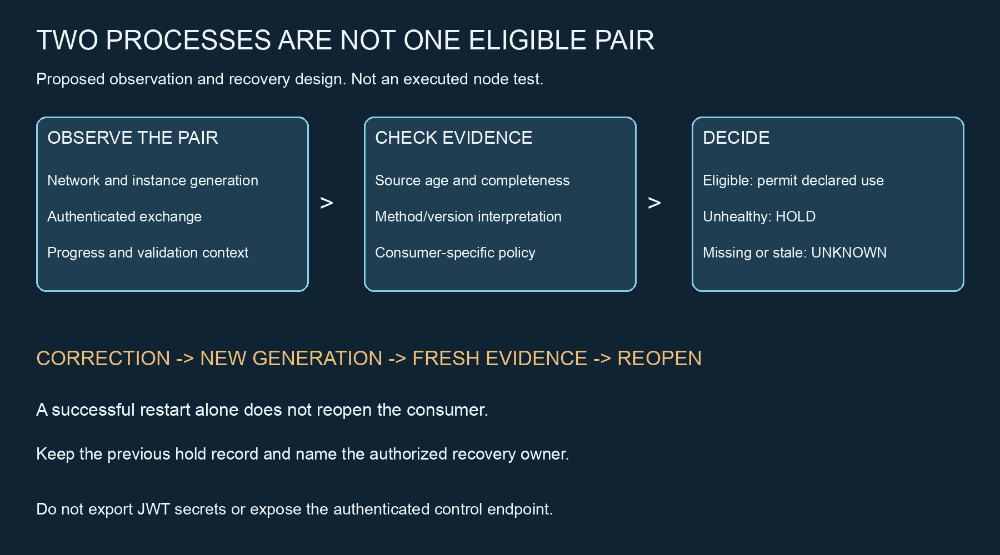
Treat missing telemetry as a separate failure
A collector can scrape successfully while replaying an old value.
Track the source timestamp separately from scrape time. If the source cannot supply one, record that limitation and use a conservative freshness policy appropriate to the signal. Do not manufacture precise observation age from the time the monitoring system happened to receive a cached response.
Collection failure, stale source data and a reported unhealthy condition need separate states. All can make current use ineligible, but they lead to different investigations. A collector outage should not be labeled execution invalid. A reported invalid payload should not disappear into a generic scrape-error bucket.
Test empty vectors and disappearing labels in the real alerting stack. A query that returns no series may not behave like a series containing zero. The dashboard needs an explicit absent-data presentation and the alert rule needs a documented missing-data branch. An apparently empty panel is not an operational instruction.
For teams whose node operation feeds an application, Pharos Production's blockchain engineering service includes node, RPC and indexer infrastructure. Make source age and missing-observation behavior part of that integration's acceptance requirements. The service scope supports this engineering fit; it does not establish that the proposed seam monitor has passed a customer deployment test.
Classify failure before choosing a response
Start with the narrowest supported cause. If P-42 records authentication rejection after a configuration change, investigate configuration alignment before touching the chain database. If the only evidence is a timeout, keep the cause unresolved until the route, peer and resource observations distinguish it.
Use separate operational branches for connection failure, authentication failure, unsupported method/version, synchronization, execution-validation failure, local progress stall and missing telemetry. A single red node badge cannot tell an operator which action is justified. It also prevents later incident reviews from distinguishing protocol work from monitoring-system failures.
Resource pressure is a possible cause, not an interchangeable diagnosis. Disk latency, capacity or memory pressure can accompany slow processing. Correlate them with the pair's observations and retain the time relationship. High resource use alone does not establish why a particular payload-processing exchange failed.
Avoid automated restart loops driven by ambiguous health. A restart can discard useful diagnostic context and begin a new synchronization period. Define the narrow conditions under which a restart is authorized, who owns that decision and what must be captured first. Retry policy for a collector is separate from process-recovery authority.
Route alerts to an operator who can act on the affected boundary. A platform team may own networking while a node operator owns client compatibility. The application owner decides whether a degraded read mode is acceptable. Assigning all three decisions to whichever engineer receives the first notification leaves the actual hold policy undefined.
Give each consumer a budget, not a universal threshold
Specify the observation gap the service can tolerate, the freshness required at use and the response deadline for an unhealthy pair. Those are policy choices tied to the consumer. They are not universal Ethereum constants and should not be copied from a sample dashboard without a documented reason.
For a proposed current-state consumer, describe the acceptance predicate in plain language: the intended pair is observed, required fields are fresh, execution validation is sufficient for policy and the selected progress/reference conditions are satisfied. Keep process liveness as a prerequisite, not the entire predicate.
Decide how warnings become holds. A brief synchronization transition can merit observation rather than paging, while persistent ineligibility affecting an active consumer can require immediate operator attention. Use measured behavior from the actual deployment to set durations later. This article supplies no latency benchmark or recommended universal number of missed slots.
Evaluate service availability at the decision boundary. A healthy denominator consisting only of successful scrapes can hide periods when no eligible pair observation existed. Retain ineligible and unknown periods, document planned maintenance treatment and avoid silently excluding startup whenever it makes the service-level result look better.
An eligibility budget also needs a stopping rule for fallback. If the application switches to another provider, name the selected route and its separate evidence policy. A fallback cannot inherit the failed local pair's validation history. Availability routing and chain-context correctness are different contracts, even when the same engineer implements both.
Build a dashboard that preserves disagreement
The overview should show the consumer decision and its reason first. Beneath it, expose pair identity, authenticated exchange state, progress/freshness and validation context as independently inspectable evidence. A composite green badge is useful only if its inputs and unknown-data behavior are visible.
Keep a time-aligned timeline for changes in deployment, route, pair generation and eligibility. In the fictional P-42 example, the secret-mount revision precedes the authentication failures while both process checks remain successful. That sequence directs investigation. It does not, without configuration evidence, prove that every similar failure is a secret mismatch.
Show disagreements rather than averaging them away. If one source reports useful progress and another reports stale state, retain both observations with their ages and scope. A mean value can produce a plausible-looking number that no component actually observed. Explain which source the policy trusts for each decision and why.
Keep detailed errors in a controlled evidence store with bounded references from the dashboard. Metrics should support counting and alerting, not become a repository for raw payloads or credentials. Redaction must preserve the classified failure and correlation identifier, so security controls do not erase the diagnostic distinction the record was designed to retain.
The final view should answer a handoff question: which consumer was held, on what evidence and who can release it? Process CPU and peer counts can support that answer, but they cannot replace it.
Reopen on new evidence, not on a successful restart
After a correction, start a fresh observation generation. Confirm the intended pair and configuration, observe authenticated interaction and collect the required progress/validation fields. A green process check is a starting point for recovery verification, not its conclusion.
Use the consumer's declared observation window rather than inventing a universal reopen delay. Define what must stay true throughout that window, what resets it and how a new unknown state affects the decision. Preserve the evidence supporting the eventual release and the identity of the person or policy authorized to make it.
Pharos Production's blockchain delivery process includes production-readiness monitoring, runbooks and rollback. A pair-bound hold/reopen record makes that scope inspectable for this dependency. Ask the receiving team to demonstrate which configuration change starts a new generation and which evidence permits the consumer to resume; a screenshot of two green processes is insufficient acceptance evidence.
Recovery can also require downstream repair. Identify reports, caches or exports produced while the pair's eligibility was uncertain. Do not assume that restoring the local node recalls material already consumed elsewhere. Keep any reprocessing decision separate from the operational decision that the pair can serve new work again.
Rehearse the branches in a controlled environment
The following are proposed acceptance exercises, not results of tests executed for this article. Run them against the actual client versions, adapters and alerting rules with authorization and an isolated environment. Keep the input change, observed response and consumer decision together.
- Leave both processes running while breaking the intended inter-client route. Confirm that liveness stays separate from pair eligibility.
- Introduce an authentication-configuration mismatch without exporting the secret. Verify the narrow classification and the absence of a misleading payload-invalid label.
- Supply a synchronization outcome during expected startup. Confirm that the declared startup policy differs from an unexplained persistent consumer hold.
- Make the adapter receive a method/version outcome it cannot interpret. Require an explicit unknown or unsupported branch instead of a favorable default.
- Freeze the source observation while the scraper remains successful. Verify that source age expires eligibility even though collection continues.
- Remove a required metric series completely. Check the real dashboard and alert rule rather than assuming absence behaves like zero.
- Replace one client instance while retaining an old successful exchange record. Confirm that the previous generation cannot authorize the replacement pair.
- Restore the route and restart a process, then withhold required validation evidence. Verify that restart alone does not reopen the consumer.
Record actual outcomes when those exercises run. A written specification cannot prove that the chosen client exposes a field, that the exporter preserves it or that the alert rule detects its absence. Keep unsupported observations visible in the delivery gap list instead of asserting coverage because a panel exists.
Hand over one eligible observation record and one held record, with their pair generations and recovery decisions. The receiving operator should be able to reconstruct why each consumer state was permitted. That is the seam the monitoring system must make visible: the evidence connecting two processes to a useful service, including the moment that connection stops being trustworthy.
More insights to read
- Smart Contract Upgrade Authority: Timelocks, Multisigs, and Emergency Controls
- A Smart Contract Upgrade Needs an Evidence Bundle
- Your Contract Upgraded. Can the Indexer Still Read Its Events?
- Verify an Indexer Can Recover from a Chain Reorganization
- Smart Contract Release Audit: 8 Repository Artifacts
About the author

Written by Dmytro Nasyrov PhD, software architect with 24 years of production experience. Dmytro is the founder and CTO of Pharos Production. He works on production software architecture for FinTech, AI, Web3 and blockchain systems.