Altcoin Payment Provider: How to Choose One (Coin Coverage, Fees, Settlement and Risk)
Most comparisons of an Altcoin Payment Provider start and end with the coin count: one lists 350, another lists 70, a third claims "all major coins," and the biggest number wins the comparison. That's a reasonable first instinct and a poor way to actually decide, because a long list tells you what a provider can receive, not what a payment costs, how you get paid, or what happens when a token misbehaves.
The short answer
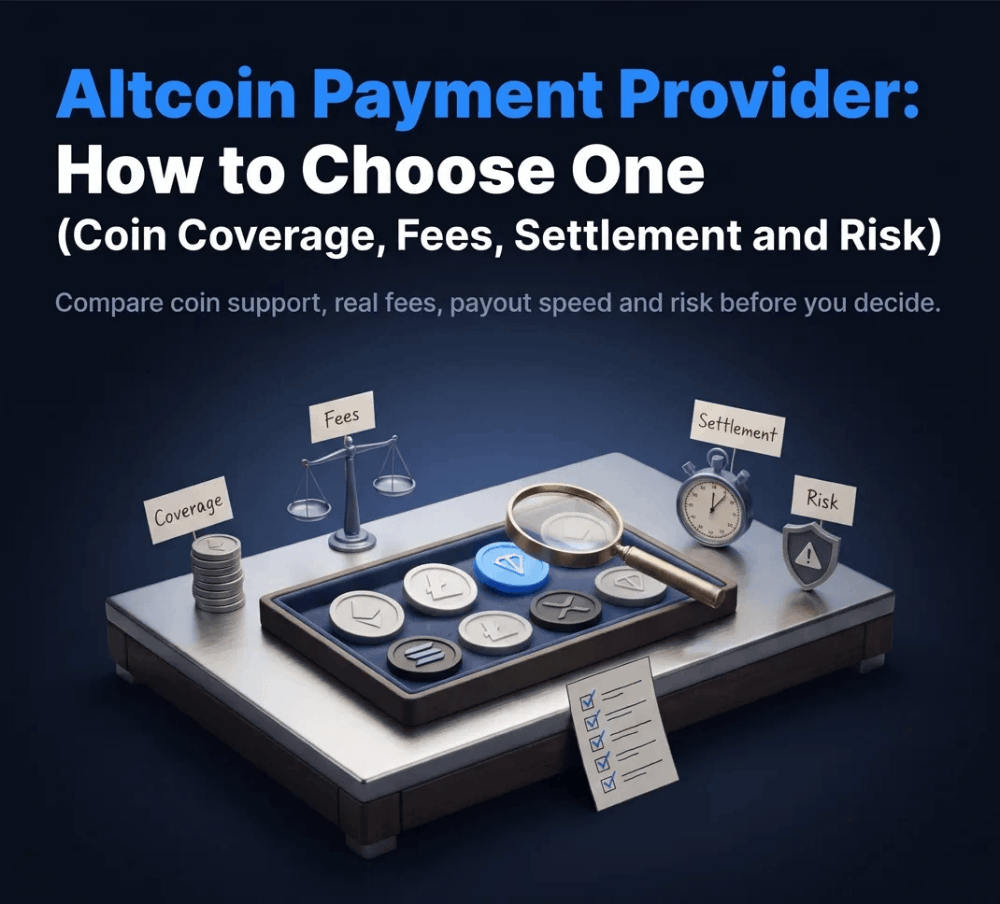
An Altcoin Payment Provider is a gateway that lets a business accept coins beyond Bitcoin and the main stablecoins, handling the invoice, watching the blockchain, and paying you out in crypto, a stablecoin, or fiat depending on the provider. To choose one, compare four things: which coins and networks it genuinely supports, what a payment actually costs in dollars once every layer is added, how and when you get settled, and what risk the setup adds. An Altcoin Payment Provider worth shortlisting should answer all four clearly rather than leading only with its coin count.
Why coin coverage matters less than it first appears
Look at your own customers before looking at any provider's coin list. In most online stores, the bulk of crypto payments arrive in a small handful of stablecoins and major coins, with true altcoins making up a thinner slice of real transaction volume. That said, a thin slice can still represent meaningful money: if even a small percentage of buyers want to pay in a coin you don't support, some portion of them will simply abandon the purchase rather than switch to an alternative. Coverage can genuinely be worth more than a slightly lower fee, but only for coins your actual buyers use, not for a long list you'll never see transactions on.
Why the network matters as much as the coin itself
A provider that "supports" a given coin might mean support across one network or across several, and support for receiving a coin doesn't always mean support for holding or settling in it. For every coin you actually care about, get a clear answer to three questions: which networks can the buyer actually pay on, can you be settled directly in that coin or does it automatically convert, and what happens to your setup when a token rebrands, migrates contracts, or gets delisted. These operational details matter more than the number on a provider's homepage.
Why altcoin fees carry a hidden layer stablecoin payments often skip
The basic cost formula is order value times the platform rate, plus any exchange spread, fixed fee, network fee, and payout fee. Altcoins add a layer plain stablecoin payments often avoid entirely: the exchange step. If a buyer pays in an altcoin and you want it settled as a stablecoin, something has to perform that swap, and the swap carries its own price, whether that shows up as a higher percentage, a spread, or both. Two providers advertising the same low headline rate can end up costing meaningfully different amounts once their actual conversion spreads are factored in, which is exactly the part that rarely appears on a pricing page.
Why settlement choice matters more for altcoins than for stablecoins
This is where altcoin payments genuinely differ from stablecoin ones. A stablecoin invoice is worth roughly the same amount when you receive it as when it was issued. An altcoin invoice is worth whatever that coin happens to be trading at the moment you actually convert or sell it, and a mid-cap coin can move several percent in the time between a customer paying and a business converting, whether that gap is an hour or a week. A price move of just a few percent on a meaningful invoice can easily dwarf the platform fee itself. This is why settlement timing deserves as much scrutiny as the headline rate: ask when conversion happens, which rate gets used, whether that rate can be locked, and who carries the price risk in between.
Why custody and risk questions separate reliable providers from risky ones
Altcoins carry risks that Bitcoin and major stablecoins mostly don't: price swings before conversion, thin liquidity on smaller tokens that can produce poor conversion rates on larger payments, look-alike tokens carrying a real coin's ticker but a fake contract, deposits sent on the wrong network, coins a provider decides to delist with little notice, and ordinary custody risk if the provider holds funds before paying out. A provider that credits payments by ticker name alone can be fooled by a fake token; one that verifies the actual contract address can't. Ask directly which approach a given provider uses.
Why compliance deserves its own line item
Rules around accepting different coins vary by country and by activity, and a provider that screens incoming payments for flagged or risky sources protects your business as much as it protects itself. Regardless of local requirements, keeping a clean record of every payment, including transaction ID, amount, timing, and fiat value on the day received, matters for tax purposes no matter which provider you choose. Local legal and tax advice is worth getting before building a business around less common coins.
Why custodial and non-custodial setups suit different businesses
A custodial provider holds funds briefly before paying out, which is what makes automatic conversion and fiat settlement possible for most altcoin gateways. A non-custodial setup sends payments straight to a wallet you control, cutting counterparty risk but typically supporting fewer coins out of the box and requiring more technical work. If you want broad auto-conversion across many coins, you'll likely end up with a custodial setup, so the real work is checking how that provider holds funds and what withdrawal limits apply, not avoiding custody altogether.
Why a simple scorecard beats comparing homepages
Scoring each candidate forces you to decide what matters before any sales page gets a chance to persuade you. Rate each provider on coin and network coverage, total cost, settlement and conversion clarity, risk and compliance practices, and integration quality, weighting the criteria that matter most for your specific business before you look at any provider's actual numbers. A provider with the longest coin list can still lose on a weighted score once cost, settlement clarity, and risk handling are factored in properly.
A practical checklist before choosing a provider
- Confirm which of your actual coins are supported today, and on which networks.
- Ask whether you can be settled directly in that coin or only receive and auto-convert it.
- Get the exact fee for an altcoin payment, with and without a conversion step, in writing.
- Confirm when conversion happens, at what rate, and whether that rate can be locked.
- Ask how look-alike tokens and wrong-network deposits are handled.
- Run a small real payment, a conversion, and a payout before committing real volume.
Where FaradPay fits
FaradPay lists a 0% platform fee on standard processing, cross-currency exchange, and wallet conversions, with network fees applying separately and fiat conversions priced as competitive rather than free. Rate locks are available on stablecoin payments, and its pages describe cold-storage custody, scoped API keys, and AML screening on incoming payments. Ask it directly which coins, networks, and compliance documentation apply to your specific account before building a checkout around any assumption. Those specific answers are the real test behind Altcoin Payment Provider decisions for any business comparing options today.
FAQ on Altcoin Payment Provider: How to Choose One
What is an altcoin payment provider? A gateway that lets a business accept coins beyond Bitcoin and the main stablecoins. It creates the invoice, watches the blockchain, notifies your store when payment lands, and pays you out in crypto, a stablecoin, or fiat depending on the provider.
How many coins should a crypto payment provider support? Fewer than most comparison lists suggest. Most businesses take the bulk of their crypto payments in a handful of major coins and stablecoins, so look at which coins your own buyers actually ask for rather than chasing the longest published list.
How much does it cost to accept altcoin payments? Headline platform rates vary, but altcoins typically add a conversion spread on top that plain stablecoin payments often avoid. Add network fees, payout charges, and any fixed per-invoice fee to the platform rate to get the real total cost.
Should I settle in the altcoin, a stablecoin, or fiat? Most merchants settle in a stablecoin or fiat, since altcoin prices can move several percent between payment and sale. Whichever you choose, confirm when conversion happens, at what rate, and who bears the price movement in between.
What are the biggest risks of accepting altcoins? Price swings before conversion, thin liquidity on smaller tokens, look-alike tokens carrying a real coin's ticker, wrong-network deposits, provider-driven delistings, and ordinary custody risk. Compliance and AML screening matter too.
Is a bigger coin list always better? No. More coins mean more support questions, more accounting complexity, and more tokens that can be delisted or spoofed. A shorter list covering your actual buyers' coins on reliable networks usually beats a longer one nobody uses.
Final thoughts
The best Altcoin Payment Provider is the one covering the coins your buyers actually use, charging what it genuinely costs once every layer is added, settling you in a form you can live with, and not leaving you exposed to avoidable risk. Score two or three candidates against your own priorities, test each with small real payments, and ask the uncomfortable questions in writing before moving meaningful volume.