The Birth of a Synthetic Human

How Polish Startup Clone Robotics is Challenging Global Giants
The visions known from cult science-fiction productions like The Matrix, Terminator, and Westworld are turning into reality right before our eyes. While the most high-profile humanoid robot projects from companies like Tesla (Optimus), Figure, and 1X rely on traditional, rigid electric motors, the Wrocław-based startup Clone Robotics has taken a completely different, radical path. They have created Protoclone (in its V1 version)—an android powered by artificial muscles, bones, and even a synthetic heart.
This is the story of a technology that could completely disrupt the robotics market and become the "iPhone moment" in an era dominated by rigid, mechanical designs.
The Roots of Innovation: From Tragedy to Hydraulics
The design built by the Wrocław engineers did not stem from a desire to copy existing industrial machines, but from a fascination with the mechanics of the human body. The roots of the technology used by Clone Robotics trace back to the story of Joseph McKibben, a physicist who once worked on the Manhattan Project. When his daughter lost the use of her hands due to paralysis, McKibben devoted himself to creating an artificial muscle that could restore her mobility. He developed a pneumatic muscle—an inner rubber tube surrounded by a braided textile sleeve that expanded radially and contracted linearly when pressurized, mimicking human tendons.
Years later, Łukasz Koźlik (now the CTO of Clone Robotics) experimented with this design in Poland, searching for an alternative to heavy motors. However, classic pneumatic muscles powered by air were too weak and required loud, bulky compressors. The breakthrough came when Janusz Jakubowski (the company's CEO) joined the project. Together, they made the decision to abandon pneumatics in favor of hydraulics. Water, being an incompressible fluid, allowed for the transmission of massive forces while keeping the system's size remarkably compact.
The Architecture of Protoclone V1: Anatomy from a 3D Printer

- A Polymer Skeleton: The structure features 206 bones 3D-printed from lightweight, highly durable plastics.
- Myofiber Muskulature: The frame is enwrapped by over 1,000 artificial muscles (called Myofiber). Crucially, they are attached to the skeleton at the exact anatomical points where human muscles connect to bones.
- The Circulatory System and "Heart": Inside the robot's rib cage sits a miniaturized hydraulic system called Aquajet. At its core is a miniature 500 W electric pump acting as a heart, which pushes water under high pressure directly into the muscles. The circulating fluid serves a dual purpose: it causes the muscles to contract and simultaneously dissipates heat, cooling the system in a way identical to the human bloodstream.
By eliminating electric motors from the joints, Protoclone boasts impressive freedom of movement. The structure offers over 200 degrees of freedom (DoF), whereas the most advanced competitors usually top out between 30 and 60.
The First Step: Perfecting the Human Hand
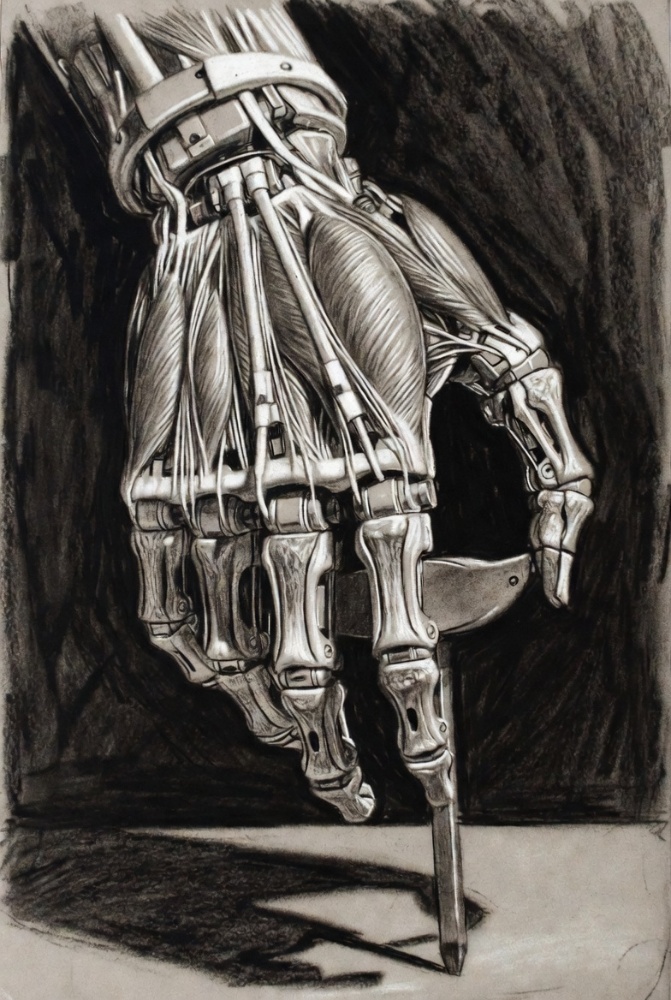
A single Myofiber artificial muscle weighs just one gram but can generate enough pulling force to lift a load 300 times its own weight. Its contraction time is under 50 milliseconds, matching human capabilities. As a result, the robot's hand can lift objects weighing up to 7 kg (15 lbs) and can manipulate standard human tools with extraordinary precision.
The Nervous System and the Local Nvidia Jetson "Brain"
To manage such a dense network of muscles, Protoclone is equipped with an extensive array of sensors that functions like a biological nervous system:
- Vision: 4 depth cameras located in the android’s head.
- Proprioception: Over 500 sensors across the body, including 70 inertial measurement units (IMUs) that monitor position and movement.
- Sense of Touch: 320 pressure sensors integrated into the muscles and outer skin. These sensors allow the robot to perform bimanual manipulation and ensure precise force modulation—preventing the robot from crushing a paper or plastic cup when picking it up.
An onboard microcomputer powered by an Nvidia Jetson processor, tucked inside the skull, handles the thinking and data analysis. This architecture utilizes Edge AI—meaning the foundational model controlling the robot runs locally. The robot does not send queries to cloud servers, ensuring an instantaneous reaction time to external stimuli. Ultimately, the company plans to decentralize the computing architecture by embedding dedicated ASIC chips directly into the limbs, mimicking natural nerve ganglia in the human body.
The Challenges: Walking, the Uncanny Valley, and Virtual Training
Locomotion and Bipedal Walking
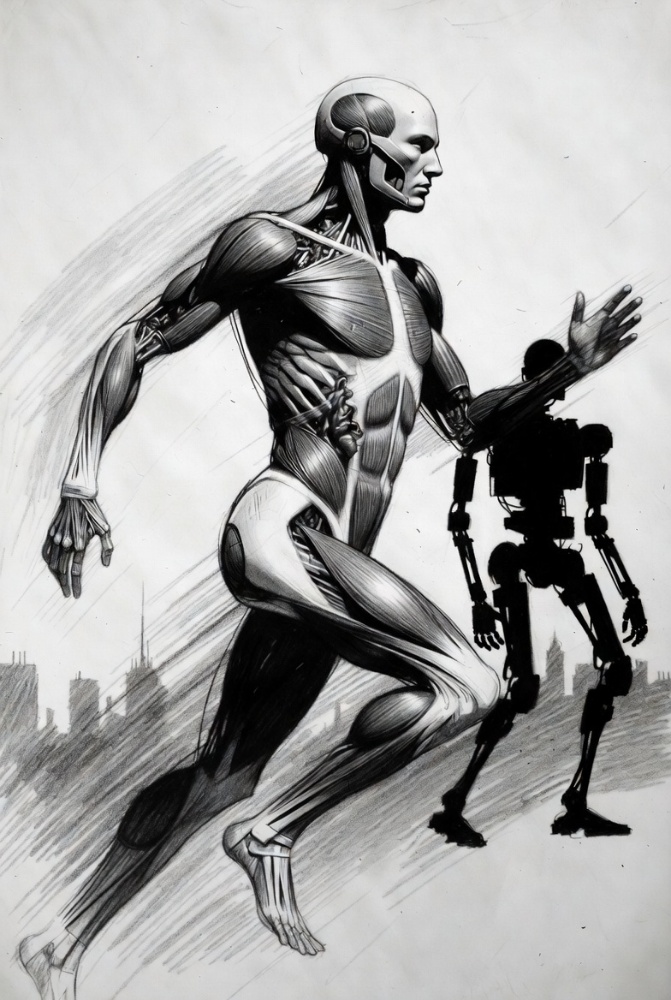
In its current laboratory phase, the robot is still suspended from a safety cable system attached to the ceiling. The engineers' main goal for the next generation (Clone Alpha) is to pack the batteries, valves, and fluid reservoir inside the limited volume of the rib cage to achieve a completely untethered, bipedal walking android. Maintaining balance on two legs without a tail is one of the hardest challenges in robotics.
The Uncanny Valley
The current version of the robot is intentionally left without a face or skin, revealing a fascinating, yet to some, unsettling view of working muscles and translucent tubes. Future consumer versions are slated to be covered in synthetic skin. However, the creators emphasize that replicating a human face requires installing about 40 precise facial micro-muscles. Any error in their synchronization risks falling straight into the uncanny valley—a phenomenon where a humanoid form triggers subconscious fear and discomfort in humans.
Training in Simulators
The artificial intelligence embedded in the robot (Embodied AI) cannot be trained purely on text data like large language models (such as ChatGPT). The robot must physically experience gravity, friction, and resistance. To achieve this, Clone Robotics created a highly advanced physics simulator (a virtual playground). Thousands of digital twins of the Protoclone train there in parallel. The machines constantly test different movement variations and learn from their mistakes; only after mastering a task in the digital environment is the finalized algorithm uploaded to the physical robot.
The Ultimate Goal: A Safe Home Assistant
The ultimate vision of Clone Robotics is to introduce these machines into households as personal companions that can alleviate the burden of hated chores, like doing the laundry or washing the dishes. The robot is designed to learn through simple observation—standing behind a human and copying their actions.
Interestingly, the Wrocław-based designers deliberately decided against building an indestructible machine. Protoclone features intentionally designed strength limitations and relatively fragile joints that mirror our own. Robots with superhuman strength and massive weight could pose a severe safety hazard in a home environment. Sharing the same physical vulnerabilities is meant to make humans feel completely comfortable and safe in their presence.
This Polish project proves that the evolution of artificial intelligence needs a physical body to unlock its full potential in the material world. If the creators deliver on their promises of untethered bipedal walking and localized power management, Protoclone V1 and its successors could usher in a new era of bionic consumer robotics worldwide.
Resources:
https://www.youtube.com/watch?v=ygTIrYDFqZQ
https://techsetter.pl/protoclone-najbardziej-realistyczny-i-jednoczesnie-niepokojacy-android-na-swiecie-jest-polakiem/
https://wroclaw.tvp.pl/85247409/przelom-w-robotyce-wroclawska-firma-prezentuje-humanoidalnego-robota-z-1000-sztucznych-miesni-i-206-kosci
https://www.focus.pl/artykul/polski-robot-protoclone-humanoidalna-maszyna
https://spidersweb.pl/2025/02/protoclone-v1-robot-miesnie.html
https://www.youtube.com/@CloneRobotics/videos
https://www.youtube.com/watch?v=WcZjLQyRoR8
https://www.youtube.com/watch?v=yPyXuLVYN5Q