Why Big Tech is Buying Up Nuclear Power Plants

We have all been sold a beautiful, ethereal lie about the cloud. For years, big tech marketed the digital world as a weightless, frictionless dimension. A clean, white void where your photos, essays, and code repositories float effortlessly in the ether. But if you peer behind that sleek, minimalist user interface, you will find something else entirely. The cloud is not a cloud at all. It is a massive, sprawling concrete jungle of server racks, roaring cooling fans, and high-voltage transmission lines.
Lately, that physical reality is crashing into our energy grids with the force of a tidal wave. While the average person treats artificial intelligence like a magic trick that happens instantly on a screen, the infrastructure supporting it is pushing our planetary limits. The crisis has become so acute that the MIT Technology Review named hyperscale AI data centers one of the definitive breakthrough technologies of the year, highlighting a massive shift from software optimization to a high-stakes, real-world battle over raw energy.
The Insane Math of AI Compute

To understand why the tech world is collectively panicking over power grids, you have to look at how fundamentally different AI is from traditional internet architecture. When you look up a recipe, check a crypto chart, or stream a video, a conventional server fetches a static file and sends it down the wire. It is efficient, predictable, and requires relatively little electrical juice.
AI doesn’t just fetch data, it invents it on the spot through massive, mind-numbing matrix multiplication. A single generative AI query can consume an astonishing amount of power compared to a standard web search, a reality that has turned speed to power into the ultimate competitive metric for tech giants. According to a comprehensive analysis by the Brookings Institution, global data center energy consumption could cross 1,065 TWh by 2030, effectively making these facilities the fifth-largest energy consumer on Earth if they were a unified country. At the server level, advanced graphics processing units are packed into high-density racks that pull immense amounts of kilowatts each, meaning that if you try to power an entire campus of these machines using standard infrastructure, you don’t just trip a circuit breaker, you threaten to destabilize regional power supplies.
Tech Giants Turn to Fission
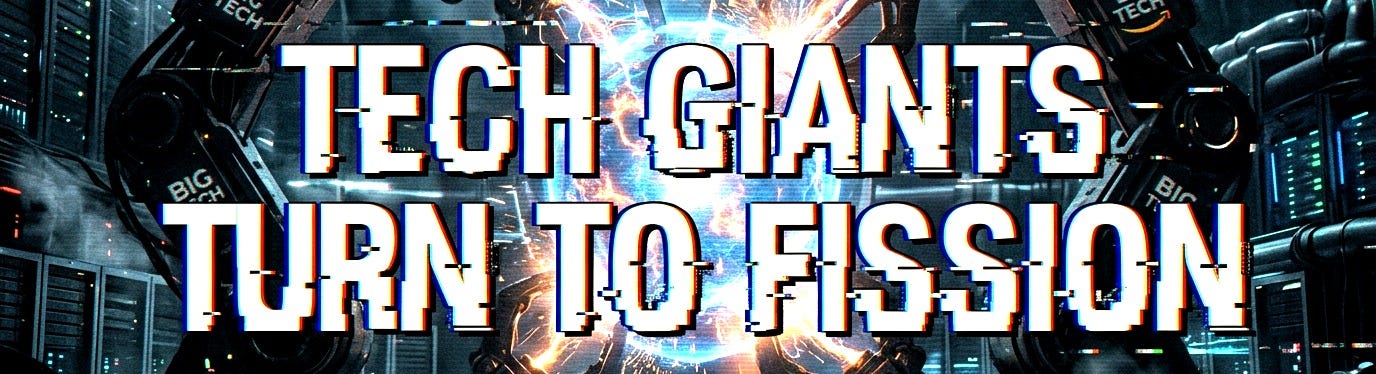
So, what do you do when your software needs more power than entire mid-sized cities? If you are a trillion-dollar technology firm, you skip the local utility company altogether and go look for your own private nuclear reactors. We are witnessing an unprecedented corporate land grab for atomic energy because big tech absolutely needs firm power, which is just industry speak for baseload electricity that runs twenty-four hours a day, seven days a week, regardless of whether the sun is shining or the wind is blowing. Because solar and wind are variable, tech companies are writing massive checks to secure dedicated nuclear infrastructure, which is how we ended up in a timeline where Microsoft signed a deal to help revive a portion of Pennsylvania’s infamous Three Mile Island facility to secure over eight hundred megawatts of carbon-free energy.
Not to be outdone, Amazon Web Services secured a long-term agreement with Talen Energy for up to 1,920 megawatts of power through 2042 to purchase power straight from the Susquehanna nuclear plant in Pennsylvania. Meta is taking an even more futuristic approach by partnering with companies to build power campuses utilizing small modular reactors, which are compact, scalable reactors designed to be deployed directly alongside server clusters to slash the transmission losses that occur when moving electricity across hundreds of miles of public lines. It turns out the ultimate flex in the tech world isn’t owning the best algorithm anymore, it is owning a literal nuclear reactor.
Grids, Communities, and Hidden Costs

This sudden, massive demand for electricity isn’t happening in a vacuum, and hyperscale AI data centers are plugging directly into grids that were originally designed for steady, predictable domestic and industrial growth. The result is a growing tension between the digital economy and everyday utility consumers who are just trying to keep their lights on. In major data center hubs, the sheer volume of new cloud infrastructure is forcing utility companies to completely overhaul their long-term infrastructure plans, and research shows that these rapid utility expansions are translating into direct rate hikes for residents. Regular households are seeing their monthly electricity bills tick upward to subsidize the high-voltage lines and substations required to keep nearby AI clusters humming.
Then there is the water problem, because these server farms generate an incredible amount of heat, and many rely on massive evaporative cooling systems to keep the hardware from melting down. The Environmental and Energy Study Institute notes that individual hyperscale data centers can consume up to 1.8 billion gallons of water per year, with total U.S. data center water demand projected to grow dramatically as AI scales. This is enough liquid to supply hundreds of thousands of residential homes and is turning data center site selection into a highly localized environmental battleground over precious natural resources.
Beyond the Screen

The next time you ask an AI model to generate an image, debug a line of code, or write a blog post, remember that the transaction isn’t entirely digital. Somewhere out there, a massive array of silicon is pulling juice from a dedicated power plant, dumping heat into a water system, and altering the structural planning of an electrical grid. We are quickly moving past the point where software development can be treated as a pure exercise in logic and code, because the future of artificial intelligence will be won by whoever manages to secure the physical power needed to run the servers. The digital frontier has collided head-on with the limits of physical reality, and the grid is fighting back, leaving us to wonder just how much physical infrastructure we are willing to build to support our digital world.
Thanks for reading everyone! Visit my site to learn more about me and explore what I’m building at Learn With Hatty. I hope everyone has a great day and as I always say, stay curious and keep learning.
Original article on PublishOX