How Movement is rebuilding blockchain security in $FIVELAYERS


When Meta abandoned its grand ambitions to establish a global digital currency, it left behind an expensive graveyard of slides, academic papers, and regulatory settlements. But deep within that corporate wreckage lay one highly resilient piece of computer engineering: the Move programming language. It was a system designed from the ground up to treat digital assets not as simple numbers in a centralized database, but as physical-like resources governed by strict conservation laws.
Today, that language has escaped the corporate laboratory. Movement Labs is spearheading an effort to take this safety-first runtime and wrap it around Ethereum’s deep pools of capital and liquidity. The result is a highly modular network designed to prevent the catastrophic smart-contract exploits that have defined the decentralized finance era. By analyzing the five distinct layers that govern how transactions transition from user input to finality, it is possible to map out where the performance gains lie, and where modularity introduces hidden cracks.
The Split-Brain Pipeline: A Five-Layer Structural Layout
The Movement blockchain rejects the monolithic design of legacy networks, where every node must ingest, sequence, execute, verify, and store every transaction in a single lockstep loop. Instead, the network operates a highly segregated pipeline, dividing operations across five distinct architectural layers. This division of labor allows the network to maximize throughput and ensure cryptographic safety at each stage of the transaction lifecycle.
Layer One: The API and Ingestion Gateway
The journey of a transaction begins at the API layer, which manages the boundary between external clients and the internal state machine. The gateway supports a REST API for basic, stateless operations, allowing developers to query raw Move resources directly and broadcast signed payloads into the mempool. To handle more complex, multi-resource queries, the platform exposes a GraphQL interface. This interface enables type-safe schema queries that prevent the need for sequential database lookups.
Significantly, the native nodes do not support real-time WebSocket connections for event or block streaming, a design choice intended to protect the core validator nodes from resource exhaustion under high load. Instead, real-time data streaming is offloaded to a dedicated indexing pipeline. This service consumes a gRPC transaction stream directly from the node. A cache worker pushes the raw stream into a Redis database, which is subsequently written to an immutable file store and exposed via an external GraphQL Indexer API. By segregating data querying from state execution, the system maintains a low-overhead entry point for raw transactions.
Layer Two: The Decentralized Shared Sequencer
Once ingested, transactions land in the mempool, where the Sequencing Layer establishes the order of execution. In standard Layer 2 rollups, transaction ordering is controlled by a single, centralized operator—a setup that presents a massive point of failure and invites frontrunning exploits. Movement replaces this model with a Decentralized Shared Sequencer (DSS). Built on a proof-of-stake consensus mechanism, the DSS utilizes a network of validators to order transactions concurrently across multiple execution environments.
The DSS supports multi-asset staking, giving validators the flexibility to secure the sequencing layer with diverse collateral options. An authorized leader node pulls transactions from the mempool, orders them to mitigate maximal extractable value (MEV) attacks, and packages them into "protoBlocks". These protoBlocks are then committed to a data availability (DA) layer, such as Celestia, making the sequenced data publicly accessible before execution begins.
Layer Three: The Hybrid Execution Engine and Block-STM
The core computational engine of the network resides in the Execution Layer, powered by the Move Executor. This engine is fundamentally hybrid; it is capable of identifying whether an incoming transaction from the sequenced protoBlocks is written in native Move bytecode or Solidity. If the transaction targets an Ethereum Virtual Machine (EVM) contract, the Move Executor translates and routes the execution accordingly, allowing developers to run legacy solidity code with high efficiency.
Rather than executing these transactions sequentially, the layer employs Block-STM (Software Transactional Memory). Block-STM executes transactions in parallel under an optimistic assumption that there are no state conflicts. During execution, the system dynamically monitors memory read-write footprints. If a conflict is detected—such as two transactions attempting to edit the same account balance simultaneously—the conflicting transaction is aborted, its dependencies are re-evaluated, and it is speculatively re-executed. Block-STM guarantees that the final state changes are committed in a strictly deterministic order, delivering massive execution speeds without compromising state consistency.
Layer Four: Direct Resource Mapping and Cryptographic State Commit
After execution, the resulting state changes are processed by the Storage Layer. Traditional EVM storage models write state changes to arbitrary, flat storage slots, a design that makes structural safety difficult to verify programmatically. Movement's Account Store utilizes direct, address-based mapping to hold native Move resources. Because Move is resource-oriented, assets cannot be implicitly created or destroyed; they must exist within the defined resource type of an account. The Account Store optimizes read-write paths for these structured types while employing data compression to minimize storage costs.
Simultaneously, the storage engine writes state updates to cryptographic Merkle Trees. This generates a state root commitment that acts as a secure cryptographic proof of the entire global state transition. To allow fast verification by light nodes, the Merkle tree architecture supports rapid, incremental updates with low computational overhead. An isolated Transaction History database maintains a ledger of all historical operations, enabling full audibility while supporting optional pruning to prevent local node storage bloat.
Layer Five: Fast Finality Settlement and L1 Postconfirmations
The final layer of the architecture solves the chronic latency bottleneck associated with Layer 2 finality. In standard rollups, users are trapped in a multi-day dispute window before transactions are fully settled on the L1. Movement’s Fast Finality Settlement (FFS) system implements a split finality mechanism.
Nodes group executed protoBlocks into finalized blocks, which are then aggregated into a consolidated state digest known as a "superBlock". The FFS writes this state digest directly to an Ethereum L1 contract as a "Postconfirmation". This state commit is backed by economically collateralized validators who verify the transition. Because the postconfirmation is cryptographically validated and economically bonded, the network achieves native, near-instant finality. Once the postconfirmation is written to the L1, other nodes pull the settlement details to update their local state, ensuring global synchronization.
Technical Configuration of EVM and Economic Utilities
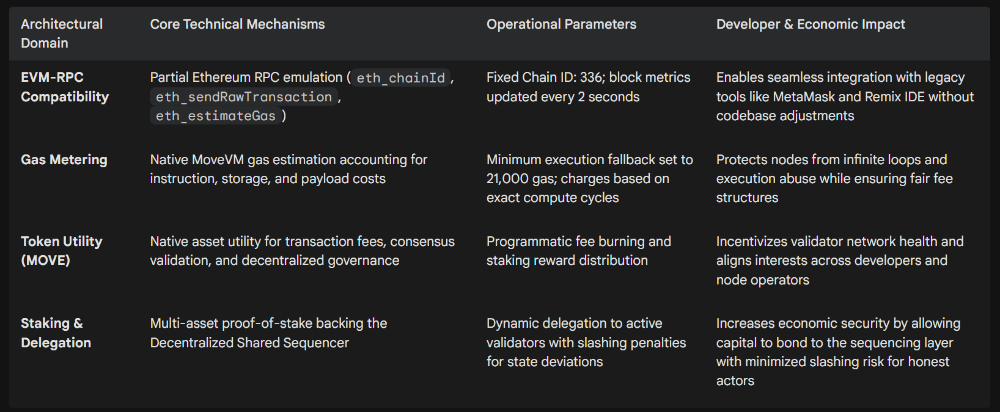
To ground these architectural layers in concrete technical parameters, one must look at how the network interfaces with both the Ethereum developer ecosystem and its own native financial incentives. The following table maps the operational parameters of Movement’s EVM compatibility layer against its native token economics:
Speculative Use Cases and Performant Niches
The decoupling of execution, storage, and settlement within Movement's five-layer architecture does not merely offer theoretical speed increases; it enables applications that are functionally impossible on legacy, monolithic networks.
Parallelized, Reentrancy-Safe Decentralized Exchanges
The history of DeFi is written in exploit reports. In Solidity, reentrancy attacks—where an external contract hijacks the execution flow to drain funds before state variables can update—have cost billions in lost TVL. MovementSwap, an AMM designed on this architecture, represents a paradigm shift. Because the Move language compiles assets as protected resource types that cannot be copied or discarded, reentrancy is structurally impossible at the VM level.
Furthermore, parallel transaction processing via Block-STM allows different liquidity pools to execute trades concurrently. If a high-volume trading pair experiences a massive spike in activity, it does not congest the rest of the exchange's pools, ensuring that dynamic arbitrage and flash swaps execute with sub-second settlement times even during periods of extreme market volatility.
High-Fidelity Virtual Worlds and Gaming Asset Lifecycles
On-chain gaming has historically struggled with latency and asset state tracking. In standard EVM environments, updating the state of a game asset (such as upgrading a weapon's attributes or transferring an item between player characters) requires sequential execution, driving up gas fees and bottlenecking gameplay.
Within Movement's architecture, gaming assets are declared as native, address-bound resources. Because the Account Store maps resources directly to the player's address, the transaction pipeline can process parallel item upgrades across thousands of players simultaneously. Dynamic attributes can be modified and settled immediately through the FFS without causing network-wide lag. This allows developers to build games with complex, high-frequency economies where the minting, upgrading, and trading of game assets occur at the pace of traditional multiplayer games, backed by the underlying security of an Ethereum L1 settlement.
High-Frequency Telemetry and DePIN Data Ingestion
Decentralized Physical Infrastructure Networks (DePIN) rely on a constant influx of real-time telemetry data from physical nodes, such as IoT sensors, GPS trackers, and decentralized storage systems. Processing thousands of telemetry reports per second on a monolithic chain causes rapid state bloat and prohibitive fee spikes.
Movement’s architecture is uniquely suited to absorb this strain. Telemetry streams can be ingested via the high-throughput gRPC stream, ordered by the Decentralized Shared Sequencer, and executed in parallel using Block-STM. Because the Storage Layer supports native state data compression, the footprint of high-frequency IoT data is minimized. The Merkle Tree state commitments enable lightweight verification, allowing edge devices to submit cryptographically secure proof of activity without requiring full historical ledgers.
The Modular Paradox: Security Cracks at the Layer Boundaries
While modularity is praised as a cure for scalability, it introduces a dangerous level of complexity at the boundaries where different layers meet. Splitting transaction processing across five independent layers creates hidden vulnerabilities, as demonstrated by a critical vulnerability discovered in Movement's Data Availability (DA) integration.
The network relies on Celestia to store and verify transaction data blobs. To optimize communication, these blobs are compressed before submission. However, the core execution engine’s ingestion function (into_da_blob) lacked any restriction on the decompressed size of the payload. This created an opening for a "Zstd bomb" exploit. An attacker could construct a small, highly compressed payload that complied with Celestia’s 2MB compressed size limit. When a Movement node fetched this blob, the decompression process would attempt to expand the payload into a massive, 100-gigabyte memory buffer.
Because decompression occurred before signature verification, any node on the network attempting to sync the chain would experience immediate memory exhaustion and crash, resulting in a total network shutdown.
This vulnerability exposes the structural trade-off of the modular design. In a monolithic chain, state transitions are tightly bound and verified at every step. In a modular ecosystem, the execution layer must trust the data provided by the sequencing and data availability layers. If the translation protocols between these layers are not perfectly insulated, the entire network remains vulnerable to catastrophic denial-of-service exploits, regardless of how secure the underlying virtual machine claims to be.
Technical Evolution and the Road Ahead
Looking forward, the roadmap for the Movement network involves transitioning from sidechain operations to a fully decentralized native Layer 1 architecture. This evolution requires refining the coordination protocols between the Decentralized Shared Sequencer and Fast Finality Settlement systems to eliminate execution latency. The ultimate promise of the network lies in proving that a programming language designed in a corporate boardroom for a stablecoin can serve as the hyper-secure, high-performance execution engine for the entire decentralized web. If the network can resolve the engineering frictions that arise at the borders of its modular layers, the five-layer design may set a new standard for safe, parallelized computational throughput in Web3.
Learn more
- What Is Movement Network? Move-Based Blockchain Explained | Gate Learn, accessed May 17, 2026, https://www.gate.com/learn/articles/movement-network-explained-the-move-based-blockchain-reimagining-web3/10272
- What is M1 | Movement Docs, accessed May 17, 2026, https://docs.movementnetwork.xyz/general/l1/what-is-movement-l1
- Movement Network: Technical Overview and Ecosystem Growth - DWF Labs, accessed May 17, 2026, https://www.dwf-labs.com/research/540-movement-network-overview
- RedStone Blockchain Oracle Integrating with Movement's Layer 2, accessed May 17, 2026, https://blog.redstone.finance/2025/02/15/redstone-blockchain-oracle-integrating-with-movements-layer-2/
- Attackathon | Movement Labs Bug Bounties - Immunefi, accessed May 17, 2026, https://immunefi.com/audit-competition/movement-labs-attackathon/resources/
- movementlabsxyz/M1: An L1 for Move VM - GitHub, accessed May 17, 2026, https://github.com/movementlabsxyz/M1
- M1 Architecture | Movement Docs, accessed May 17, 2026, https://docs.movementnetwork.xyz/general/l1/architecture
- What is Movement Sidechain, accessed May 17, 2026, https://docs.movementnetwork.xyz/general/sidechain/what-is-movement-sidechain
- 42233 [BC-Critical] critical dos vulnerability in movement network s da layer due to zstd bomb blob exploit | Immunefi Audit Competitions, accessed May 17, 2026, https://reports.immunefi.com/movement-labs-attackathon/42233-bc-critical-critical-dos-vulnerability-in-movement-network-s-da-layer-due-to-zstd-bomb-blob-ex
- Indexer | Movement Docs, accessed May 17, 2026, https://docs.movementnetwork.xyz/devs/indexing?utm_source=immunefi
- movementlabsxyz/movement: The Movement Network is a Move-based L2 on Ethereum. - GitHub, accessed May 17, 2026, https://github.com/movementlabsxyz/movement
- movementlabsxyz/evm-rpc - GitHub, accessed May 17, 2026, https://github.com/movementlabsxyz/evm-rpc
- movementlabsxyz/movementswap-core - GitHub, accessed May 17, 2026, https://github.com/movementlabsxyz/movementswap-core
- Full article: QBUILD: Quantum-Resistant Blockchain Architecture for Secure and Transparent Construction Supply Chains in the Post-Quantum Era - Taylor & Francis, accessed May 17, 2026, https://www.tandfonline.com/doi/full/10.1080/08839514.2026.2630461
- Decentralized Physical Infrastructure Network (DePIN): Challenges and Opportunities, accessed May 17, 2026, https://arxiv.org/html/2406.02239v1
- #43330 [BC-Critical] Freezing new transaction processing by sending invalid requests to movement DA light node | Immunefi Audit Competitions, accessed May 17, 2026, https://reports.immunefi.com/movement-labs-attackathon/43330-bc-critical-freezing-new-transaction-processing-by-sending-invalid-requests-to-movement-da-lig
- Overview | Movement Docs, accessed May 17, 2026, https://docs.movementnetwork.xyz/general/networks

$FIVELAYERS
$FIVELAYERS is the token celebrating all architectural elegance and audaciousness of Movement's 5 layers.
Head on over to our Wurk.Fun community to find ways to engage and be rewarded https://wurk.fun/community/98e160ba-00dd-4028-829a-446521cee9e8