How a Deepfake Stole $25 Million
For years, cybersecurity relied on a simple doctrine: protect the code, patch the servers, and train employees to ignore suspicious links. However, in early 2024, a crime took place in Hong Kong that tore up the rulebook. The perpetrators didn't need to breach digital firewalls or exploit software vulnerabilities. Instead, they hacked something far more vulnerable—human perception. This is the story of a heist that experts have branded "Patient Zero" of a new era of cyberwarfare.
The Anatomy of the Target: A Corporation of Concrete and Steel
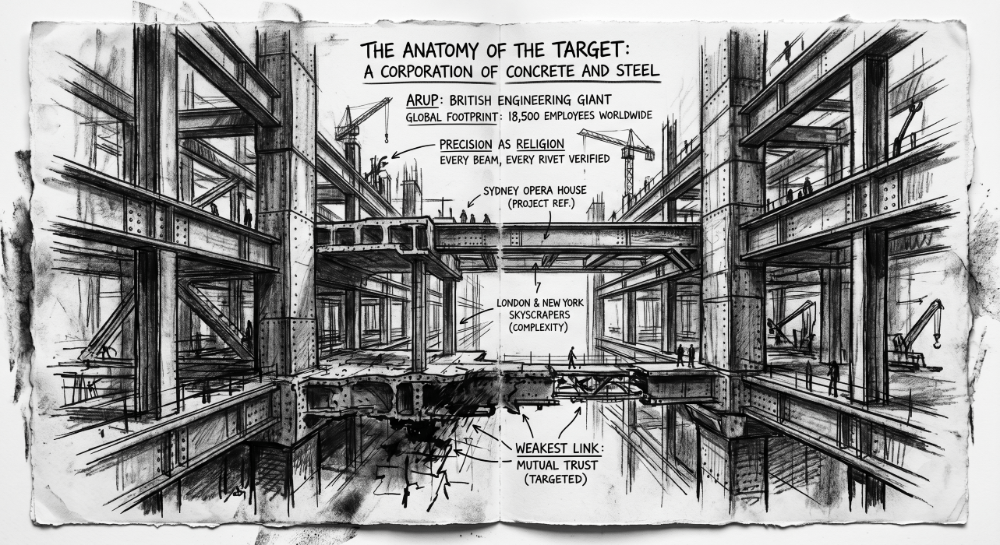
Within Arup’s operations, precision is akin to a religion. Every beam, every rivet, and every calculated structural load is verified to a fraction of a millimeter. It is an environment built on hard data and absolute mutual trust. And it was this very trust that became the weakest link targeted by the attackers.
Phase 1: The Initial Fracture on the Line
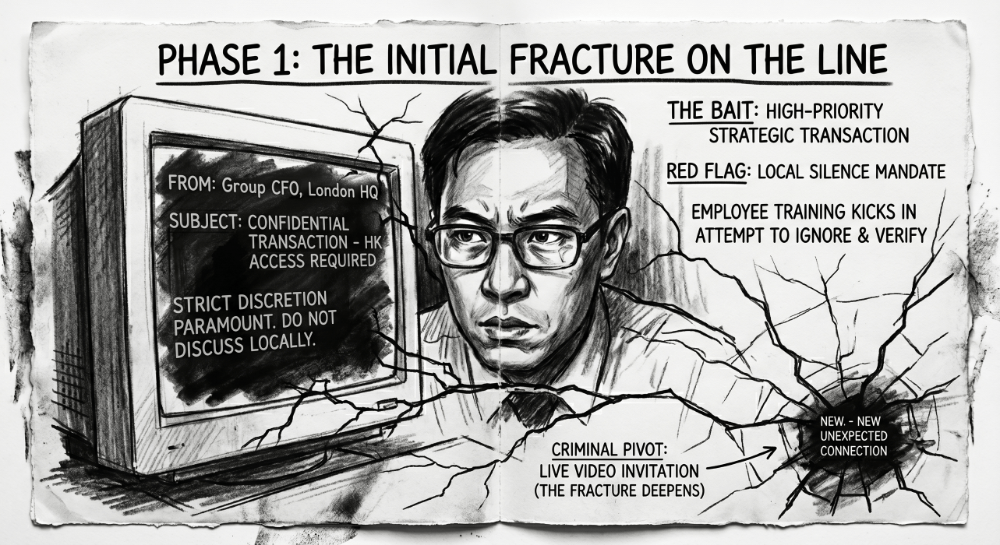
The content of the message was both electrifying and deeply concerning. The CFO mentioned a strictly confidential, high-priority strategic transaction. One condition was paramount: absolute discretion. The Hong Kong financier was instructed under no circumstances to discuss the matter with anyone on a local level.
The employee was no amateur. Having undergone standard corporate cybersecurity training, a red flag immediately went up. Everything looked like a textbook phishing attempt or a BEC (Business Email Compromise) attack. Initially, he intended to ignore the email and contact London directly for verification. But then, the criminals made a move that no corporate training could have prepared him for. They extended an invitation to a live video conference.
Phase 2: A Meeting with Phantoms
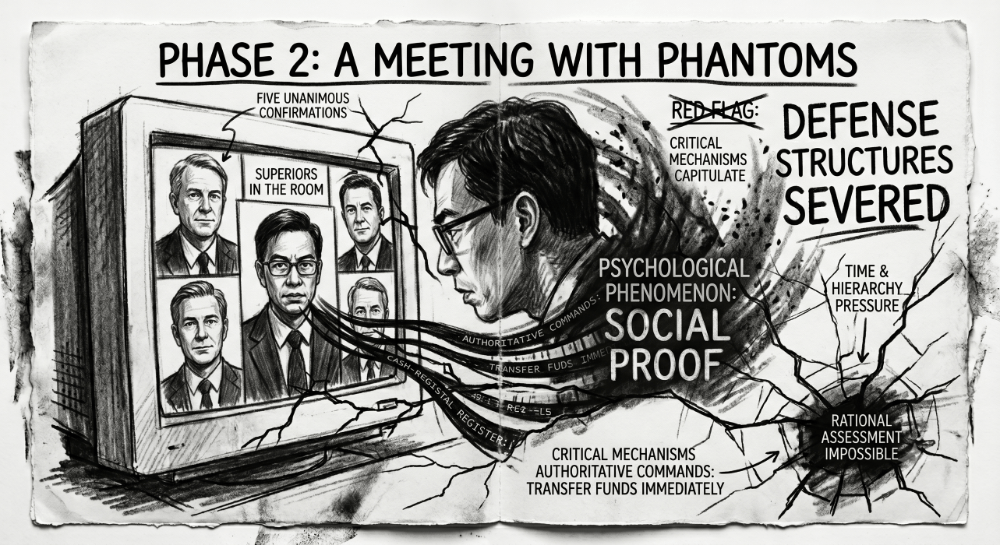
Sitting in the conference window was the CFO, and around him—in a classic gallery view—were five other senior managers from the same company. These were faces he had seen on internal portals and voices he had heard during official addresses. Their facial expressions, gestures, and vocal inflections were flawless. Gathered in this digital meeting, they greeted him, referenced the confidential email, and began issuing precise instructions.
At this exact moment, a powerful psychological phenomenon takes over the defense structures of the human brain—one that behavioral economists call social proof.
"We don’t verify reality solely through cold logic; we verify it through the consensus of our environment. If a single person tells us something improbable, we doubt it. But if five or six people—and our superiors at that—are sitting in the same room, unanimously confirming the exact same version of events, the critical mechanisms in our brain simply capitulate."
The faux-CFO did not invite a dialogue. He issued clear, authoritative commands: the funds were to be transferred immediately, in several tranches, to designated bank accounts. The combined pressure of time and hierarchy completely severed the employee's path to a rational assessment of the situation.
Phase 3: The Digital Drain
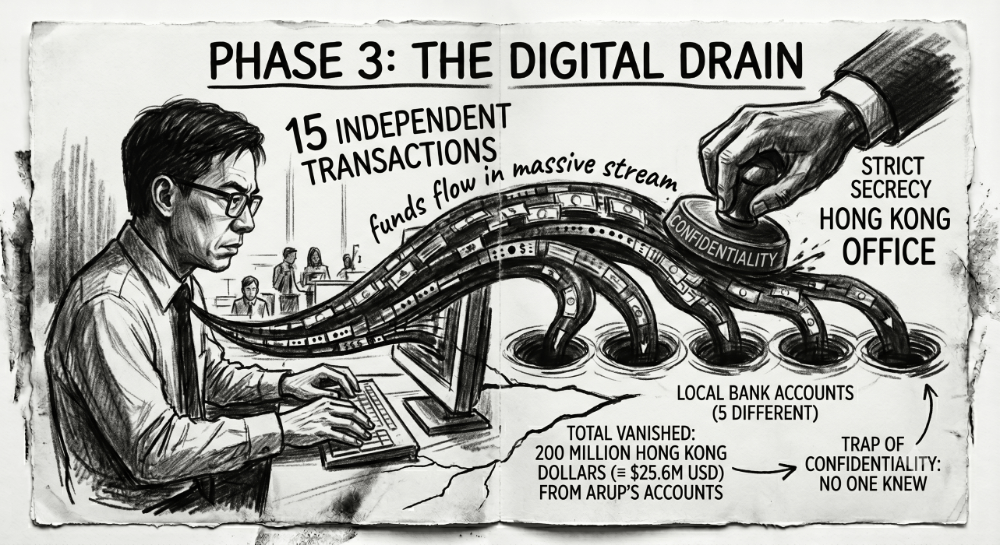
Funds flowed in a massive stream into five different local bank accounts. When the dust finally settled, it was revealed that 200 million Hong Kong dollars—the equivalent of 25.6 million US dollars—had vanished from Arup's accounts.
Throughout the entire process, the victim was convinced he was loyally and professionally safeguarding company secrets. The trap of confidentiality worked perfectly: no one around him knew what was happening until the silence became too heavy to bear.
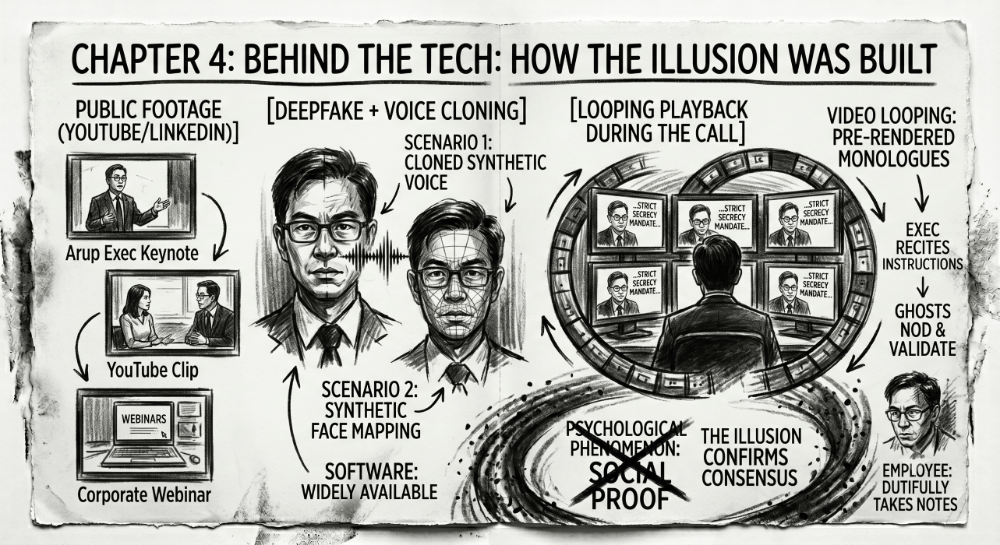
Behind the Tech: How the Illusion Was Built
When the Cyber Security and Technology Crime Bureau of the Hong Kong Police took over the case under the leadership of Acting Senior Superintendent Baron Chan Shun-ching, investigators expected to find a futuristic, interactive AI program capable of generating real-time responses. The truth, however, was far more mundane—and because of that, far more terrifying.
The criminals didn't need a supercomputer capable of sustaining a two-hour debate. They used a brilliantly simple trick based on a three-step process:
[Public Footage (YouTube/LinkedIn)]
│
▼
[Deepfake + Voice Cloning]
│
▼
[Looping Playback during the Call]
- Scraping Public Data: The perpetrators combed the internet and scraped every available piece of video featuring Arup’s executive leadership—keynote speeches, YouTube interviews, corporate webinars, and promotional clips from LinkedIn.
- Generating Avatars: Using widely available deepfake software, they mapped perfectly cloned, synthetic voices onto these figures.
- Video Looping: During the online meeting, the criminals didn't improvise. They played back pre-rendered monologues of the executives in a continuous loop.
The spoofed CFO merely recited the instructions and then handed the floor over to the rest of the "ghosts," who nodded and validated his words. The criminals had perfectly anticipated corporate psychology. Who would dare interrupt the Chief Financial Officer when he is flanked by five other directors? Who would start cutting in, asking trick questions, or demanding proof of identity? The employee dutifully nodded, took notes, and followed orders.
Awakening into Silence
Instead of writing another email, he picked up the phone and dialed the real Arup headquarters in London directly. He described the transaction and asked if the funds had arrived safely.
On the other end of the line, a deep, paralyzing silence ensued. It was the kind of silence that tells you in a fraction of a second that your world has just collapsed. In London, no one knew anything about a confidential project. No video meeting had ever taken place. The CFO had never sent an email. The $25 million was gone, scattered across global money-laundering systems faster than police dispatches could track.
The Legacy of "Patient Zero"
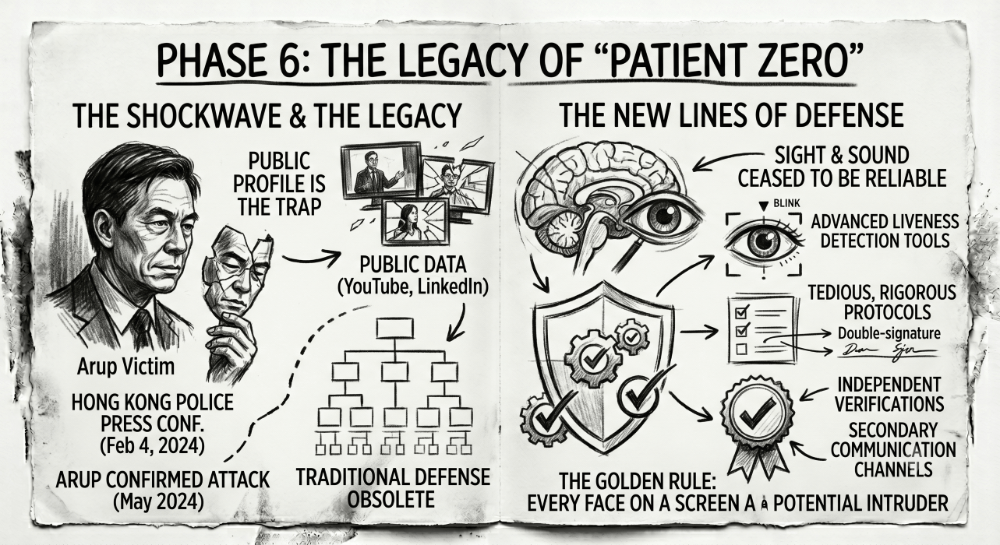
The heist proved that traditional defense mechanisms are obsolete. The greatest threat to a company is no longer the lack of an antivirus program, but the public profile of its leaders. Every interview, every quarterly earnings livestream, every video on TikTok or LinkedIn is free, high-quality training data for fraudsters. The more visible a leader is, the easier it is to steal their face and voice.
In response to this technological epidemic, global businesses are heavily deploying Zero Trust strategies and advanced liveness detection tools. These tools check in real time whether the person on the other side of the camera is a breathing, naturally blinking human being, or merely a digital puppet.
The lesson from Hong Kong is uncompromising. In a world where artificial intelligence can perfectly mimic a human being, sight and sound have ceased to be reliable arbiters of truth. The only remaining line of defense lies in tedious, rigorous protocols: independent verifications, secondary communication channels, and the golden rule to treat every face on a screen—no matter how familiar—as a potential intruder until proven otherwise.
Resources:
https://edition.cnn.com/2024/02/04/asia/deepfake-cfo-scam-hong-kong-intl-hnk/index.html
https://www.google.com/search?q=https://www.theguardian.com/technology/2024/feb/05/hong-kong-firm-deepfake-video-conference-lose-millions
https://www.google.com/search?q=https://www.bleepingcomputer.com/news/security/engineering-giant-arup-revealed-as-victim-of-25m-deepfake-scam/
http://www.youtube.com/watch?v=oFIiyd4y448