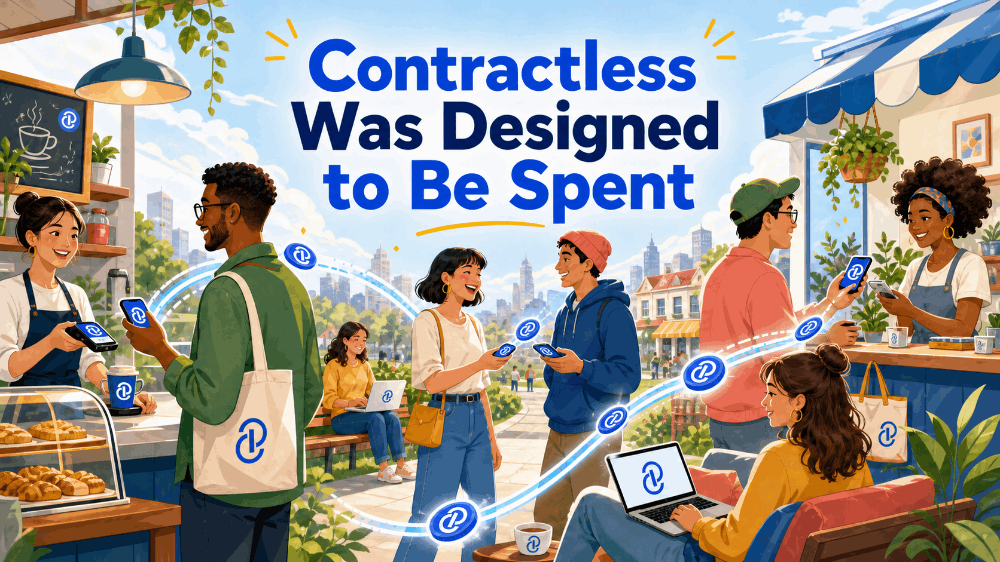
Why moove.xyz could become the stripe of web3

Cross-chain payments, wallet handles, and simple crypto payment links.
Crypto has made massive progress over the last decade.
We have faster blockchains.
Cheaper transactions.
Stablecoins that move billions of dollars daily.
But there’s still one problem that keeps Web3 from reaching mainstream adoption:
Payments are still too complicated.
Sending crypto today often requires users to understand wallets, networks, bridges, gas fees, and token standards. For people already inside the ecosystem, this feels normal.
For everyone else, it feels overwhelming.
This is where platforms like @moove.xyz come in.
Moove is trying to simplify crypto payments in a way that feels familiar to everyday internet users. This is something Web3 desperately needs:
The Stripe of Web3 payments.
But to understand why that matters, we first need to understand the problem Moove is solving.
The real problem with web3 payments
Most people assume crypto adoption is slow because of volatility or regulation.
In reality, the biggest barrier is user experience.
Think about what happens when someone wants to send crypto today.
They usually have to ask several questions first:
”Which blockchain is the receiver using?”
”Which token should be sent?”
”Do both parties use the same wallet?”
”Is there enough gas for the transaction?”
”What happens if the wrong network is used?”
Even something as simple as a wallet address can be intimidating.
Instead of sending money to a readable name, you send it to something like:
0x742d35Cc6634C0532925a3b8D4C9F3b4d8e7A921
One mistake in that string and the funds could be lost permanently.
For experienced users this is manageable.
For everyone else, it’s a major obstacle.
If crypto payments are going to compete with traditional payment systems, the process has to become dramatically simpler.
Fragmentation (too many chains)
Another issue is fragmentation.
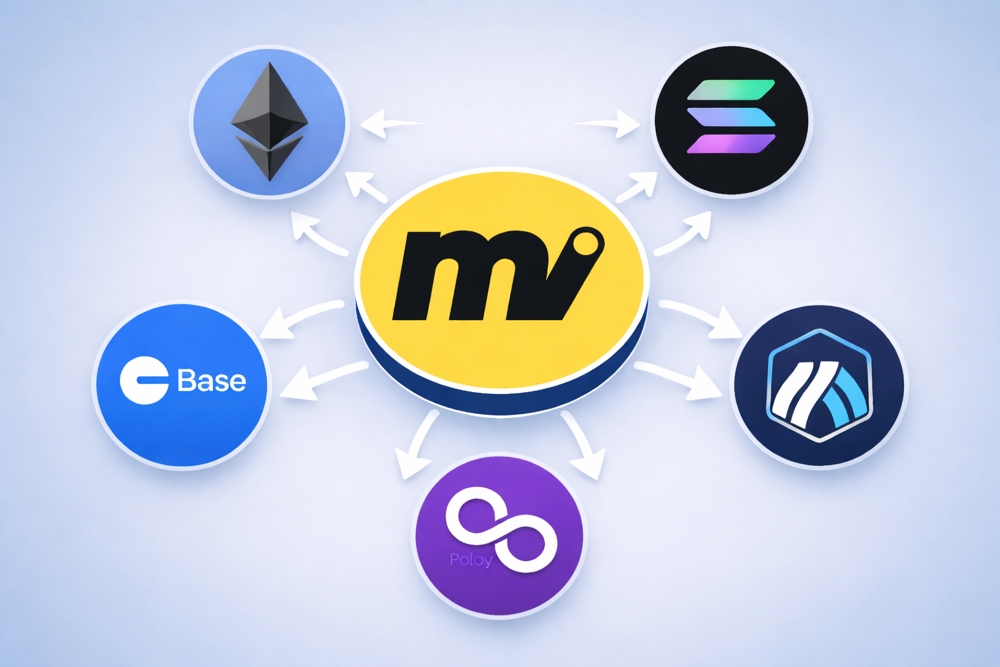
Today’s Web3 ecosystem is spread across many blockchains:
Ethereum
Solana
Base
Arbitrum
Polygon
and many more.
Each chain has its own:
✢ Tokens
✢ Wallet standards
✢ Gas fees
✢ Infrastructure
This creates friction.
If someone holds USDC on Ethereum but the receiver uses Solana, the sender may need to bridge assets or perform a swap before completing the payment.
To a normal user, this feels like unnecessary complexity.
What’s needed is a system that removes these technical decisions from the user experience.
This is where Moove enters the picture.
What Moove.xyz Is building
@moove.xyz is building a payment infrastructure designed to make crypto transactions feel as simple as modern internet payments.
Instead of forcing users to navigate the complexity of blockchains, Moove handles much of that complexity in the background.
Their approach focuses on three core improvements:
✢ Wallet handles
✢ Cross-chain payments
✢ No-code payment links
Together, these features make Web3 payments far easier to understand and use.
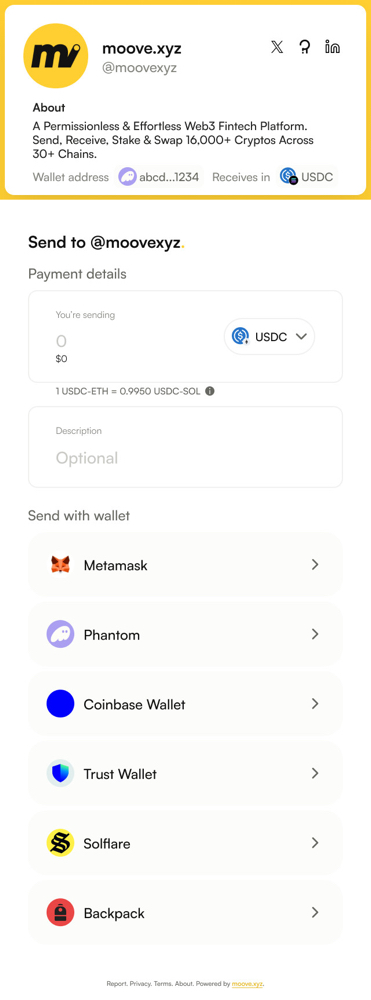
Wallet handles replacing complex addresses
One of Moove’s most practical features is wallet handles.
Instead of sending funds to a long cryptographic address, users can send them to a simple handle such as:
@username
This works similarly to how people send money using usernames on apps like Cash App or PayPal.
Handles dramatically reduce the risk of sending funds to the wrong address while also making crypto payments feel more intuitive.
For new users especially, this removes one of the biggest psychological barriers to using crypto.
Wallet handles also introduce a new layer of Web3 identity.
A simple username can represent your wallet across multiple chains, making it easier for people to send and receive payments without memorizing technical details.
Cross-chain payments by default
Another major advantage of Moove is its support for cross-chain transactions.
Instead of forcing users to worry about which blockchain they are on, Moove allows payments to move between multiple chains automatically.
This means:
Someone could send a payment from one network while the receiver gets it on another.
The technical routing happens behind the scenes.
For users, the process becomes simple:
- Enter a handle
- Enter an amount
- Send the payment
This removes a huge amount of friction from the Web3 experience.
Cross-chain capability is particularly important for global adoption, because the crypto ecosystem will likely remain multi-chain rather than single-chain.
Tools that unify these networks will play a critical role in making the system usable for everyday payments.
No-code crypto payment links
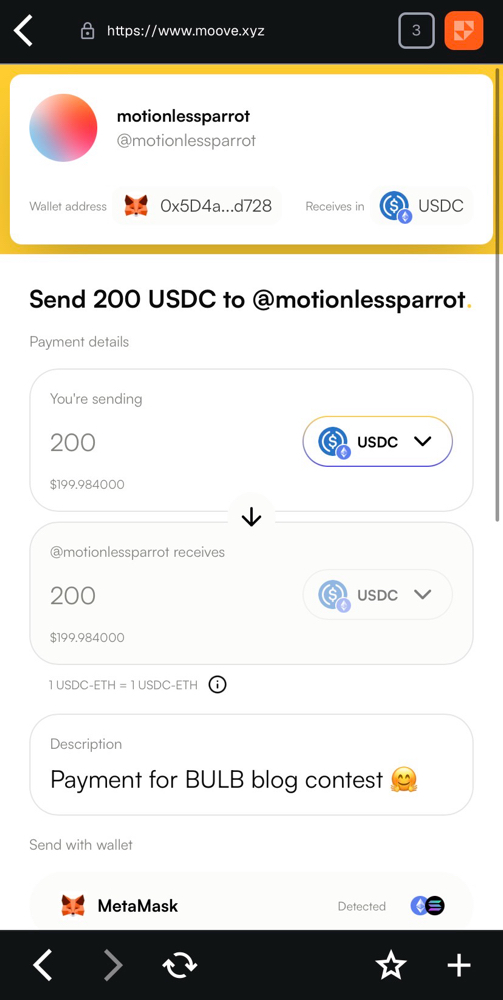
Moove also introduces payment links, which allow anyone to create a simple link that accepts crypto payments.
This feature is especially useful for:
✢ Freelancers
✢ Creators
✢ Small businesses
✢ Online communities
Instead of sharing wallet addresses or explaining which network to use, users can simply generate a link and send it to the person making the payment.
The sender opens the link, confirms the transaction, and the payment is completed.
This is very similar to how platforms like Stripe or PayPal handle online payments today.
No-code payment links lower the barrier for anyone who wants to start accepting crypto without technical knowledge.
Why Moove could become the Stripe of web3
To understand the comparison with Stripe, it helps to look at how online payments evolved in Web2.
Before Stripe, integrating online payments into a website was difficult.
Businesses had to deal with banks, payment processors, security layers, and complicated infrastructure. The process could take months.
Stripe changed that by simplifying the entire system.
Developers could integrate payments quickly, and businesses could start accepting money online with minimal friction.
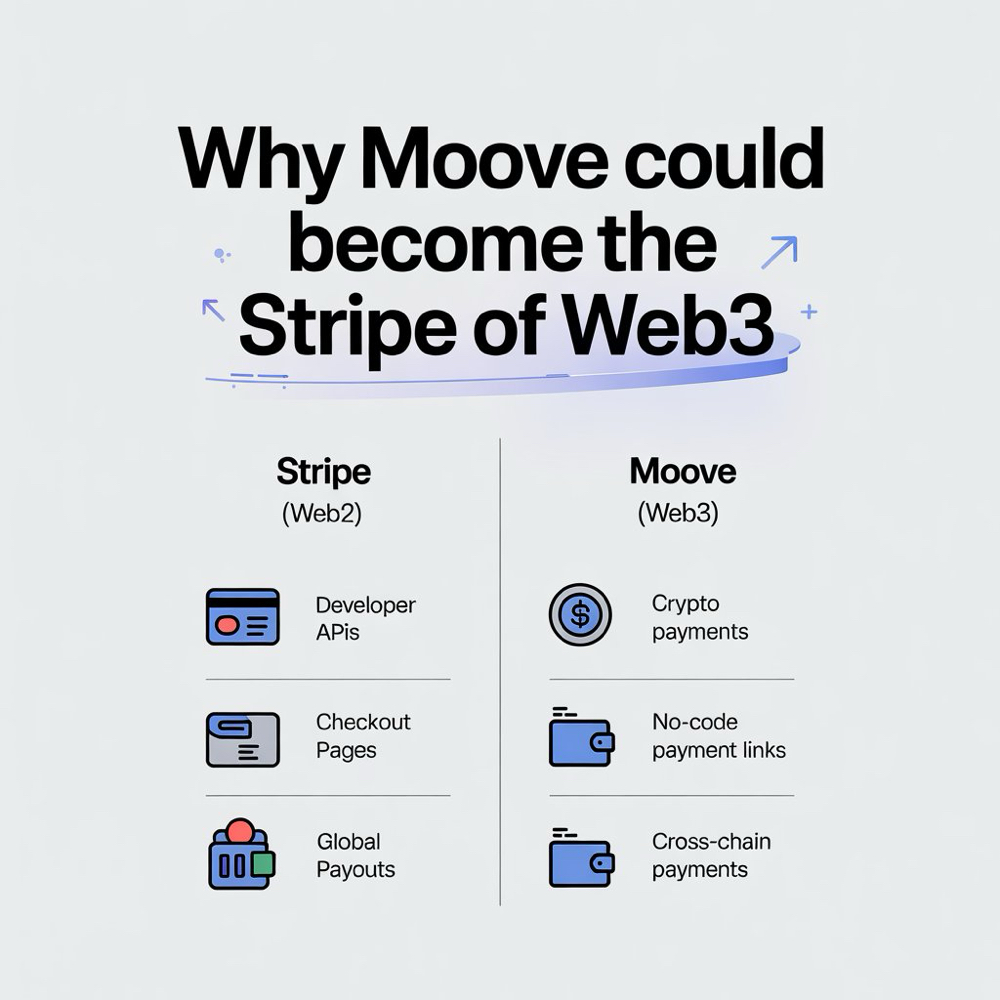
Moove is doing something similar for Web3.
Traditional crypto payments
✢ Long wallet addresses
✢ Confusing onboarding
✢ Network compatibility issues
✢ Difficult for businesses to integrate
Stripe (web2 payments)
✢ Simple checkout experience
✢ Payment links
✢ Familiar user interfaces
✢ Easy integration for businesses
Moove.xyz
✢ Wallet handles instead of addresses
✢ Cross-chain payment infrastructure
✢ No-code crypto payment links
✢ Simpler onboarding for new users
Instead of requiring people to understand blockchains, Moove focuses on removing that complexity from the experience.
If Web3 payments are going to reach a global audience, this type of simplification will be essential.
How this connects with the future of web3
The biggest barrier to crypto adoption has never been the technology itself.
Blockchains already work.
Transactions are fast. Networks are secure. Stablecoins provide price stability.
The real challenge has always been usability.
If Web3 payments are going to reach mainstream users, they must become dramatically easier to understand and use.
@moove.xyz is building infrastructure designed to move the ecosystem in that direction.
By combining wallet handles, cross-chain payments, and no-code payment links, it attempts to hide the technical complexity of blockchains while keeping the advantages of decentralized finance.
Crypto payments may eventually feel simple as sending a link. Then the gap between Web2 and Web3 could start to disappear.