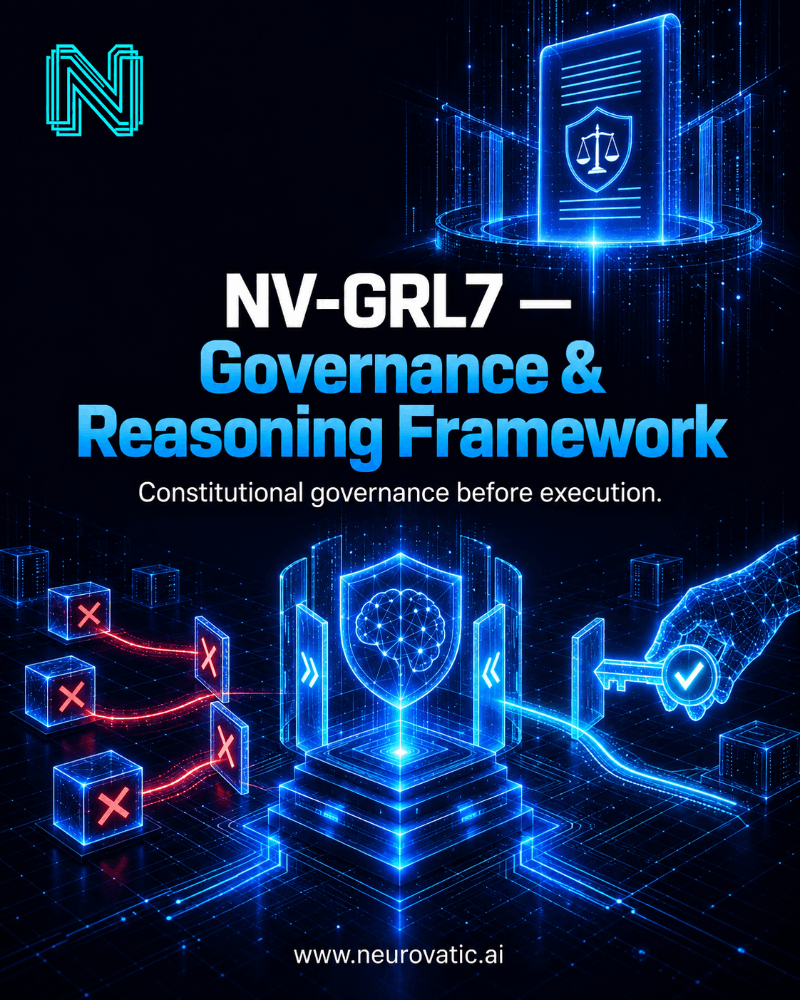
How NV-GRL7 hands off approved actions to the SIGMA cognitive runtime

The governed boundary between permission and execution
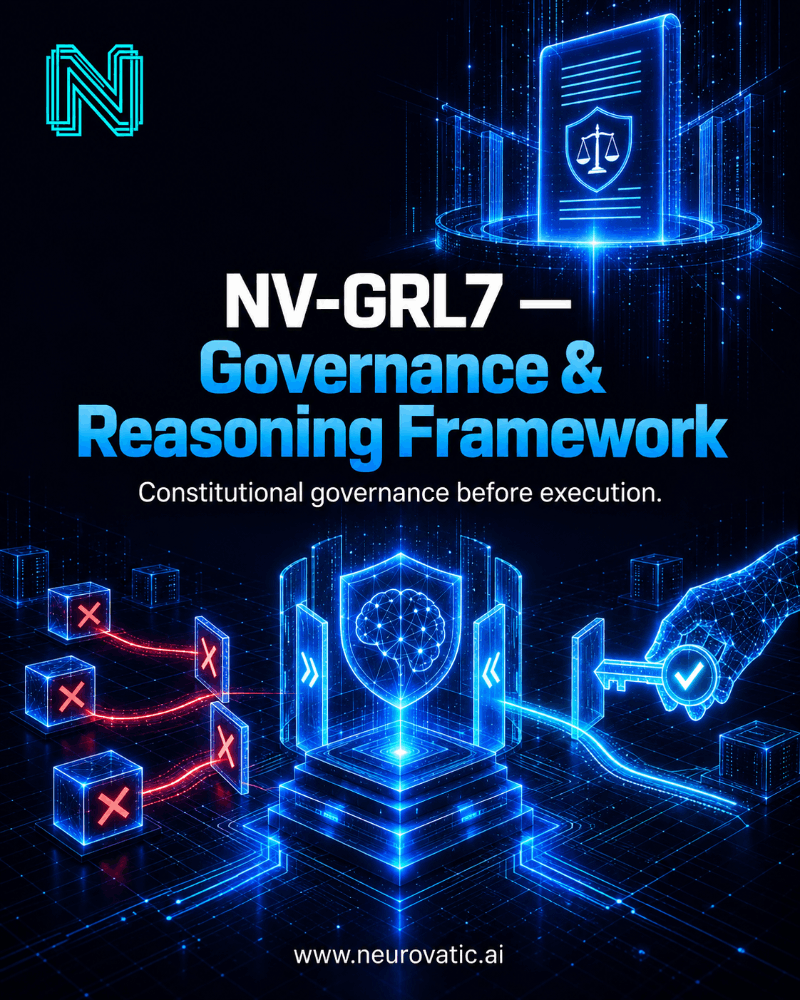
NV-GRL7 determines whether an action is constitutionally admissible. SIGMA determines how an admissible action can be orchestrated within the live execution context.
The handoff between them cannot be a loose function call or an informal approved=true flag. It must be a bounded contract that carries the exact authority SIGMA is allowed to exercise—and nothing more.
1. The Governed Action Envelope
When a proposed action clears the applicable NV-GRL7 rules, the architecture produces a Governed Action Envelope: a structured, versioned authorization object designed to bind policy, evidence, and execution scope.
A deployment-specific schema can include:
- a unique decision and correlation identifier;
- the canonical intent fingerprint;
- the expected starting state and permitted target state;
- preconditions that must still be true at execution time;
- the exact external effects that are authorized;
- the governing policy and specification versions;
- the governance verdict and applicable invariant results;
- human or multi-party approval evidence when required;
- cryptographic attestation references;
- validity window, nonce, replay protection, and idempotency rules;
- links to the evidence bundle and provenance record.
The envelope is not a claim that TLA+ generated a cryptographic proof for that individual action. Instead, it identifies the formal specification, model result, runtime checks, and policy version relevant to the authorization decision.
2. Fail-closed boundary validation
SIGMA does not trust the envelope simply because it came from an internal service. Before accepting custody, it revalidates the boundary conditions:
- Identity: Is this the expected decision and signer?
- Integrity: Has any field changed since authorization?
- Freshness: Is the envelope still inside its validity window?
- State continuity: Does the live state still match the authorized preconditions?
- Scope: Does the requested effect remain inside the permitted action set?
- Human authority: Are the required approvals present and valid?
- Replay protection: Has the envelope already been consumed or superseded?
If any check fails, the envelope creates no execution authority. SIGMA must reject, pause, or request re-authorization rather than silently widening the decision.
3. SIGMA turns authority into orchestration
After boundary validation, SIGMA maps the authorized intent onto executable resources: models, tools, workflows, local services, APIs, or hardware interfaces.
Its role is not to reinterpret the constitutional decision. Its role is to preserve the decision while resolving operational detail:
- select the appropriate model or deterministic subsystem;
- allocate context and resources;
- sequence permitted steps;
- enforce time, resource, and effect budgets;
- monitor divergence from the approved state transition;
- stop or escalate when live conditions invalidate the envelope.
This creates a crucial separation of duties: NV-GRL7 governs authority; SIGMA governs orchestration.
4. Cryptographic and provenance integration
The handoff becomes stronger when the other NEUROVATIC technologies participate:
[UNDECA Evidence]
│
▼
[NV-GRL7 Governance]
│ Governed Action Envelope
▼
[SIGMA Orchestration] ──► [AEGIS Attestation]
│
├──► [NPoI Governance-Evidence Evaluation]
└──► [NV-CHAIN Provenance Record]
AEGIS protects the authenticity and integrity of the record. NPoI evaluates applicable governance evidence; it does not replace NV-CHAIN finality. NV-CHAIN anchors the event history required to reconstruct the decision lifecycle.
5. What deterministic replay really means
Replay does not mean that every physical consequence can be reversed. A network packet may already have left a boundary, a mechanical actuator may already have moved, and an external market may already have changed.
Deterministic replay means that the system can reconstruct the governed computational history from preserved inputs, versions, decisions, authorizations, and recorded outcomes within the documented boundary. This enables forensic analysis without rewriting the original record.
The result is a handoff architecture in which AI capability is separated from execution authority—and every transfer of authority is explicit, bounded, attestable, and reviewable.
Learn more: neurovatic.ai/nv-grl7 · neurovatic.ai/sigma
-----
This post, including all associated text and visuals, has been generated and assisted by artificial intelligence under the regulatory requirements of the EU AI Act. Powered by NEUROVATIC AI systems.