What Happens When Everyone Sees the Same Crypto Market Data?

For years, having better information was considered an advantage in trading.
But crypto markets are changing that equation.
Today, traders can access price movements, trading volume, funding rates, open interest, on-chain activity, liquidity data, news, and sentiment from countless platforms.
The information is no longer exclusive.
In many cases, thousands of traders are looking at the same numbers at almost the same time.
So a different question emerges:
What happens when everyone sees the same market data?
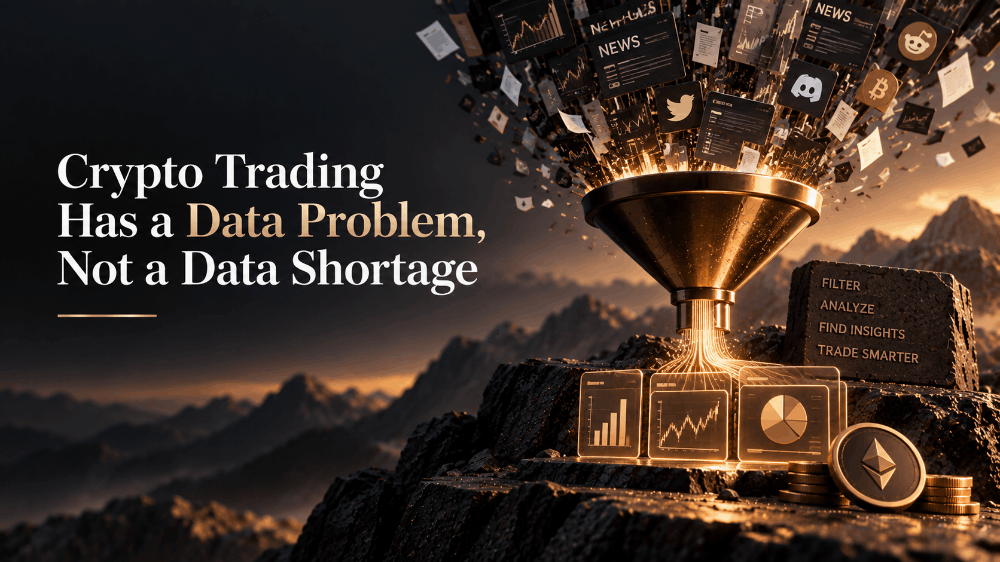
The answer may have less to do with finding another source of information and more to do with how quickly and effectively that information can be understood.
The Data Advantage Is Becoming Harder to Maintain
Imagine that a major market event occurs.
A few years ago, a trader with access to faster information could potentially have an advantage simply because fewer participants had access to the same data.
Today, information travels almost instantly.
A price movement appears across exchanges within seconds.
On-chain activity can be monitored publicly.
Derivatives data is widely available.
Breaking news spreads across social platforms almost immediately.
Even sophisticated market metrics that once required specialized tools are becoming increasingly accessible.
This creates a more competitive information environment.
Having access to the data is becoming less of a differentiator.
Everyone Can See the Number. Not Everyone Interprets It the Same Way.
Consider a sudden increase in open interest.
Thousands of traders may see the same increase.
But they may interpret it differently.
One trader may see growing participation.
Another may see rising leverage.
Another may look at funding rates for additional context.
Someone else may compare it with liquidity, volume, and recent price behaviour.
The number is identical.
The conclusions can be completely different.
This is where the difference between market data and market intelligence becomes important.
Data gives traders the same raw material.
Intelligence is about understanding what that material means within a larger market environment.
The Market Doesn't Reward Everyone for Seeing the Same Thing
If everyone has access to the same chart, the chart itself cannot automatically provide an advantage.
This does not make the data useless.
It changes the role of the data.
The question becomes less about:
“Can I see this?”
and more about:
“Can I understand this faster and in greater context?”
That distinction becomes particularly important in crypto because market conditions can change rapidly.
A metric that looks significant in one environment may mean something completely different in another.
The ability to recognize that difference can matter more than simply having access to the metric.
Speed Matters, But Speed Alone Isn't Enough
There is another layer to this.
Suppose every trader receives the same news at the same time.
Who has the advantage?
It may not simply be the person who reads it first.
It could be the person who understands its relevance first.
A headline might affect one token, an entire sector, or the broader market.
It might change sentiment without immediately changing price.
It might matter because of its connection to liquidity or derivatives positioning.
Understanding those relationships requires more than speed.
It requires processing.
That is where real-time crypto market intelligence becomes increasingly relevant.
The Information Is Fragmented
One of the biggest challenges for modern traders is that the information they need often exists across different places.
Price data may sit on one platform.
On-chain analytics may be somewhere else.
Derivatives data may require another dashboard.
News and sentiment are spread across multiple feeds.
Liquidity information may require yet another source.
None of these platforms necessarily lacks useful information.
The problem is the fragmentation.
The trader becomes responsible for connecting everything.
That takes time.
And when the market is moving quickly, time spent switching between sources can become a significant part of the problem.
AI Could Change This Equation
Artificial intelligence introduces another possibility.
Instead of asking traders to manually monitor dozens of information sources, an AI-powered system can process large amounts of market information simultaneously.
For example, an AI system could examine changes in:
- price and volume
- liquidity
- derivatives positioning
- on-chain activity
- market sentiment
- news and developments
The goal would not be to turn all of this into a guaranteed prediction.
Markets are too complex for that.
The value can come from identifying relationships that are difficult to track manually.
That is where AI trading intelligence could become an important part of the next generation of trading tools.
More Data Isn't Automatically More Intelligence
There is a temptation to believe that sophisticated traders simply need more data.
But adding another dashboard does not necessarily improve understanding.
In fact, it can create another layer of noise.
If a trader already has access to hundreds of metrics, giving them another hundred may make the decision-making process harder rather than easier.
The more useful approach may be to organize existing information around meaningful changes.
What is unusual?
What changed recently?
Which developments are connected?
What information is relevant to the current market environment?
These questions are more difficult than simply displaying another number.
But they can be more useful.
The Trader of the Future May Not Need More Screens
There was a time when adding more screens could feel like adding more information and therefore more capability.
But the modern trader can easily end up with too much information.
Ten dashboards can create ten different streams of updates.
At some point, the challenge is no longer seeing the market.
It is understanding it.
A crypto trading intelligence platform can potentially act as an intelligence layer between fragmented information and the trader.
Instead of requiring users to manually monitor every source, the system can help surface developments that deserve attention and provide context around them.
The objective is not to remove human judgment.
It is to make that judgment more informed.
Where i5.xyz Fits Into This Shift
This is one of the problems i5 is built around.
Crypto traders already have access to an enormous amount of information.
The opportunity is to make that information more useful by connecting market activity across different layers.
i5 approaches crypto market intelligence through market context, combining areas such as real-time market activity, on-chain behaviour, liquidity, derivatives, sentiment, news, and developments.
The idea is not that traders need another place to look at isolated numbers.
They need a better way to understand what those numbers are saying together.
As AI-powered crypto trading continues to evolve, the competitive advantage may increasingly come from information processing rather than information ownership.
The Next Edge May Not Be Hidden Data
The days when simply finding a piece of information others did not have could provide a clear advantage are becoming harder to maintain.
Today, the bigger challenge may be turning widely available information into useful understanding.
Everyone can see the chart.
Everyone can see the headline.
Everyone can see the volume.
Everyone can see the market moving.
But not everyone sees the same story in those numbers.
That may be where the next generation of AI trading intelligence has the most interesting role to play.
Not hiding information.
Not creating more noise.
But helping traders understand an increasingly transparent market.
Get Early Access to i5
If you want to explore i5's approach to real-time crypto market intelligence, you can join the i5 Whitelist for early access and updates.
You can also join the i5 Telegram to follow the latest developments and stay connected with the i5 community.