Best 10 Smart Contract Development Companies for DeFi and Tokenization in 2026


A DeFi protocol and a tokenization platform can use the same token standard while demanding very different engineering. A lending market must survive stale prices, liquidation stress and liquidity shocks. A tokenized asset needs issuance, transfer restrictions, servicing, redemption and an offchain record that stays aligned with onchain state. Both need a team that can explain who may change the contracts after launch and who takes the first production call when the assumptions fail.
Pharos Production prepared this shortlist and selected the order. It is an editorial buyer guide, not an independent audit, a security certification or a formula-generated league table. The evidence cutoff is September 19, 2026. Every company below publishes a current smart-contract, blockchain, DeFi or tokenization delivery scope. Public pages can establish that scope, but they cannot prove the quality of the engineers assigned to your project, current availability, commercial terms or the safety of code that has not been reviewed.
Choose three candidates whose published scope resembles the system you are building. Give all three the same architecture brief and ask for the same release evidence. A polished capability deck should not survive as a deciding factor once one team can map upgrade authority, oracle behavior, token controls, deployment provenance and incident ownership while another cannot.
Start with five production boundaries
Most rankings compare chains, languages, team size and service breadth. Those fields help with initial eligibility. They do not tell an operator whether the delivered system will remain understandable after the original developers leave.
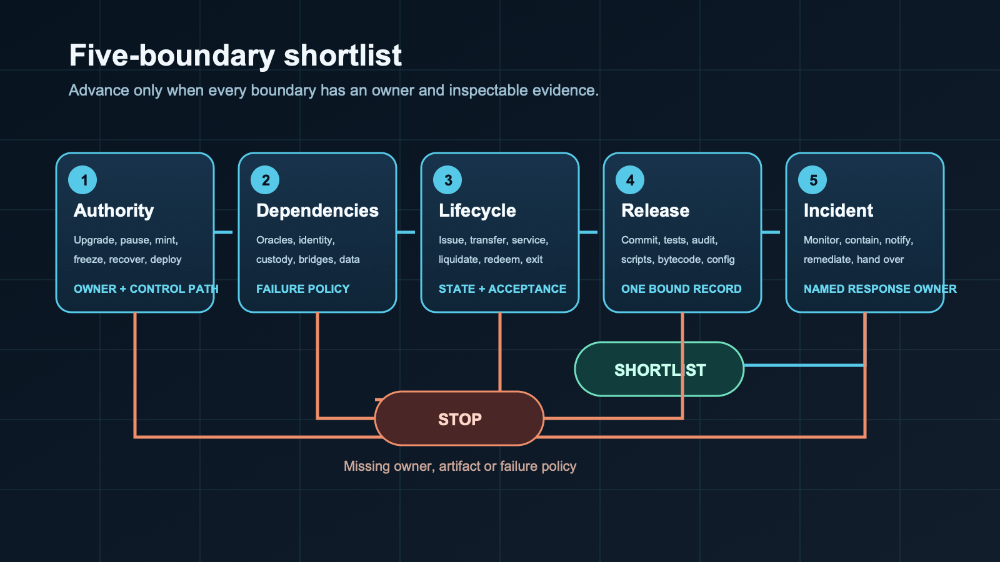
Use five boundaries before reading the company profiles:
- Upgrade authority. Identify every address or role that can replace logic, pause execution, mint, seize, freeze, recover or change parameters. Record the controller behind each address and the delay, quorum or governance path that constrains it.
- Oracle and offchain dependencies. List price feeds, proof-of-reserve inputs, identity registries, transfer agents, custodians, backend signers and indexers. Define freshness, deviation and failure behavior for each input.
- Token lifecycle controls. For tokenization, trace issuance, allocation, transfer eligibility, corporate actions, redemption, burning and exceptional recovery. For DeFi, trace accounting, solvency assumptions, liquidation and fee distribution.
- Release evidence. Bind the specification, repository commit, dependency lock, test results, audit scope, deployment scripts, network configuration and deployed bytecode to one release record.
- Incident ownership. Name who monitors the system, who may contain a fault, who communicates with users or counterparties and which team owns remediation after deployment.
Boundaries two and three distinguish a serious DeFi or tokenization engagement from generic Solidity staffing. The other three determine whether the buyer can operate what gets delivered.
Ten-company operator matrix
This matrix shows the public scope that makes each company relevant and the evidence gap a buyer should close. It does not score undisclosed work.
1. Pharos Production
Published scope: Smart-contract architecture, DeFi and token standards, testing, audit coordination and deployment preparation
Evidence to request: One commit-bound release pack and the named owner of every privileged action
2. Neti
Published scope: Architecture-first DeFi, token flows, tokenized assets and wider product integration
Evidence to request: A dependency map linking contracts, wallets, backend services and operational owners
3. LimeChain
Published scope: EVM, Solana and Daml contracts with invariants, fuzzing, audit preparation and deployment rehearsal
Evidence to request: One risk-mapped test pack plus the exact ownership-transfer rehearsal
4. PixelPlex
Published scope: Custom DeFi mechanics, tokenization and Daml-oriented multi-party workflows
Evidence to request: A representative lifecycle trace from issuance or deposit through exit and recovery
5. Webisoft
Published scope: Solidity, Rust and CosmWasm delivery with app integration, audit work and post-launch support
Evidence to request: The independent-review boundary and a live incident escalation map
6. Innowise
Published scope: DeFi and tokenized-asset contracts, oracle feeds, cross-chain work and upgradeable systems
Evidence to request: Stale-data tests, bridge assumptions and storage-layout evidence for upgrades
7. Antier Solutions
Published scope: Broad DeFi delivery, multi-network contracts and post-deployment maintenance
Evidence to request: Named engineers, exact chain scope and a support runbook tied to response ownership
8. Purrweb
Published scope: Web and mobile dApps, smart-contract execution, DeFi products and product interfaces
Evidence to request: Contract-specific review depth separated from application delivery milestones
9. Altoros
Published scope: Enterprise blockchain delivery across Ethereum and permissioned frameworks
Evidence to request: A ledger-choice record plus chaincode, integration and operating acceptance tests
10. 4soft
Published scope: Full-cycle blockchain applications, smart contracts, exchanges, dApps and tokenization
Evidence to request: A representative repository, audit handoff and production authority map
Use different acceptance tests for DeFi and tokenization
A company can qualify for one product and fail the other. DeFi correctness is dominated by economic state transitions. The engineering team must reason about balances under sequences of deposits, borrows, repayments, withdrawals, liquidations and price changes. A passing happy-path test says little about a position that moves across several collateral ratios while an oracle becomes stale. Ask the bidder to state the system invariants in plain language, then show which automated tests try to break them.
Tokenization starts from a different object: a right or claim that exists beyond the token. The contract may represent ownership, entitlement, access or settlement status, but the buyer still needs an authoritative record of the asset and its legal lifecycle. The technical acceptance test should connect wallet eligibility, issuance, transfer restrictions, corporate actions, redemption and exceptional recovery to the responsible offchain parties. A token that transfers correctly can still be an unusable product when its servicing and records disagree.
Their overlap sits at the operating boundary. Both systems need privileged-role control, reproducible deployment, external data policies and a monitored incident path. Both also need an explicit decision about what happens when onchain and offchain state diverge. DeFi might reject a stale price and pause a market. A tokenization system might block a transfer until an identity registry or administrator resolves the discrepancy. The desired response is product-specific, but silence is not a design.
Use that distinction during vendor interviews. Give DeFi candidates a value-preservation scenario with changing market data. Give tokenization candidates a lifecycle scenario that crosses contract, registry and human approval boundaries. If one company is shortlisted for both, require both exercises. A generic token contract demonstration should not count twice.
1. Integrated build-to-release evidence
Current published scope covers smart-contract architecture, Solidity engineering, token standards, upgradeable contracts, DeFi protocols, automated testing and deployment preparation. That combination is relevant when the contract layer cannot be separated from a wider production handoff. It also fits a buyer who expects an external audit to be coordinated against a known release rather than treated as a detached PDF.
Fragmentation is the central procurement problem: architecture sits in one document, tests in another repository, the auditor reviews a third revision and the operator receives addresses without a usable authority map. The published Pharos Production method addresses that problem by joining architecture, tested source, external-audit coordination and a deployment runbook in one delivery path. This is evidence of a stated method, not proof that a future engagement will be secure or successful.
This entry fits a DeFi or token product that needs contract engineering plus a structured mainnet handoff. Before signing, verify the named team, target-chain experience, independent auditor, audit-scope commit and the operator who accepts control after deployment.
2. Neti: architecture before isolated contract code
Neti's current materials place architecture, permissions, upgradeability and product integration ahead of isolated Solidity output. The published scope includes DeFi mechanics, staking, rewards, vesting, token flows, tokenized assets and surrounding wallet or backend work. That makes the company relevant where onchain logic is only one part of a financial product.
Use a boundary walk instead of a language quiz. Give the team a deposit, transfer or redemption flow and ask it to mark which decisions live onchain, which depend on an external service and which require an operator. Then ask how that map changes when one dependency is unavailable.
Shortlist Neti when a nonstandard DeFi, RWA or token workflow needs architecture and integration work. Verify which published experience matches your asset model, then confirm whether monitoring, documentation and post-launch ownership are in scope.
3. LimeChain: invariant-led delivery and audit preparation
LimeChain publishes a concrete engineering sequence: define invariants, size assurance to risk, document permissions and upgrade paths, review value-bearing logic, produce test evidence and rehearse deployment. Its listed language and ecosystem coverage includes Solidity for EVM chains, Rust for Solana and Daml for Canton Network.
That process is relevant to protocols whose safety properties can be stated before implementation. A vault might require that liabilities never exceed permitted assets. A tokenization workflow might require that an ineligible address cannot receive a restricted asset, including after an upgrade or recovery action.
LimeChain is most relevant when property testing, multi-ecosystem work or audit preparation is central. Ask for the proposed invariants, the depth and duration of their test campaigns and the independent-review boundary after internal work.
4. PixelPlex: custom DeFi mechanics and tokenization workflows
PixelPlex publishes work across custom smart-contract logic, advanced DeFi mechanics, physical and digital asset tokenization and Daml development for controlled multi-party workflows. This breadth can suit a product that combines contracts with interfaces, data services and institutional process design.
Broad scope creates a specific diligence task. Ask for one comparable workflow with confidential details removed. Trace it from business rule to deployed control. For tokenization, include issuance, eligibility, transfer, servicing and redemption. For DeFi, include accounting, oracle input, stress behavior and exit.
Consider PixelPlex for a full Web3 product engagement rather than a contract-only workstream. Confirm the chain and language depth of the proposed engineers, the origin of reusable modules and the independent audit plan for modified code.
5. Webisoft: multi-chain contracts with integration and support
Webisoft currently publishes Solidity, Rust, CosmWasm, EVM, Substrate, Cosmos and Solana capabilities. Its service page describes custom development, backend and frontend integration, optimization, audit work, deployment and post-launch monitoring, upgrades and incident response.
Your operating question is whether those stages form one accountable release. Ask the team to show how a finding moves from audit report to code change, retest, deployment manifest and monitor. If the company both authors and reviews the code, require a separate independent assessment for the final production scope.
Webisoft may fit a multi-chain product that connects contract work with application delivery and ongoing support. Verify who performs each review, what support hours mean during an exploit and whether emergency authority transfers to the buyer.
6. Innowise: oracle, cross-chain and upgrade-heavy systems
Innowise publishes a scope that includes contract architecture, pre-audit checks, optimization, oracle feeds, cross-chain contracts and upgradeable systems. Those capabilities are relevant to DeFi and tokenized-asset products whose correctness depends on data or messages arriving from outside the contract.
An integration list is not a failure policy. Ask for tests covering stale data, excessive deviation, unavailable feeds, delayed cross-chain messages and duplicate delivery. For upgradeable contracts, request the storage-layout comparison and authority path for every change.
Use the upgrade-authority evidence model here because a protected signing key and a controlled implementation change solve different risks. Removing that distinction makes the article's test for an upgrade-heavy vendor incomplete.
Put Innowise on the list when several external feeds, bridges or planned upgrades dominate the scope. Verify the exact integrations owned by the team, the degraded modes and the operator who decides whether to pause, reject or continue.
7. Antier Solutions: broad DeFi scope and maintenance
Antier Solutions publishes DeFi smart-contract work across multiple networks along with consulting, development and post-deployment support. The wider company catalog also covers lending, staking, wallets, tokens and digital banking components.
Breadth is useful only when the proposal names the team and boundary for your system. Ask which engineers will handle the contract layer, which have experience with the target chain and which support staff can change code or production configuration after launch. Separate regulatory guidance from legal advice provided by qualified counsel.
Antier Solutions is relevant to a broad DeFi or token product scope with ongoing maintenance. Confirm named personnel, independent audit scope, production access, response hours and the exit process for every vendor-held credential.
8. Purrweb: product delivery around the contract layer
Purrweb's current Web3 offering combines web and mobile dApps, smart-contract engineering, token products, DeFi features and integrations. That makes it relevant when wallet flows, dashboards and ordinary product usability carry as much delivery work as the contracts.
One risk is accepting one product milestone as proof of another. A working interface does not establish the contract's accounting properties. A contract audit does not establish that the application submits the intended parameters or reports failures correctly. Request separate acceptance evidence for both layers and at least one end-to-end failure test.
Purrweb may fit a startup or product team commissioning a user-facing dApp together with its contracts. Identify the senior contract reviewer, the test method for financial logic and the external auditor responsible for the release candidate.
9. Altoros: enterprise and permissioned-ledger integration
Altoros publishes enterprise blockchain work across Ethereum, Hyperledger Fabric, Quorum and Corda, with requirements, architecture, network deployment, chaincode, interfaces and external-system integration in its delivery flow. That focus is useful when privacy, participant governance or existing enterprise systems make a public DeFi pattern the wrong default.
Ask for the ledger-choice record. It should explain why the proposed platform fits participant trust, privacy, finality, throughput and governance. Then inspect how the smart contracts or chaincode connect to identity, settlement and the system of record.
Altoros belongs on an enterprise shortlist when contract logic and infrastructure are procured together. Verify the assigned team's production framework expertise, responsibility for network operations and acceptance tests across external integrations.
10. 4soft: full-cycle blockchain application delivery
4soft publishes bespoke blockchain applications, smart-contract development, DEX and CEX products, dApps and tokenization work. The scope can fit a buyer that wants discovery and application delivery under one engagement.
Its public page gives less contract-specific assurance detail than the strongest evidence-led entries above, so the diligence request should be direct. Ask for a representative repository or controlled walkthrough that shows tests, privileged roles, audit handoff, deployment scripts and support ownership. Confidentiality may change the form of evidence, but it should not remove the evidence job.
Consider 4soft for full-cycle product work where blockchain is one part of a larger application. Request the names of assigned contract specialists, the external review plan and the artifacts that remain with the buyer after handover.
Why one security claim is never enough
Vitalik Buterin framed smart-contract safety as layered and incremental after reviewing early Ethereum failures:
"There will be further bugs, and we will learn further lessons; there will not be a single magic technology that solves everything."
Vitalik Buterin, Ethereum founder, Thinking About Smart Contract Security, Ethereum Foundation Blog, June 19, 2016.
Applied to procurement, the quote rules out a single-gate decision. An audit badge cannot replace a threat model. Coverage cannot replace an invariant. A multisig cannot replace a map of every privilege. Monitoring cannot compensate for an unavailable containment path. The vendor must connect those controls around one deployable system.
Send every finalist the same evidence request
Give each candidate the same bounded assignment before comparing price. Use one representative feature from your product rather than a generic coding exercise.
For a DeFi lending market, the feature could be collateral withdrawal after a price update. Require the team to state the solvency invariant, oracle freshness rule, authorization path, failure behavior and test strategy. For a tokenized asset, use a restricted transfer followed by redemption. Require eligibility checks, record synchronization, exceptional handling, admin powers and the retained event trail.
Ask for these artifacts:
- a one-page contract and dependency map.
- a role register for upgrade, pause, mint, freeze, recover and deploy powers.
- one specification-to-test trace for a value-bearing rule.
- a repository commit with pinned compiler and dependency versions.
- a threat model naming economic, integration and administrative failure modes.
- unit, fuzz, invariant, integration or fork-test evidence chosen for those risks.
- an independent audit plan tied to a scope commit and remediation process.
- a deployment rehearsal, address manifest and bytecode-verification step.
- monitoring rules for authority changes, oracle faults and balance drift.
- an incident and handover runbook with named buyer and vendor owners.
Do not ask for private keys, customer data or another client's proprietary source. A sanitized project, a reference implementation or a controlled screen share can demonstrate the process. If a candidate cannot show private client work, it can still show how a release is built, reviewed and handed over.
Operator disqualifiers
A company can remain generally capable and still be wrong for this engagement. Stop or pause the procurement process when any of these conditions survives clarification:
- the team cannot identify who controls upgrade, pause, mint, freeze or deployment authority.
- the audit report is not bound to the code and configuration intended for mainnet.
- oracle freshness, deviation or unavailability has no defined contract behavior.
- tokenization is reduced to token deployment while eligibility, servicing, redemption and legal-record ownership remain unassigned.
- a cross-chain path has no replay, duplicate-delivery or delayed-finality test.
- deployment depends on remembered console steps rather than versioned scripts and a rehearsal.
- support is promised without a named incident owner, response boundary or credential-exit plan.
- the same team is presented as independent reviewer of code it authored.
- legal or regulatory conclusions are supplied by the software vendor without qualified counsel in the relevant jurisdiction.
Price comparison begins after these stops are cleared. Before that point, proposals describe different risk allocations and cannot be compared as equivalent builds.
Make the shortlist operational
For a specific DeFi or tokenization product, the best development company is the one whose assigned team can make its assumptions inspectable. Published capability establishes a reason to interview. The contract, evidence pack and live technical review establish whether to hire.
Choose three candidates from the list, send the same architecture brief and use the five production boundaries as the interview agenda. Keep the resulting authority map, dependency model, release record and incident handoff as contractual deliverables. If the winning team changes, those artifacts should still let another authorized operator understand the system without reconstructing it from sales calls.
This shortlist is a dated research view, not a guarantee of availability, price, regulatory fit or future security. Recheck the proposed personnel and public scope during discovery. DeFi teams should obtain independent security review. Tokenization teams should involve qualified legal and compliance advisers for asset classification, investor eligibility, custody and transfer restrictions before mainnet launch.
More insights to read
- Smart Contracts. Their Potential and Real Limitations. Part 1
- Smart Contract Release Audit: 8 Repository Artifacts
- Smart Contracts. Their Potential and Real Limitations. Part 2
- Upgradeable Solidity Smart Contracts. Part 1: Versioning
- Web3. Smart Contracts. Oracles. Part 1
About the author

Written by Dmytro Nasyrov PhD, software architect with 24 years of production experience. Dmytro is the founder and CTO of Pharos Production. He works on production software architecture for FinTech, AI, Web3 and blockchain systems.