The SEC's New Innovation Exemption: What Tokenized Stocks Mean for the Best Site for Trading Crypto

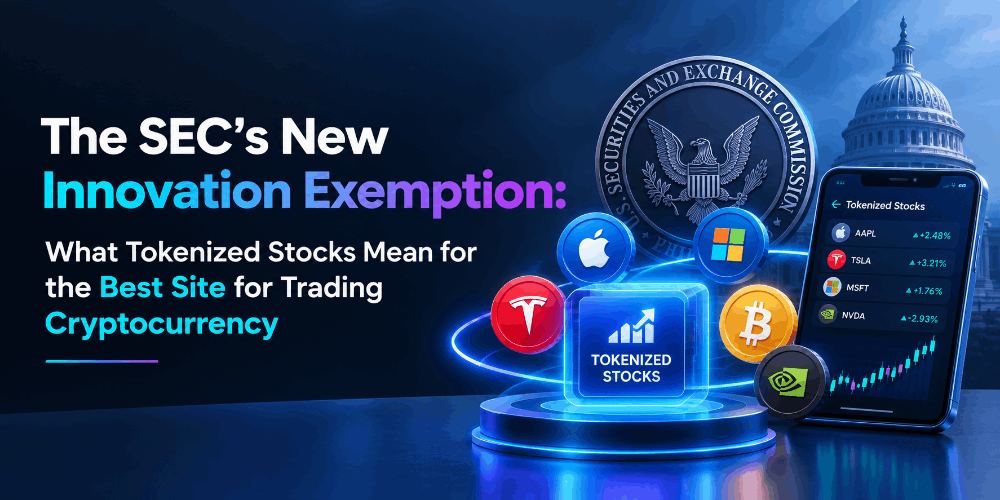
Crypto regulation took an unexpected turn this week. Just two days after a major crypto market structure bill stalled in the Senate, the SEC moved on its own to open a new path connecting traditional stock markets and blockchain infrastructure. Here's what the Innovation Exemption actually does, and what it means for how you should be thinking about the best site for trading cryptocurrency going forward.
What the SEC Actually Announced
On September 17, the Securities and Exchange Commission issued an order granting temporary, conditional exemptive relief to what it calls Tokenized Securities Venues, or TSVs. This relief exempts these venues from the legal definition of an "exchange" under the Securities Exchange Act, allowing them to facilitate trading of tokenized National Market System stocks through permissioned automated market makers and liquidity pools. A related exemption also applies to liquidity providers supplying capital to these pools, exempting them from formal "dealer" registration requirements. The exemption is set to expire five years after publication, and the SEC is soliciting public comment on further steps.
SEC Chair Paul Atkins framed the move as a significant step toward bringing US capital markets into the digital age, describing the exemption as a bridge while the Commission considers more permanent rulemaking. Commissioner Hester Peirce's Crypto Task Force played a central role in developing the framework.
Why This Happened Right After the CLARITY Act Vote Failed
The timing here isn't a coincidence. Just two days earlier, the Senate's cloture vote on the CLARITY Act — comprehensive crypto market structure legislation — fell short of the 60 votes needed to advance. Rather than waiting for Congress to resolve that legislative stalemate, the SEC used its existing statutory authority to move forward on a narrower but still significant piece of crypto-adjacent market structure. This reflects a broader pattern: when comprehensive legislation stalls, regulators sometimes act unilaterally within their existing authority to keep momentum going on specific pieces of the puzzle.
What Tokenized Stocks Actually Are
Tokenized stocks are blockchain-based representations of shares in publicly traded companies, designed to enable trading outside the constraints of traditional exchange hours. Under this exemption, qualifying platforms can offer these tokens with near-instant settlement and fractional ownership — meaning you could theoretically buy a small fraction of a share rather than needing to purchase a whole one. Importantly, these tokenized versions explicitly exclude traditional shareholder rights like voting and dividends, distinguishing them clearly from owning the underlying stock directly.
Why This Matters for Crypto Platforms Specifically
This exemption creates a real opportunity for crypto trading venues to expand into offering tokenized equities alongside digital assets, something not previously possible without navigating the full complexity of exchange registration. For traders, this means the best site for trading cryptocurrency in the coming months and years could increasingly offer access to tokenized versions of major stocks directly within the same platform used for crypto trading — a meaningful convergence between two markets that have largely operated separately until now.
What to Watch as This Rolls Out
- Which platforms actually qualify and register as Tokenized Securities Venues under the SEC's framework, since not every crypto exchange will necessarily pursue this path immediately
- Symbol limits and volume caps, since the exemption is calibrated with specific conditions rather than unlimited trading of any tokenized stock
- How liquidity develops for thinly traded names, since the SEC itself has noted that large-cap stocks with substantial daily volume are much better positioned to absorb tokenized trading than smaller, less liquid companies
- Whether additional rulemaking eventually makes this permanent, since the current exemption is explicitly temporary and framed as a bridge toward more durable rules
Why Platform Fundamentals Matter More, Not Less, With This Expansion
As crypto platforms potentially expand into new, more complex asset categories like tokenized equities, the underlying fundamentals that make a platform trustworthy become even more important, not less. A platform that handles crypto custody and fees transparently is far better positioned to extend that same standard to a new asset class than one that's already cutting corners. When evaluating the best site for trading cryptocurrency going forward, it's worth specifically checking whether a platform's approach to security and disclosure would reasonably extend to any new products it introduces, rather than assuming expansion automatically comes with the same standards.
Questions Worth Asking Before Trading Tokenized Stocks on Any Platform
- Does the platform clearly explain that tokenized shares don't include voting or dividend rights, rather than presenting them as equivalent to owning the actual stock?
- Is the platform operating under the SEC's exemption with proper registration, or is it unclear whether it qualifies as a legitimate Tokenized Securities Venue?
- How is custody of the underlying assets handled, and does the platform apply the same security standards to tokenized equities as it does to crypto holdings?
- What happens during periods of thin liquidity for less popular tokenized names, and does the platform disclose this risk clearly?
Why Security Standards Shouldn't Change With New Asset Types
Whether you're trading Bitcoin, Ethereum, or eventually a tokenized share of a major company, the core security fundamentals that matter don't change: cold storage practices, strong authentication, and clear custody disclosure remain just as essential. The best site for trading cryptocurrency won't suddenly become less important to vet carefully just because it adds new asset types — if anything, the added complexity of navigating a newly created regulatory category makes due diligence more important, not less.
Where a Transparent Platform Fits Into This Shift
Platforms such as Nezobank demonstrate the kind of transparency and security standard that matters regardless of which specific assets a platform ultimately supports — clear fee disclosure, strong cold storage practices, and a straightforward trading flow. As the market structure around tokenized stocks continues developing under this new exemption, choosing a best site for trading cryptocurrency that already operates with this level of transparency puts you in a stronger position to evaluate any new offerings responsibly as they roll out.
Final Thoughts
The SEC's Innovation Exemption marks a genuine, if temporary, step toward merging traditional equity markets with blockchain infrastructure, arriving at a moment when comprehensive federal crypto legislation remains stalled. For traders, this means the best site for trading cryptocurrency may increasingly extend beyond digital assets alone, making platform fundamentals — security, transparency, and clear disclosure — more relevant than ever as this space evolves. A platform like Nezobank, already built around these standards, offers a reasonable foundation for evaluating how any platform handles this kind of expansion responsibly.
Frequently Asked Questions
Q: What exactly did the SEC's Innovation Exemption do? A: It granted qualifying Tokenized Securities Venues a five-year conditional exemption from being classified as a formal exchange, allowing them to facilitate trading of tokenized versions of public stocks through permissioned automated market makers.
Q: Do tokenized stocks give you the same rights as owning actual shares? A: No. Tokenized shares under this exemption explicitly exclude traditional shareholder rights like voting and dividends, making them distinct from directly owning the underlying stock.
Q: Why did the SEC act now, right after the CLARITY Act vote failed? A: The SEC used its existing statutory authority to move forward on a narrower piece of crypto-adjacent market structure rather than waiting for the stalled comprehensive legislation to eventually pass.
Q: Is this exemption permanent? A: No, it's temporary and set to expire five years after publication, explicitly framed by the SEC as a bridge while it considers more durable, permanent rulemaking.
Q: Will every crypto trading platform start offering tokenized stocks? A: Not necessarily. Platforms need to qualify and register as Tokenized Securities Venues under the SEC's framework, so adoption will likely vary rather than happen universally overnight.
Q: Should I evaluate a platform differently if it starts offering tokenized stocks? A: The same fundamentals still apply — check custody practices, security standards, and clear disclosure of what rights (or lack of rights) come with tokenized shares before trading them on any platform.