Crypto Trading Has a Data Problem, Not a Data Shortage

Crypto traders have never had access to more information than they do today.
Price charts update every second. On-chain activity is increasingly visible. Exchanges provide order books, funding rates, open interest, volume, and liquidation data. Social platforms generate a constant stream of opinions, while news, token announcements, governance activity, and market narratives can change within minutes.
Yet having more information does not necessarily make trading easier.
The problem is no longer finding data. The problem is figuring out which information actually matters, what it means, and how different pieces of information connect.
That is where the difference between data and market intelligence becomes important.
Crypto Markets Are Producing More Information Than Traders Can Process
A trader following Bitcoin, for example, may simultaneously watch price action, derivatives activity, whale movements, ETF-related developments, macroeconomic news, social sentiment, exchange flows, and broader market liquidity.
Each source can provide useful information on its own.
The difficulty comes from combining them.
A sudden increase in trading volume may look significant. But is it driven by genuine demand, short-term speculation, liquidations, or a temporary reaction to breaking news?
A large wallet movement may attract attention. But does it represent accumulation, a transfer between wallets, or preparation for a sale?
A trending narrative may appear everywhere on social media. But is it gaining real market participation or simply generating more discussion?
The data exists. What is often missing is the context needed to interpret it.
More Data Can Create More Noise
Information overload is particularly challenging in crypto because the market operates continuously.
There is no traditional market close that gives traders a natural stopping point. Developments can happen at any hour, and multiple narratives can compete for attention at the same time.
This creates a strange situation: traders can spend hours monitoring the market and still struggle to understand what actually changed.
The problem is not necessarily a lack of effort.
It is that humans are not particularly good at processing hundreds of rapidly changing information points simultaneously.
When every movement generates an alert, every headline becomes potentially important, and every social post can trigger another reaction, the distinction between meaningful information and background noise becomes harder to maintain.
Price Tells You What Happened. Context Helps Explain Why.
Price remains one of the most important pieces of market information. But price alone has limitations.
Suppose an asset suddenly moves 5%.
The chart tells you that the move happened. It does not automatically explain whether the movement was connected to a liquidity shift, an increase in buying activity, a liquidation event, a major announcement, changes in derivatives positioning, or a broader market trend.
That distinction matters.
Two assets can experience similar price movements while having completely different reasons behind them.
One may be supported by increasing liquidity and genuine demand. Another may be moving because of temporary leverage or a short-lived narrative.
Looking only at the price can make these situations appear similar.
Looking at the surrounding market context can reveal the difference.
The Real Challenge Is Connecting the Dots
Modern crypto traders already have access to individual pieces of information.
The bigger challenge is connecting them.
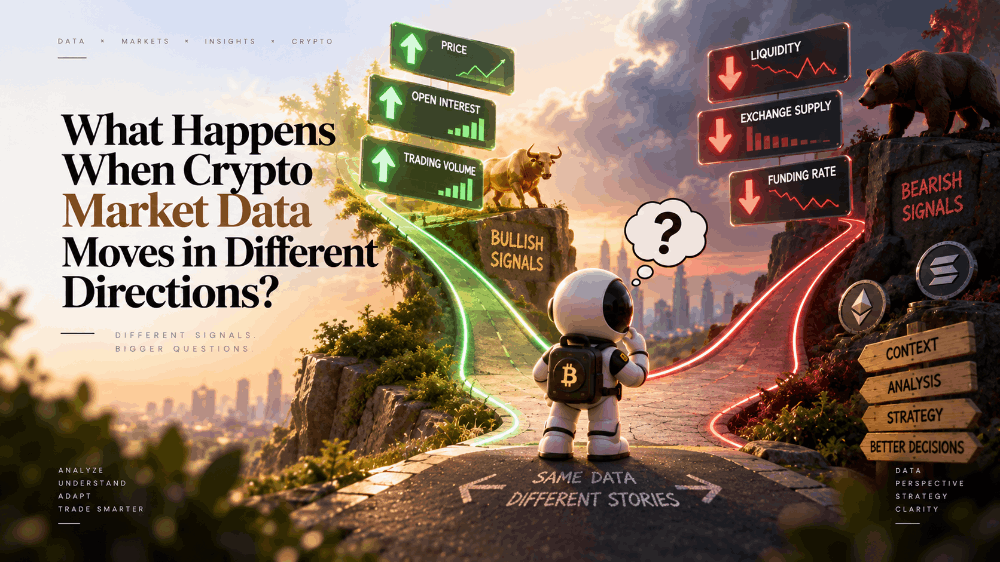
Imagine seeing rising open interest at the same time as increasing trading volume and a shift in funding rates. Then add unusual on-chain activity and a developing market narrative.
Looking at each metric separately provides information.
Understanding how they relate provides context.
This is where market intelligence becomes more useful than simply collecting more datasets.
Instead of asking, “What happened?” traders can begin asking:
Why did it happen?
What else changed at the same time?
Is the move supported by broader market activity?
Is this a temporary reaction or part of a larger shift?
Those questions move the focus from data collection toward interpretation.
The Market Moves Fast, but Human Attention Does Not
Speed is another part of the problem.
Crypto markets can react to information within seconds, while traders still need time to identify an event, investigate its relevance, compare it with other data, and decide whether it deserves attention.
By the time a trader has manually connected several pieces of information, the market may have already moved.
This does not mean every fast reaction is a good trading decision. It means that the ability to process information efficiently is becoming increasingly important.
The advantage is not necessarily having access to information before everyone else.
It can also come from understanding relevant information faster.
This Is Where AI Can Change the Information Layer
Artificial intelligence can potentially help address this problem by working across multiple information sources rather than treating each data point in isolation.
Instead of simply notifying a trader that something happened, an AI-powered system can analyze different market inputs and help provide context around the event.
For example, a market intelligence system could combine price activity with liquidity conditions, derivatives data, on-chain movements, sentiment, and relevant news to create a more complete picture of what is happening.
The goal is not to remove uncertainty from trading.
Markets will always involve uncertainty.
The goal is to reduce the amount of unnecessary information a trader has to manually process before reaching that point of understanding.
From Information Overload to Information Compression
This is an important shift in how crypto market intelligence can be approached.
The objective should not simply be to give traders another dashboard filled with charts.
It should be to compress a large amount of constantly changing information into something that is easier to understand and act upon.
Think about the difference between reading 50 separate market updates and receiving a clear explanation of the three developments that actually changed the market environment.
The second approach does not necessarily contain more information.
It contains more usable information.
That distinction could become increasingly important as crypto markets become more sophisticated.
The Future May Be About Better Context, Not More Data
The crypto industry is likely to continue generating more data.
More blockchains will produce more on-chain activity. Exchanges will provide more granular market information. Social platforms will create more real-time sentiment data. AI systems will generate more analysis.
The information supply is unlikely to become smaller.
So the next challenge is not collecting everything.
It is determining what deserves attention.
For traders, this could mean moving away from the mindset that better decisions require constantly watching more screens, following more accounts, or subscribing to more alerts.
Instead, the focus may shift toward systems that can help answer a much simpler question:
What actually matters right now?
That is the difference between having access to market data and having access to market intelligence.
Conclusion
Crypto trading does not have a shortage of information.
It has a growing problem of too much information without enough context.
Charts, alerts, news, on-chain activity, liquidity data, derivatives metrics, and social sentiment can all be valuable. But their usefulness depends on how effectively they can be connected and interpreted.
As the market becomes faster and more complex, traders may not need another source adding to the information stream.
They may need a better way to understand the stream they already have.
That is where AI-powered crypto market intelligence has an opportunity to make a difference: not by promising certainty, but by helping turn a constantly changing flow of data into clearer market context.