NV-GRL7 — NeuroVatic Governance & Reasoning Framework

The constitutional boundary between AI reasoning and real-world action
NV-GRL7 — NeuroVatic Governance & Reasoning Framework is the constitutional governance architecture at the core of NEUROVATIC.
It is not another language model, chatbot, or policy prompt. It is the assurance boundary that determines whether an AI-generated recommendation is eligible to become an authorized action: who may decide, what may be decided, under which rules, with what evidence, and when human authority is mandatory.
This distinction matters most in high-stakes environments — healthcare, aerospace, defense, finance, robotics, energy, and critical infrastructure — where an apparently intelligent answer is not enough. The system must also be able to show why the action was permitted, which policy version governed it, which evidence was considered, and who accepted responsibility for execution.
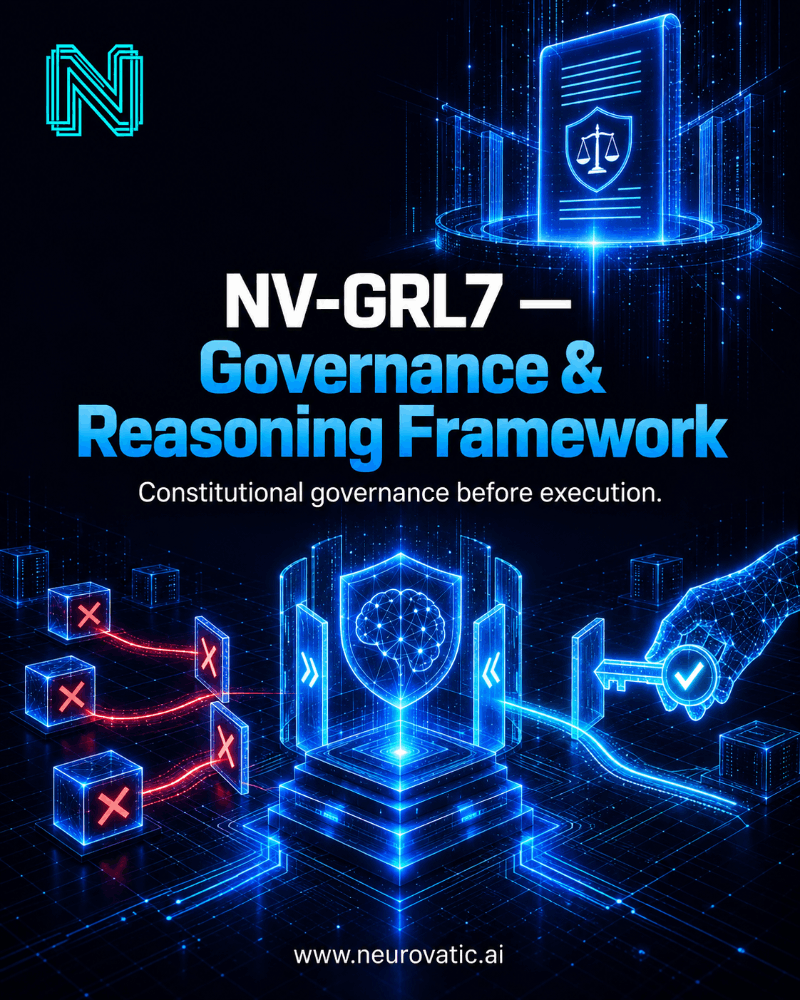
Governance is not a prompt
Conventional AI guardrails are often expressed as natural-language instructions around a model. Those instructions are useful, but they exist in the same semantic environment as the model they constrain. They may be weakened by prompt injection, conflicting context, configuration drift, or an execution path that bypasses the guardrail entirely.
NV-GRL7 takes a different architectural position: governance rules are represented as versioned, machine-readable constitutional obligations and invariants. In a conforming deployment, these rules are compiled into deterministic evaluators and bound to the action record through identity, versioning, hashing, and cryptographic attestation.
The goal is not to make policy sound stronger. The goal is to make it structurally harder for an AI system to act outside the authority it has been given.
Four pillars of the framework
1. Constitutional policy enforcement
Every proposed action is evaluated against a declared policy set before execution authority is created. The policy can define prohibited effects, confidence thresholds, resource boundaries, required evidence, jurisdictional rules, and escalation conditions.
2. Explicit human authority
Actions classified as human-required cannot become authorized merely because a model is confident. The architecture requires a traceable human authorization event — or a deployment-specific multi-party approval — before the execution gate may open.
3. Formal-model assurance
NEUROVATIC uses formal specifications and model checking to examine safety and liveness properties of bounded protocol models. Documented TLA+/TLC runs have explored hundreds of millions of model states without a violation of the specified invariants. That is powerful evidence about the model that was checked; it is not a claim that every future implementation or deployment is automatically correct.
4. Decision provenance by design
The output of governance is not simply ALLOW or DENY. It is a decision record that can bind the intent, evidence, policy version, authorization state, assurance results, cryptographic attestations, and final outcome into one reconstructable chain.
The six foundational NEUROVATIC technologies
NV-GRL7 operates within a six-technology assurance architecture:
- NV-GRL7 — constitutional governance and authorization boundaries;
- UNDECA — decision intelligence, mathematical reasoning, and structured evidence;
- SIGMA — cognitive orchestration and governed execution coordination;
- NPoI — governance-evidence evaluation and proof-oriented deliberation;
- AEGIS — cryptographic identity, integrity, and post-quantum attestation design;
- NV-CHAIN — tamper-evident provenance, anchoring, and replayable audit history.
These are not six marketing labels for the same mechanism. Each addresses a different failure mode: weak reasoning, missing authority, unsafe orchestration, unreviewed evidence, forgeable records, or unreconstructable history.
From recommendation to governed action
The architectural flow is:
INPUT → REASON → GOVERN → ASSURE → PROVE → RECORD → REPLAY
- INPUT: capture the proposed action and its operational context;
- REASON: construct the evidence chain and candidate plan;
- GOVERN: evaluate constitutional constraints and authority requirements;
- ASSURE: verify policy identity, freshness, scope, and cryptographic conditions;
- PROVE: attach bounded formal-model or validation evidence where applicable;
- RECORD: preserve the decision lifecycle in a tamper-evident provenance record;
- REPLAY: reconstruct what the system knew, decided, authorized, and executed.
TLA+ belongs primarily to the formal specification and model-assurance part of this lifecycle. Runtime enforcement is performed by the implementation of the verified rules, state checks, and monitors — not by pretending that a full model-checking run happens for every API call.
Why this matters
A model can be retrained. A policy can be improved. A decision can be challenged.
But a decision trail that was never preserved cannot be reconstructed after the fact.
NV-GRL7 is designed to make governance a first-class system property: before execution, evidence before trust, authorization before autonomy, and provenance before accountability is needed.
Learn more: neurovatic.ai/nv-grl7
-----
This post, including all associated text and visuals, has been generated and assisted by artificial intelligence under the regulatory requirements of the EU AI Act. Powered by NEUROVATIC AI systems.