AI Agents vs. AI Chatbots for Ecommerce: Which Is Better for Your Business?
Ecommerce businesses are increasingly adopting artificial intelligence to improve customer engagement, streamline operations, and reduce friction throughout the buying journey. However, AI agents and AI chatbots serve different purposes, even when they operate through similar conversational interfaces.
An AI chatbot primarily helps customers find information, understand product specifications, track orders, and resolve routine queries. Traditional chatbots rely on predefined conversational flows, while modern AI-powered chatbots can interpret natural language, retrieve relevant information, and maintain conversational context.
AI agents go further by working toward a defined objective. They can analyse customer requests, plan multiple steps, retrieve information from connected systems, and execute authorised actions. For example, a chatbot might explain a return policy, whereas an AI agent could validate an order, check eligibility, initiate a return, and update the customer on the outcome.
The distinction lies in their operational capabilities: chatbots primarily facilitate conversations, while agents can combine conversations with workflow execution.
How AI Chatbots Improve Ecommerce Customer Experiences
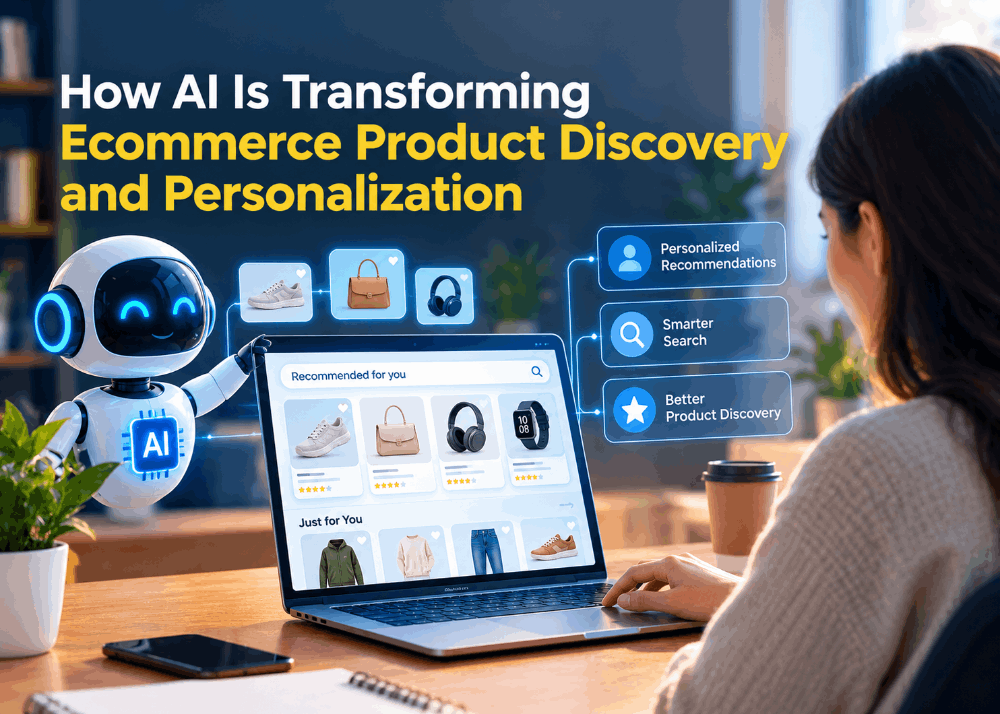
An ecommerce chatbot can support shoppers throughout product discovery and purchasing without requiring them to navigate multiple pages. When connected to a structured product catalogue and an accurate knowledge base, it can answer product questions, explain delivery policies, and recommend relevant items based on customer preferences.
Businesses exploring an AI Chatbot for Ecommerce MVP can begin with a focused implementation covering high-volume customer queries before introducing more advanced automation. This approach allows teams to validate customer demand, evaluate response quality, and identify integration requirements without committing to an extensive system from the beginning.
Common applications include:
- Product discovery: Helping customers filter products by size, specifications, price, availability, and intended use.
- Order assistance: Retrieving shipment updates and explaining delivery timelines through connected order-management systems.
- Cart support: Clarifying product differences, delivery charges, and return conditions before checkout.
- Customer service: Answering frequently asked questions and routing unresolved issues to human representatives.
The effectiveness of a chatbot depends on information accuracy, response relevance, and its ability to recognise when a request requires human assistance. It should not invent stock availability, delivery commitments, or promotional terms.
How AI Agents Automate Complex Ecommerce Workflows
AI agents are particularly useful when a business process involves several systems, conditional decisions, and actions that must occur in a specific sequence.
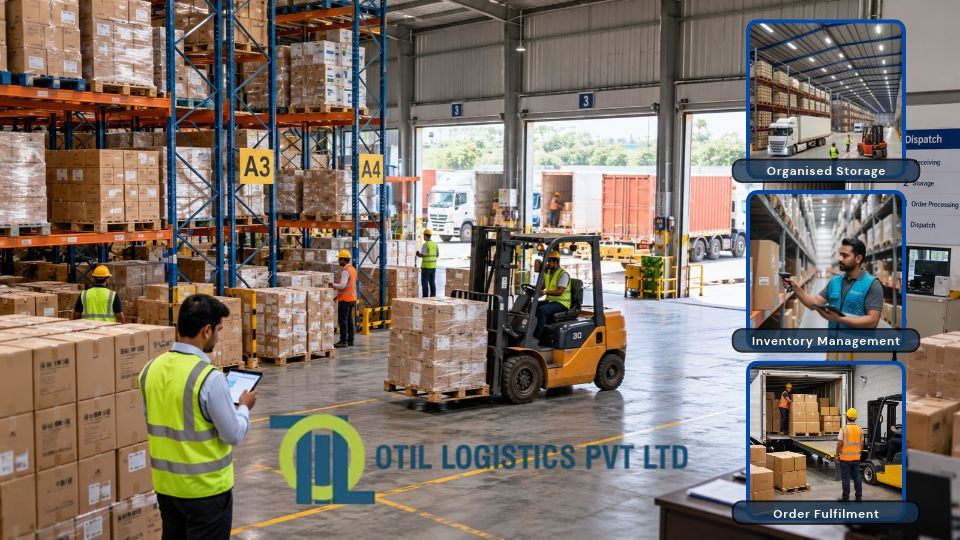
Consider an order delayed because a warehouse cannot fulfil it on time. An AI agent could retrieve shipment information, inspect inventory at alternative fulfilment locations, evaluate approved delivery options, and present a suitable resolution. Depending on its permissions, it might initiate a replacement shipment or request employee approval before changing the order.
This capability requires more than a language model. The underlying architecture typically includes API integrations, business rules, authentication, state management, tool calling, and execution monitoring. Retrieval-augmented generation (RAG) can ground responses in approved business information, while structured API calls allow the agent to interact with inventory, customer relationship management (CRM), and order-management systems.
Practical applications include:
- Inventory coordination: Checking stock across warehouses and identifying suitable fulfilment alternatives.
- Personalised recommendations: Combining purchase history, browsing behaviour, and product attributes to identify relevant options.
- Returns management: Validating return eligibility, generating requests, and initiating approved refund workflows.
- Operational monitoring: Detecting exceptions, gathering supporting information, and escalating unresolved cases to the appropriate team.
However, autonomous execution introduces additional risks. Businesses need permission controls, transaction validation, audit logs, and human approval for sensitive actions such as high-value refunds or order cancellations.
Key Factors to Consider When Choosing the Right Solution
Choosing between an AI chatbot and an AI agent depends on the complexity of the business problem, the reliability of available data, and the level of operational autonomy required. A company handling thousands of repetitive product enquiries may benefit more from a well-integrated chatbot than from a sophisticated agent that introduces unnecessary complexity.
Before selecting a solution, ecommerce teams should evaluate the following factors:
- Workflow complexity: Chatbots are suitable for information retrieval and guided conversations. Agents become more valuable when tasks require multiple API calls, conditional decisions, and coordinated actions.
- Integration readiness: Both solutions need reliable product information, but agents generally require broader access to operational systems. Inconsistent inventory records or unreliable APIs can undermine automated decision-making.
- Risk tolerance: A chatbot can provide information without changing business records. An agent that modifies orders or processes refunds needs stricter authorisation, validation, and monitoring.
- Performance measurement: Businesses should evaluate resolution rate, customer satisfaction, escalation frequency, average handling time, and cost per resolved query. For agents, task completion rate, execution failures, and unauthorised-action prevention are equally important.
A phased implementation is often practical. Start with a clearly defined use case, establish baseline performance, test the system against realistic scenarios, and expand its capabilities only after validating accuracy and reliability.
Making the Right Investment for Long-Term Ecommerce Growth
AI chatbots and AI agents should not be treated as competing technologies in every situation. They can operate together as complementary components of an ecommerce automation strategy. A chatbot can manage customer conversations and gather relevant information, while an AI agent handles complex requests that require coordination across multiple systems.
For example, a customer asking about a delayed delivery could receive an immediate response from the chatbot. If the issue requires checking warehouse availability, comparing fulfilment options, or initiating an approved resolution, the request could be transferred to an agent with the appropriate permissions.
The most effective approach is to match the technology to the operational requirement rather than adopting autonomy for its own sake. Businesses should prioritise measurable improvements, dependable integrations, transparent escalation procedures, and strong data governance.
Ultimately, an AI chatbot is a sensible starting point for improving customer interactions, while an AI agent offers greater potential for automating multi-step workflows. Ecommerce businesses that establish a reliable foundation and expand automation incrementally can improve service efficiency without compromising customer trust or operational control.