Letting Go of Old Ways So You Can Live New

I spent a long time believing that if I just tried harder, I could make things work.
The relationship that kept hurting me—I thought if I loved more patiently, understood more deeply, gave more generously, eventually it would heal. The job that drained me—I thought if I just pushed through a little longer, proved myself a little more, the satisfaction would finally come. The version of myself I'd outgrown—I thought if I just kept performing it, kept showing up as the person everyone expected, eventually I'd feel like her again.
So I tried harder. And harder. And harder.
Until one morning I woke up and realized: Trying harder wasn't fixing anything. It was just keeping me stuck.
The ways I'd learned to survive—pleasing, pushing, proving—had become the very things keeping me trapped. They'd worked once, maybe. Protected me once, maybe. But now they were just habits. Old clothes I'd outgrown but kept wearing because I didn't know who I'd be without them.
I didn't need to try harder. I needed to let go.
The Ways We Learn to Survive
We all develop ways of moving through the world. Strategies we picked up somewhere—in childhood, in past relationships, in jobs that demanded certain versions of us, in cultures that told us who we should be.
For me, it was performance. If I could just be good enough, smart enough, helpful enough, impressive enough—then I'd be safe. Then I'd be loved. Then I'd belong.
For others, it's different. Maybe you learned to stay small, because taking up space once got you punished. Maybe you learned to control everything, because chaos once hurt you. Maybe you learned to never need anyone, because needing once left you disappointed.
These strategies kept us alive. They got us through. We should thank them for that.
But somewhere along the way, they stopped serving and started confining. They became cages we forgot we built. And now we live inside them, pressing against bars we can't see, wondering why we feel so trapped.
The Trap of More Trying
Here's what I didn't understand for so long: You cannot fix an old pattern by applying more of the same pattern.
If you learned to survive by pleasing others, trying harder to please them won't set you free—it'll just exhaust you deeper into the same dynamic.
If you learned to survive by controlling everything, tightening your grip won't bring peace—it'll just make you more anxious when things inevitably slip.
If you learned to survive by never resting, pushing through harder won't restore you—it'll just burn you out faster.
The strategy itself is the problem now. More of it is not the answer.
The answer is letting go.
What Letting Go Actually Means
For a long time, I thought letting go meant giving up. Surrendering. Losing. Failing.
But I've come to understand it differently.
Letting go means:
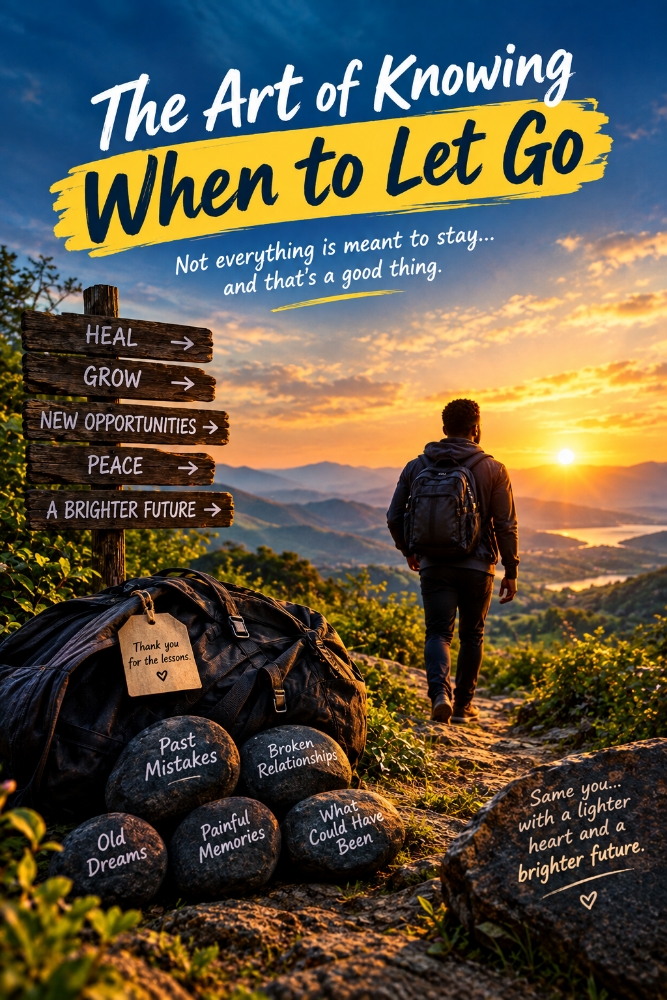
· Releasing the belief that if you just try hard enough, you can make people stay.
· Putting down the burden of being responsible for everyone else's feelings.
· Walking away from the version of yourself that was built for survival, not for thriving.
· Stopping the performance of who you're supposed to be, so you can discover who you actually are.
· Accepting that some things cannot be fixed by trying, and that's not your failure—it's just reality.
Letting go is not passive. It's not weak. It's one of the most active, courageous things you can do. Because it means facing the fear underneath: If I stop doing this, who will I be? What will happen? Will I still be safe? Will I still be loved?
And the answer, terrifying and liberating at once, is: You don't know. But you'll finally find out.
The Letting Go I Didn't Want to Do
There was a relationship I held onto long after it was over. Not because it was good—it hadn't been good for years. But because letting go meant admitting it was really done. It meant facing the empty space where that person used to be. It meant trusting that I'd be okay alone, even though I'd built my whole identity around being part of a pair.
I tried everything except leaving. More conversations. More understanding. More patience. More hoping.
Nothing worked. Because the problem wasn't that I wasn't trying hard enough. The problem was that I was trying to make something work that was already finished.
The day I finally walked away, I sat in my car and wept. Not just from sadness—from relief. From the exhaustion of all that trying finally, finally stopping.
Letting go felt like death. But it turned out to be birth.
What Comes After
Here's what no one tells you about releasing old ways: The new life doesn't arrive immediately. There's an in-between.
A kind of wilderness. A space where the old is gone but the new hasn't yet formed. You walk through days feeling unmoored, uncertain, like you're wearing skin that doesn't quite fit.
This is the hardest part. The temptation is to grab something—anything—to fill the space. A new relationship. A new identity. A new strategy for surviving. Anything to stop the discomfort of not knowing.
But the wilderness has something to teach you, if you stay in it long enough.
In the wilderness, you learn that you can survive without the old strategies. You learn that the fear you avoided—the one underneath all that trying—is actually survivable. You learn that you have resources you didn't know about. A steadiness. A core that was always there, hidden beneath all the effort.
Slowly, without forcing, a new way of being begins to emerge. Not one you designed or planned. One that grows naturally from the ground of your actual self.
What I Found When I Stopped Performing
When I finally stopped trying so hard to be impressive, something unexpected happened: People didn't leave. In fact, some came closer.
Without all the performance, there was actually room for connection. Room for imperfection. Room for realness. The relationships that remained were built on something solid—not on who I was pretending to be, but on who I actually was.
When I stopped trying to control everything, I discovered that life mostly handles itself. Problems arise, yes. But I meet them as they come, rather than exhausting myself trying to prevent things that haven't even happened.
When I stopped equating my worth with my productivity, I found rest. Real rest. The kind that doesn't feel like guilt in disguise.
I didn't become a different person. I became more of the person I'd always been, underneath all the strategies.
The letting go didn't diminish me. It revealed me.
How to Begin
If something in you recognizes this—if you sense that you're holding onto strategies that no longer serve—here's a place to start.
Sit quietly for a few minutes. Ask yourself:
· What's one way I've learned to survive that might now be keeping me small?
· What would it feel like to put that down, even for a day?
· What fear comes up when I imagine releasing it?
· Who might I be without it?
You don't have to let go of everything at once. You don't have to know where you're going. You just have to be willing to open your hand, just a little, and see what happens.
The old ways will resist. They'll tell you you're being foolish, reckless, naive. They'll remind you of all the reasons you developed them in the first place.
Listen to them. Thank them. And let them go anyway.
The New Life
The new life isn't somewhere out there, waiting for you to find it. It's been waiting for you to stop holding onto the old one so tightly.
It's in the breath you take after you stop running.
It's in the stillness after the performance ends.
It's in the relationships that remain when you stop trying to be who you're not.
It's in the version of you that emerges, slowly and quietly, when you finally put down all that weight.
You cannot live a new life with old ways. The container must crack. The soil must be turned. The letting go must happen.
And when it does—when you finally release the strategies that kept you safe but small—you might discover that what you were so afraid of losing was never really yours.
And what's waiting to be found has been there all along.
What old way are you ready to release? What new life might be waiting on the other side?