Are “Decentralized Swaps” Really Decentralized?

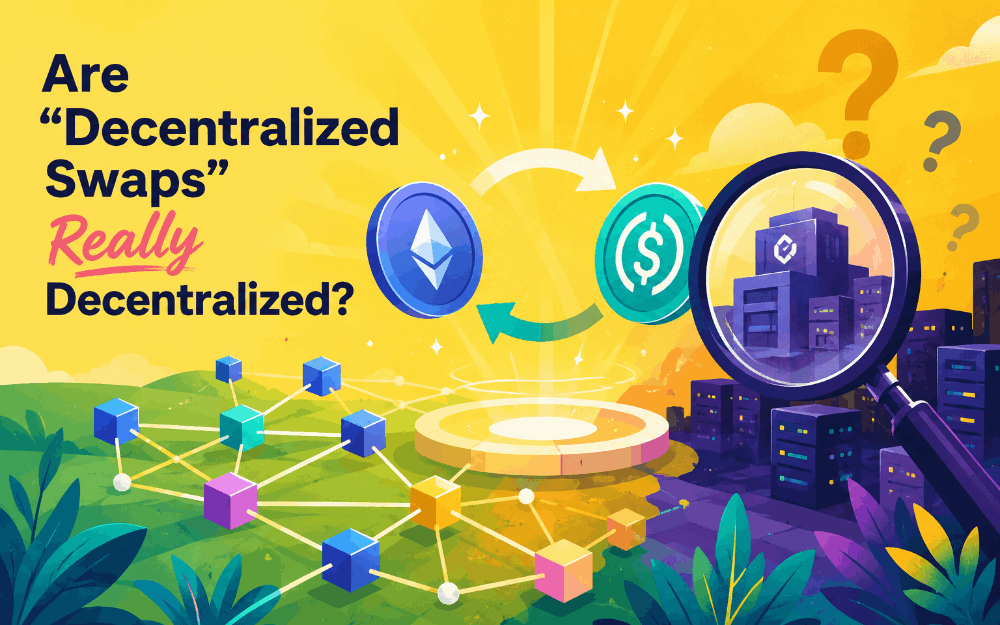
The term decentralized swap is used across the cryptocurrency industry, but it can describe several very different systems.
Some swaps settle through decentralized smart contracts while depending on centralized services to select the route. Others rely on liquidity pools holding millions of dollars in user assets. Cross-chain protocols may add bridges, relayers, validators, solvers, and additional transactions.
Contractless swaps take a much simpler approach:
One peer creates an offer. A second peer accepts it. Both sign the same transaction. The network exchanges both assets in a single atomic operation.
There are no liquidity pools, routing APIs, price oracles, bridges, or swap contracts between the participants.
🧩 The Hidden Layers Behind Wallet Swaps
Many wallets advertise decentralized swaps because the final transaction settles on a blockchain and the wallet remains noncustodial.
That is certainly better than depositing funds into a centralized exchange, but decentralized settlement does not necessarily mean the entire swap process is decentralized.
A typical wallet swap may depend on an external service to:
- Discover available exchanges and liquidity pools
- Request quotes from multiple providers
- Compare prices and estimated fees
- Select the preferred route
- Construct the transaction
- Return that transaction to the wallet for signing
For example, Phantom uses LI.FI to route supported cross-chain swaps. LI.FI describes its API as an off-chain aggregation and routing layer that performs price discovery and fetches quotes from bridges, decentralized exchanges, and solvers. The selected route is then submitted for on-chain execution. Phantom cross-chain documentation, LI.FI architecture
The wallet may remain self-custodial, and the resulting transaction may settle on-chain, but the route-discovery service is still an intermediary.
If that API becomes unavailable, blocks a region, removes a provider, or returns incomplete results, the wallet’s swap feature may stop working even while the underlying blockchains continue operating.
🎯 Who Decides the “Best” Route?
A wallet may say it searches for the best price, but the user must often trust that claim.
A proprietary routing service can technically:
- Prefer affiliated providers
- Exclude competing exchanges
- Rank routes according to commercial agreements
- Add service fees to selected routes
- Hide options it does not want users to choose
- Change its routing policies without changing the blockchain
This does not prove that any particular wallet is manipulating its users. It means the architecture makes such decisions possible and difficult for an ordinary user to independently audit.
The blockchain validates the transaction it receives. It does not prove that the wallet showed every available route or selected the best one.
🏊 Liquidity Pools Introduce Another Risk
Most same-chain decentralized exchanges use automated market makers. Instead of two people directly exchanging assets, users trade against a smart contract containing pooled liquidity.
This is closer to:
Peer → contract and liquidity pool → peer
rather than:
Peer → peer
Liquidity pools provide convenient, immediate execution, but that convenience introduces several risks:
- Smart contract vulnerabilities
- Price manipulation
- Malicious or compromised tokens
- Faulty external protocols
- Drained liquidity
- Impermanent loss for liquidity providers
- Governance and administrative controls
- Frontend or routing dependencies
These risks are not theoretical. Curve governance documented compensation for liquidity providers affected by its 2023 pool exploits, while Balancer has documented incidents where vulnerabilities or failures in connected protocols caused substantial losses to liquidity providers. Curve compensation proposal, Balancer incident report
A liquidity pool is a valuable target precisely because it holds pooled assets.
Contractless swaps do not use liquidity pools. Therefore, there is no pooled Contractless swap balance for an attacker to drain.
That removes an entire category of attack. It does not mean software can never contain a bug, but there is no swap contract or shared liquidity reserve holding everyone’s assets.
🌉 What About Atomic Cross-Chain Swaps?
Atomic swaps and genuinely peer-to-peer exchanges offer stronger decentralization than API-routed wallet swaps.
However, cross-chain trading introduces unavoidable complexity. The two blockchains do not share a common state, so the protocol needs a mechanism such as:
- Hash-time-locked contracts
- Multisignature deposits
- Bridges
- Relayers
- Solvers
- Security deposits
- Transactions on both networks
- Dispute or refund procedures
Bisq is a strong example of decentralized peer-to-peer exchange. Users run the software themselves, control their funds, and trade directly with other users.
That decentralization has a cost. Bisq’s classic protocol uses security deposits and multiple Bitcoin transactions. Its documentation states that a trade requires four on-chain Bitcoin transactions, along with trading fees.
Crypto-to-crypto trades must also transfer the other asset over its own network. Bisq trading costs, Bisq security deposits
Decentralized cross-chain systems may also support fewer active markets than centralized aggregators.
Bisq can theoretically support many altcoins, but its documentation identifies only a smaller group as having active markets, with new additions currently restricted. Bisq altcoin markets
Atomic-swap technology itself does not inherently require a developer fee. However, commercial protocols and interfaces may add trading, bridge, solver, relayer, or service fees on top of each blockchain’s network fees.
True cross-chain decentralization is possible, but it is rarely simple or inexpensive.
⚙️ How Contractless Swaps Work
Contractless swaps remain entirely within the Contractless blockchain. They can exchange:
- CLTC or CLC
- User-created tokens
- NFTs
- NFT series items
- Different combinations of supported Contractless assets
The process is deliberately direct.
1. Two users agree on the exchange
The participants decide which assets and amounts they want to trade.
Contractless does not determine a market price. It does not consult an oracle, exchange, API, or liquidity pool.
The price is whatever both participants willingly accept.
2. The first participant creates and signs the offer
The swap transaction records:
- Both wallet addresses
- The asset supplied by each participant
- The amount supplied by each participant
- NFT series numbers where applicable
- Transaction fees
- Miner tips
- The offer creation time
- The offer expiration time
The first participant signs this exact data.
3. The second participant verifies the offer
The partially signed transaction is sent directly to the other participant.
Before signing, the second participant can verify every part of the offer. Changing an asset, amount, address, fee, tip, or expiration would invalidate the first signature.
4. The second participant signs the same transaction
The second signature proves that both participants agreed to precisely the same exchange.
Neither party signs a vague promise or grants a contract permission to spend an unlimited balance.
5. The network validates the complete swap
Contractless nodes verify:
- Both wallet addresses
- Both signatures
- The existence of both assets
- NFT and series ownership
- Available balances
- Pending mempool balance effects
- Required fees and tips
- Offer expiration
- Duplicate transactions
If either participant no longer owns the required asset or cannot cover the agreed amount, the swap fails validation.
6. Both sides exchange in one transaction
The two transfers are applied together.
There is no moment where one participant receives the other participant’s asset while keeping their own. The swap is accepted as a complete exchange or rejected as a complete exchange.
That is a true same-chain atomic swap.
🛡️ What Contractless Removes
Contractless swaps require no:
- Liquidity pool
- Automated market maker
- Swap smart contract
- Price oracle
- Routing API
- Bridge
- Custodian
- Wrapped cross-chain asset
- Administrative contract key
- Third-party approval
The assets remain in each participant’s wallet until the signed swap is included in a valid block.
There is no pooled swap treasury to exploit, no contract allowance to abuse, and no route provider deciding which market the user is permitted to access.
Participants still pay normal network fees and required miner tips. Contractless swaps are not fee-free; their fees compensate the miner processing the exchange rather than an intermediary controlling liquidity or routing.
🔎 The Matchmaking Tradeoff
Contractless currently provides no built-in swap matchmaking service.
Participants must find one another, agree on terms, and exchange the partially signed transaction themselves. The protocol handles verification and settlement, but it does not decide who should trade or what price they should accept.
That is less convenient than opening a wallet and pressing a button that automatically selects a provider.
It is also honest about where coordination occurs.
Independent applications can eventually provide optional order books and matchmaking services. Those services can help participants find one another without controlling the assets or becoming part of swap validation. If one matchmaking service disappears, users can use another or exchange offers directly.
⚠️ Contractless Swaps Are Not Cross-Chain
Contractless does not claim these swaps can directly exchange BTC, ETH, SOL, or assets located on unrelated blockchains.
Contractless swaps exchange assets recorded on the Contractless blockchain.
Supporting cross-chain swaps would require bridges, external chain monitoring, locked assets, relayers, or atomic-swap protocols. Each would reintroduce complexity and additional trust assumptions that the current swap design intentionally avoids.
This is a limitation, but it is also an important security boundary.
✅ Decentralization Without the Extra Layers
Contractless swaps are not routed through an exchange that claims to know the best price.
They are not executed against assets deposited by liquidity providers.
They do not require a smart contract administrator, bridge operator, solver network, or centralized quote API.
They are direct agreements between two wallet owners, protected by two signatures and enforced as one atomic transaction by the Contractless blockchain.
No pool. No oracle. No hidden route. No intermediary holding the assets.
That is what Contractless means by a decentralized swap.
💬 Interested in Contractless Swaps?
Contractless is currently in testnet development.
If you are interested in decentralized swaps or running a Contractless testnet node, check out our source code, docs and whitepaper which can all be found at:
https://contractless.dev/contractless/Contractless