Rare Earth Minerals Tokenization: From Mining to Digital Assets

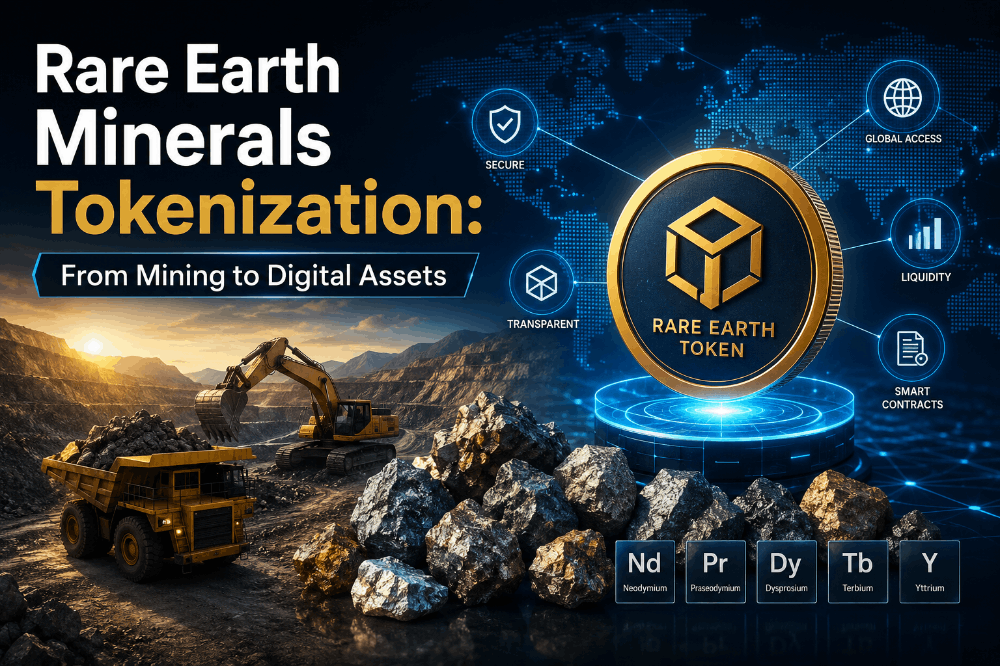
Rare earth minerals tokenization is the process of converting ownership or value rights in physical rare earth deposits, refined stock, or supply contracts into blockchain-based digital tokens. It sits at the intersection of two of 2026's biggest financial themes: real-world asset (RWA) tokenization and the geopolitical scramble for critical mineral security.
It provides a step-by-step breakdown of the process and a look at the individuals involved, along with considerations for investors considering tokenizing rare earths as an investment class.
What Is Rare Earth Mineral Tokenization?
The process of tokenization is fundamentally converting a physical, illiquid asset that is hard to access into a digital token on a blockchain. A single token represents a specific amount of a mineral – be it raw ore, a mineral oxide or a forward contract with a mining company.
An investor can purchase a token with a few grams or a small amount of money of neodymium oxide or small shares in the stock of a mining company. The token is usually supported by the stock of the minerals that are being kept in auditable custody, and the blockchain record provides a transparent and tamper-proof log of the owner of the stock.
This is not a speculation. There are platforms that have been designed around this concept that are already operational, and mining companies have already begun to put themselves into token-based financing arrangements instead of waiting for the traditional capital markets.
Why Rare Earth Minerals Tokenization Is Gaining Momentum in 2026
Rare earth tokenization is on the brink of becoming a real product category, driven by three forces.
1. Geopolitical supply pressure
China owns approximately 90% of the world's rare earth processing and refining capacity, and it has tightened its export licensing regime numerous times over the last two years (2025 and 2026). Heavy rare earths, such as dysprosium, terbium, yttrium and lutetium, are still automatically licensed for shipments to US and allied end users, and industry sources anticipate restrictions on these materials through 2027 as supply of processing capacity outside China gets up to speed.
In response, governments have imposed their own measures, such as the 54-nation critical minerals alliance that was announced early in 2026 and a multibillion dollar US strategic minerals reserve program. That's the kind of market in which financial innovation not only thrives but actually becomes expedient: Tokenization of physical stocks is indeed the ideal means of bringing new mining and refining capacity to life in a hurry than equity or debt.
2. Real-world asset tokenization is maturing
Over the last two years, tokenized real estate, treasuries and commodities are now mainstream, not experimental anymore. Specifically commodities make sense because they can be fungible, graded, and traded under standard contracts, an asset where it's easier to convince people to tokenize than one like real estate.
3. New retail and institutional demand for fractional access
In the past, investing in rare earth elements has involved purchasing stock in mining companies, trading futures contracts (typically not available to individual investors) or declining to invest in the space altogether. A third route is provided in tokenization, where access to the physical commodity is gained directly through fractional exposure, though without the need to store or ship raw ore.
How Rare Earth Minerals Tokenization Works: From Mining to Digital Assets
The typical approach to tokenizing a rare earth mineral is to go through five steps:
- Sourcing and verification — A mining or refining company works with a tokenization platform, and a physical asset (ore, concentrate or refined oxide) is verified by an independent auditor or custodian.
- Custody arrangement — The confirmed minerals are kept in safe and insured storage. It is actually the custodian, not the blockchain, that backs this token's claim to real material.
- Token issuance — Smart contracts create digital tokens on a blockchain (such as Ethereum, Tezos, and other Layer 2 networks) that are each a specific amount of the actual minerals or a promise for future production.
- Trading and settlement — Tokens are traded on exchanges or decentralized platforms, and the blockchain settlement process is used instead of the process of clearing that takes days for physical commodity trades.
- Redemption or rollover — Depending on the platform, token holders can redeem their tokens for physical delivery or cash settlement or just hold them as financial instruments for trade.
Smart contracts can also be used to automate payments of royalties, dividend-like payments based on mine output, and compliance checks, which would otherwise create an administrative burden that made small-scale mineral investment impractical.
Real-World Examples of Rare Earth Minerals Tokenization Platforms
This space has progressed from a white paper to a live product quicker than most people predicted:
- In early 2026, R&D hub Trilitech announced the launch of Metals.io, a tokenized critical minerals marketplace that enables investors to gain exposure to rare earth oxides and other critical minerals through smart-rollup technology that settles transactions almost instantly.
- Datavault AI and American Strategic Minerals announced a partnership to tokenize metals mined and refined in the United States, including the first-ever digital asset backed by antimony, and later by silver, gold and other rare earth elements refined in the United States, which explicitly includes a commitment to decreasing dependency on foreign-controlled supply chains.
The Bottom Line
The tokenization of rare earth minerals is a serious effort to address a serious issue – a resource that has been traditionally challenging for most investors to access directly and is considered critical and thus highly sought after in a geopolitically tense area. The technology is real, the platforms are real and the timing is not coincidental, considering the current global rush for the security of vital critical minerals.
However, it is still an emerging market. The deeper we get into custody and regulation and the more liquid an asset class becomes, the more it needs to be built out. Anyone thinking about exposure should not think twice about holding any new financial instrument attached to a volatile physical good, and become familiar with the entity that provides the backing, whose responsibility is it, and what do they do if their platform, their custodian or their supply chain gets into trouble?