Choosing an EVM-Compatible Blockchain: Enterprise Considerations in 2026
The Ethereum Virtual Machine (EVM) has become one of the most widely adopted standards for smart contract development, enabling applications to be deployed across multiple compatible networks with relatively small code changes.
This article provides a high-level comparison of several widely used EVM-compatible ecosystems and discusses where each architecture may be appropriate depending on organizational requirements.
Key Evaluation Criteria
When evaluating an EVM-compatible blockchain, organizations commonly assess several technical and operational characteristics:
- Performance — throughput, latency, and transaction finality.
- Security Model — validator architecture, consensus design, and resilience.
- Governance — how protocol upgrades and network decisions are managed.
- Compliance Support — auditability, logging, identity integration, and regulatory considerations.
- Ecosystem Maturity — developer tools, infrastructure providers, wallets, and community adoption.
- Application Fit — whether the architecture aligns with the intended workload.
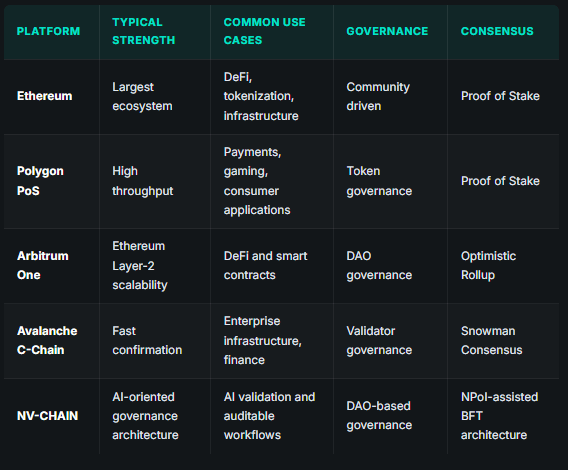
Example Comparison
Ethereum
Ethereum remains one of the most established smart contract ecosystems, offering extensive tooling, documentation, developer support, and interoperability. Organizations that prioritize ecosystem compatibility or integration with existing decentralized applications often consider Ethereum as a reference platform.
Polygon
Polygon focuses on improving scalability while maintaining compatibility with the Ethereum ecosystem. Its architecture is commonly used for applications requiring higher transaction throughput and lower operational costs.
Arbitrum
Arbitrum provides Layer-2 scaling for Ethereum by processing transactions off-chain while leveraging Ethereum for settlement. It is frequently selected for applications seeking greater scalability while remaining closely integrated with the Ethereum ecosystem.
Avalanche
Avalanche emphasizes low-latency transaction processing and flexible network deployment. Its subnet architecture enables organizations to create application-specific blockchain environments with configurable validator participation.
NV-CHAIN
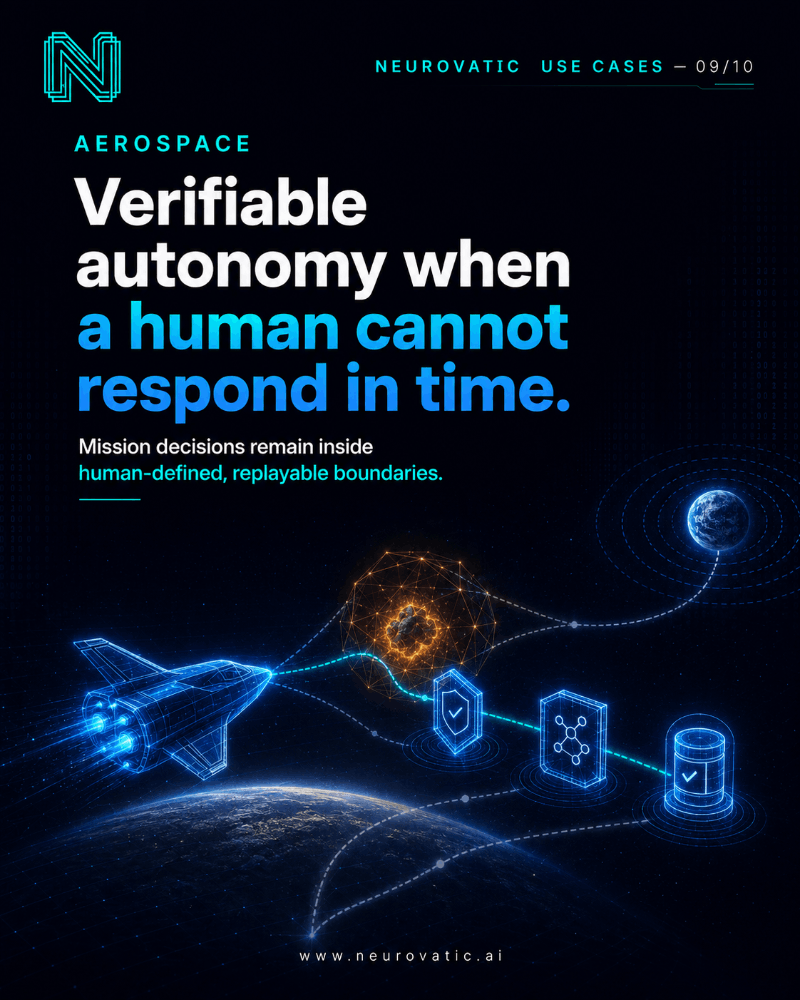
NV-CHAIN is designed as part of the broader NEUROVATIC ecosystem and focuses on supporting AI-assisted decision workflows that benefit from cryptographic verification and transparent governance.
Its architecture is intended to support capabilities such as:
- Cryptographically verifiable AI validation workflows.
- Immutable audit records for supported operations.
- Governance mechanisms designed for AI-assisted ecosystems.
- Support for modular reasoning components integrated with the broader NEUROVATIC platform.
- A roadmap that includes continued research into advanced cryptographic techniques.
The platform is intended for organizations exploring architectures where AI, governance, and blockchain infrastructure operate together within a unified ecosystem.
Selecting the Right Platform
Rather than asking which blockchain is “best,” organizations should begin by identifying their primary technical and business requirements.
Questions worth considering include:
- Is broad ecosystem compatibility the highest priority?
- Are transaction throughput and operating costs primary concerns?
- Does the application require transparent governance or auditable decision workflows?
- Will AI systems become part of the operational infrastructure?
- Are regulatory compliance and traceability significant design constraints?
Different answers naturally lead to different architectural choices.
Many enterprise deployments combine multiple blockchain platforms, using public networks where interoperability is important while deploying application-specific infrastructure for specialized workloads.
For additional information about the NEUROVATIC ecosystem, architecture documentation, and technical resources, visit: