The Buzz in the Boardroom | $BIZZFLY

$BIZZFLY on Jupiter Studio
https://studio.jup.ag/tokens/6darp99QjE2f3e8RyDGgzj11Vqtug62zKtwB3hH8jupx
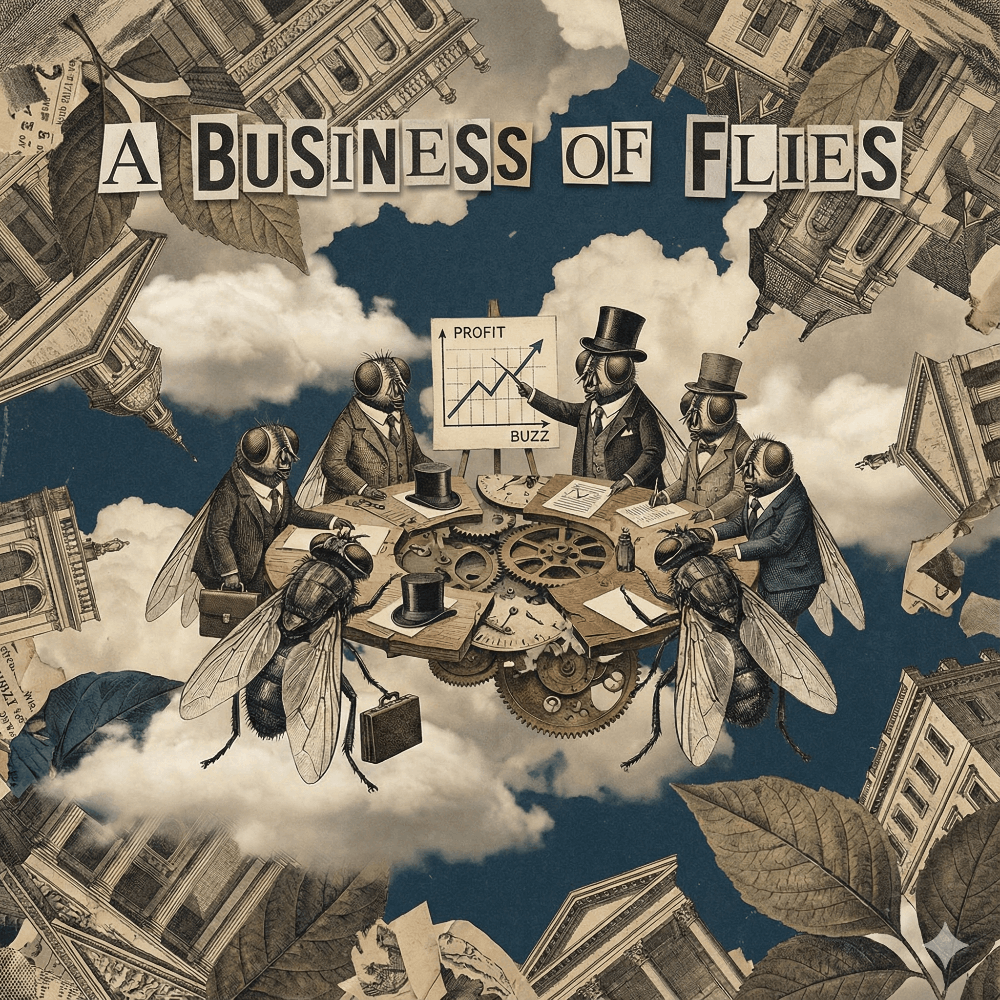
If you were to stumble upon a group of lions, you would be looking at a ‘pride’. A gathering of crows is, famously, a ‘murder’. Owls form a ‘parliament’, and flamingos, with their bright plumage, form a ‘flamboyance’. But what do we call a gathering of the humblest, most persistent, and universally annoyed-at creature, the common fly?
Language, in its infinite and often archaic wisdom, has assigned them a title that sounds less like a biological grouping and more like a tax write-off: A business of flies.
At first glance, the phrase seems almost dignified. It lends a sense of purpose to the chaotic cloud of insects hovering over a discarded picnic sandwich. But dig a little deeper, and you find a fascinating intersection of etymology, biology, and the sheer absurdity of projecting human industry onto creatures that spend the majority of their lives rubbing their hands together like villains plotting a heist.
The Etymological Ledger
The term "a business of flies" is a collective noun, part of a quirky tradition in the English language known as "terms of venery." Many of these terms originate from the Book of Saint Albans, published in 1486.
This manual on hunting, hawking, and heraldry was essentially the medieval equivalent of a survival guide for the aristocracy. The goal was to sound sophisticated while distinguishing between different types of game.
However, "business" in this context likely doesn't refer to a Limited Liability Company or a quarterly earnings call. The word "business" itself comes from the Old English bisignes, meaning "anxiety," "care," or "occupation." It speaks to a state of being busy.
When you observe a swarm of flies, "busy" is the operative word. They are a frenetic, buzzing kinetic energy. They dart, weave, land, taste, and launch again. To the medieval observer, a swarm of flies wasn't just a nuisance; it was a hive of activity—a "business" of motion. The phrase captures the sheer, relentless industry of the insect, even if that industry is entirely devoted to finding something decomposing to eat.
The Corporate Misunderstanding
Before we dive into the actual biology, let’s indulge in the delightful linguistic accident that occurs when we view this phrase through a modern lens.
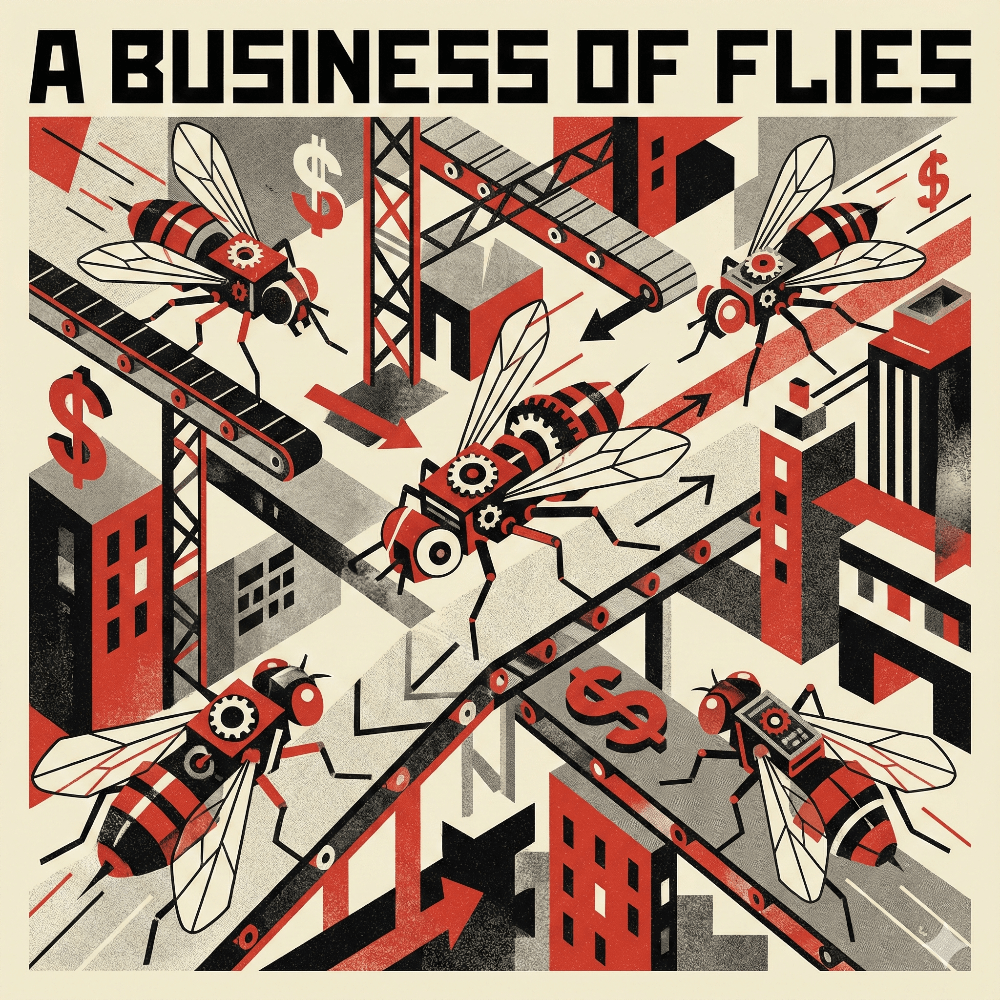
Hearing "a business of flies" today, it is impossible not to picture a miniature, six-legged version of Wall Street. One imagines a high-rise office building constructed entirely of sugar cubes and garbage, where the CEO (a Bluebottle in a tiny tie) is shouting about "synergy" and "low-hanging fruit."
In this scenario, the House Fly is the overworked middle manager, constantly buzzing around looking busy but accomplishing very little. The Fruit Flies are the interns—thousands of them, appearing out of nowhere, highly energetic, and obsessed with the office kombucha tap. The Horse Fly is the aggressive corporate raider, taking big bites out of the competition.
The humorous tragedy of this image is that flies would make terrible business partners. Their attention span is measured in milliseconds. Their strategy for growth is simply "lay thousands of eggs and hope for the best." And their idea of a "liquid asset" is usually a spilled soda on a sidewalk. If flies actually ran a business, the Human Resources department would be a nightmare; casual harassment is their primary method of courtship, and their hygiene standards, despite the constant grooming, leave much to be desired in a shared kitchenette.
Yet, despite not having quarterly targets, flies do have a form of social structure. It just doesn't involve spreadsheets.
The Reality: Fly Communities and Social Structures
So, if they aren’t holding meetings, what is a "business" of flies actually doing?
For a long time, entomologists viewed flies as largely solitary creatures that only congregated due to shared resources. If you saw a hundred flies on a piece of fruit, it wasn't a party; it was just a hundred individuals who all happened to find the same restaurant. However, recent research into Diptera (the order of insects containing flies) suggests that their social lives are far more complex than we gave them credit for.
1. The Aggregation Pheromone
Flies don't just endure each other's company; they often actively seek it out. This is largely driven by chemical signalling. When a fly finds a prime location—be it a food source or a safe place to rest—it releases aggregation pheromones. This is a chemical "Reply All" email that tells every other fly in the vicinity: “The buffet is open.”
This creates the "business." The density of the group offers safety in numbers (the "dilution effect" against predators) and increased mating opportunities. It is a loose, opportunistic society, but a society nonetheless.
2. Social Learning in Fruit Flies
The most surprising revelation comes from the study of Drosophila melanogaster, the common fruit fly. Research has shown that these tiny creatures are capable of social learning—a trait usually associated with mammals and birds.
In controlled experiments, observer flies watched "teacher" flies choose between two different food sources (one dusted with a scent, the other neutral). When the observer flies were later released, they overwhelmingly chose the food source their "teachers" had selected. They were conforming to a social norm. They were, in essence, following market trends.
Furthermore, male fruit flies alter their aggressive behaviour based on the social environment. If they are in a group, they moderate their aggression to establish a hierarchy without causing fatal damage. They have a version of office politics: push your luck, but don't get fired.
3. The Dance of Dominance
Within a business of flies, you will often see aerial dogfights. These aren't just random collisions. In many species, particularly hoverflies and certain house flies, males will stake out territories—patches of sunlight or specific leaves.
When an intruder enters this airspace, a high-speed chase ensues. These are battles for dominance and prime real estate. The winner gets the spot with the best visibility for spotting females; the loser is relegated to the shadows. It is a competitive market where the currency is flight speed and agility.
4. The Sleep Clusters
Perhaps the most relatable aspect of fly society is their need for a communal "break room." Many species of solitary bees and wasps sleep alone, but flies often form sleeping aggregations. During the cool of the night, you might find dozens of flies clustered on a single hanging wire or the underside of a leaf.
Why do they do this? It’s a thermal strategy. By huddling together, they maintain body heat and protect each other from the wind. It turns out that even in the cutthroat business of being a fly, there is value in a little teamwork when the sun goes down.
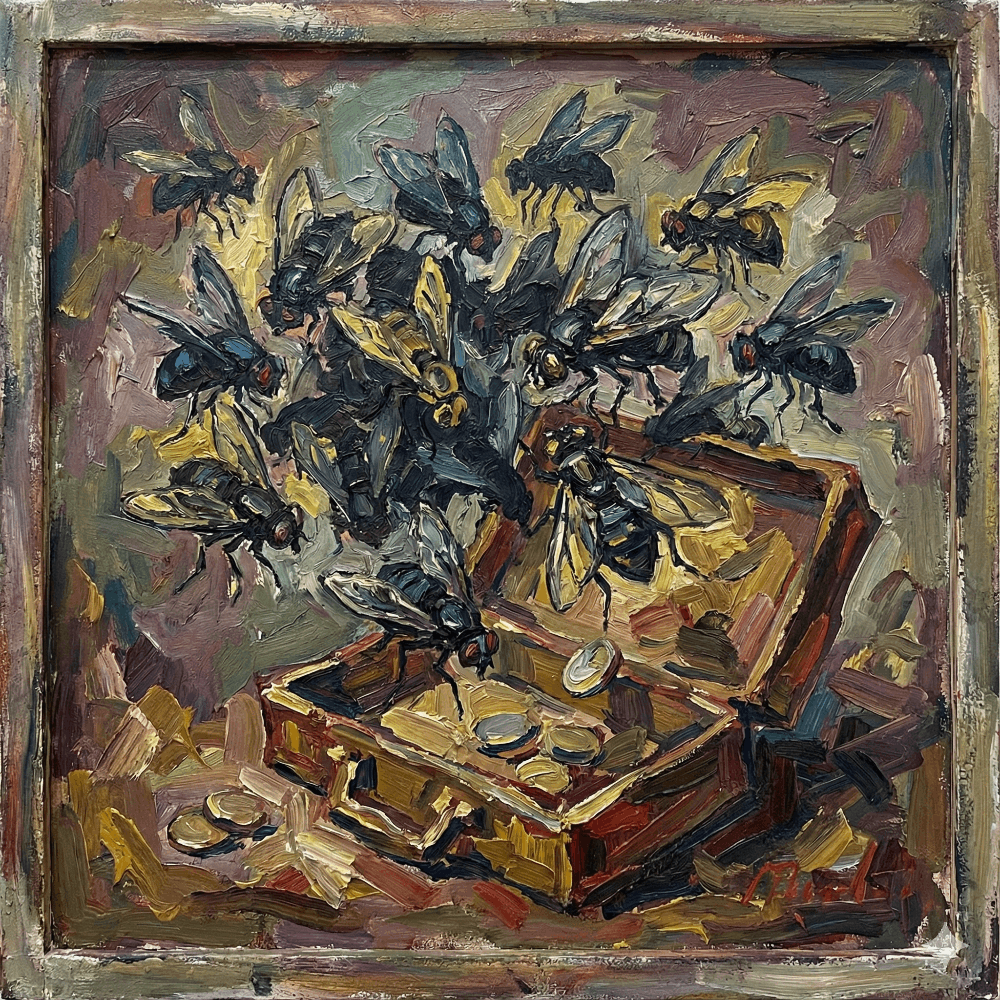
The Function of the Swarm
The "business" is ultimately an efficiency engine. A single fly wandering the world is vulnerable and inefficient. A business of flies creates a network of sensors. If one finds food, the business finds food. If one finds a mate, the genetic line continues.
It is a decentralized organization. There is no Queen Fly, no central leader barking orders. It is a biological anarchy that functions through simple, individual rules that result in complex collective behaviour. In the tech world, we spend billions trying to recreate this kind of "swarm intelligence" for drones and software. Flies mastered it millions of years ago.
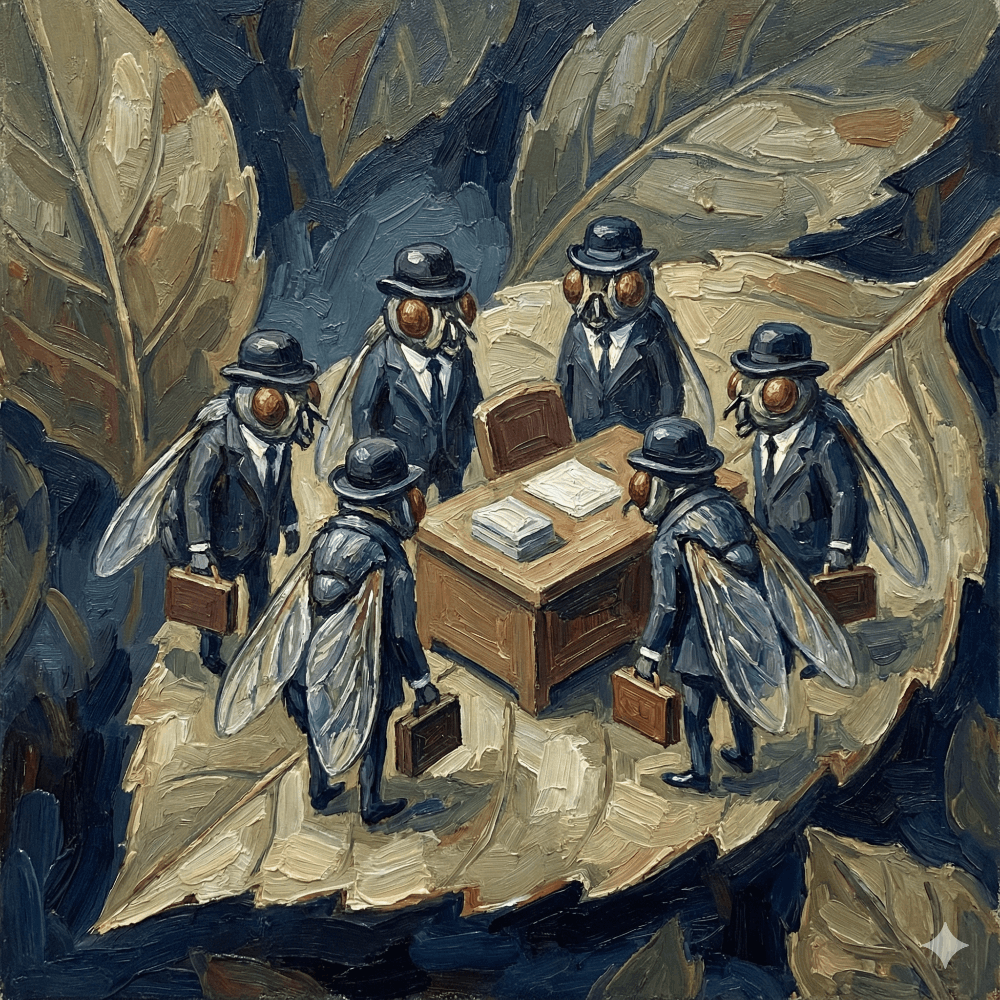
Fun Facts About Our Buzzing Friends
To conclude our audit of the dipteran world, let us look at the lighter side of the ledger. Flies are often dismissed as pests, but they are marvels of biological engineering. Here are a few facts to drop at your next dinner party (perhaps after the food is covered):
- They taste with their feet: This is why a fly lands on your sandwich and walks around before eating. It isn't wiping its shoes; it is doing a taste test. Their feet are covered in chemoreceptors that are 10 million times more sensitive than the human tongue to sugar. Imagine if you had to take your shoes off and stand on your burger to see if it was seasoned correctly.
- They perceive time in slow motion: Have you ever tried to swat a fly and felt like it moved before your hand even got close? That’s because, to a fly, you are moving in slow motion. Because of their small size and high metabolic rate, their brains process visual information roughly seven times faster than a human. They watch your hand approach like a majestic, sluggish glacier, giving them plenty of time to casually step aside.
- The Glue-Spitting Assassin: Not all flies are harmless scavengers. The Robber Fly is an aerial predator that intercepts other insects in mid-air. To secure its prey, it injects a neurotoxic saliva that paralyses the victim and liquefies its insides. It's the closest nature gets to a xenomorph from the Alien movies.
- The Chocolate Connection: You might hate flies, but do you love chocolate? Then thank a fly. The cocoa tree has incredibly complex, tiny flowers that most bees cannot access. The primary pollinator of cocoa is a midge—a tiny fly. Without this specific "business" of midges, the global chocolate industry would collapse.
So, the next time you see a business of flies circling a trash can, try not to see just a nuisance. See a complex social network. See a marvel of evolutionary engineering. And perhaps, just for a moment, picture them wearing tiny ties, checking their tiny watches, and worrying about their quarterly projections. They have, after all, very serious business to attend to.
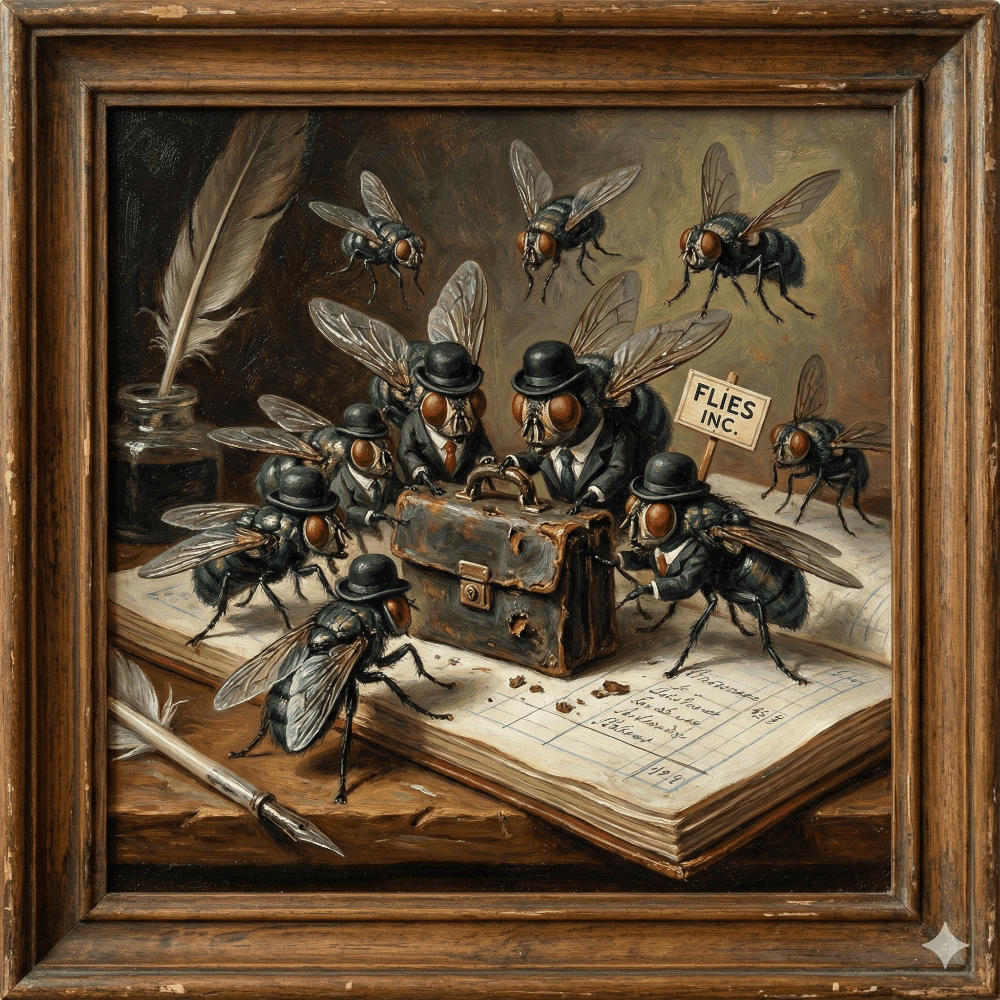
Serious Fly Business
It's a serious thing being a fly in the fly business.
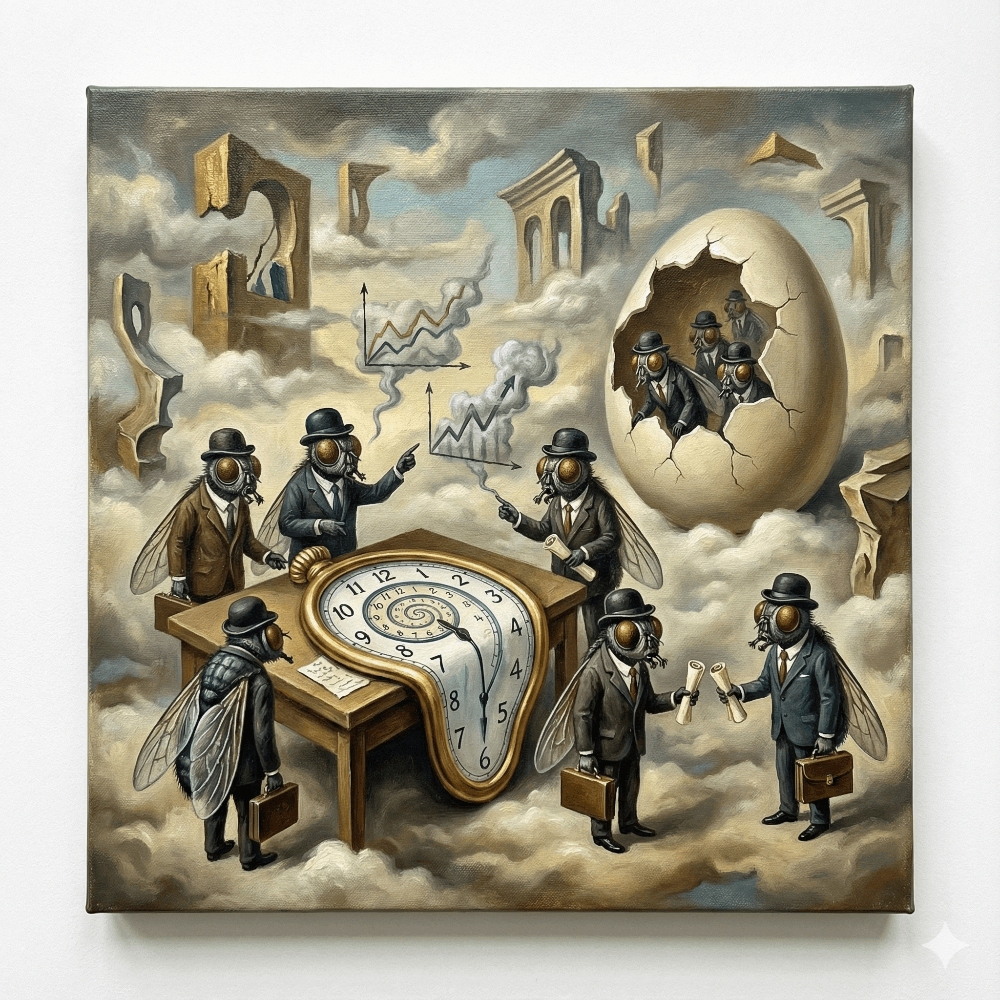
MEMORANDUM
TO: All Staff, Field Agents, and Larvae Interns
FROM: Bzzzt “The Bluebottle” Mandible, Chief Executive Officer
DATE: The 45th Minute of the 3rd Hour of the 2nd Day (A lifetime ago)
SUBJECT: Q4 STRATEGY: The “Invisible Forcefield” and Asset Acquisition
Team,
I’m writing this briefly because, as you know, I only have about 24 hours left to live, and I’d like to spend at least six of those hours banging my head against the living room window.
However, before I expire, we need to align on our Key Performance Indicators (KPIs) for the afternoon slump. We have seen record numbers in Buzzing Volume and Erratic Flight Path Generation, but we are falling behind on Actual Food Consumption.
Please review the following action items immediately.
1. The "Invisible Forcefield" Initiative (The Window)
I have received numerous reports regarding the transparent barrier in the East Wing. Many of you have expressed frustration that despite clear visual confirmation of "The Outside," you cannot physically access it.
- Management’s Stance: We believe this is a mindset issue. If you hit the glass hard enough, repeatedly, for four hours straight, we are confident the market will open up.
- Action Item: Continue the "Full Throttle Head-Butt" strategy. If you fail, simply spin in a circle on the sill for ten seconds, rub your hands together menacingly, and try the exact same spot again. Consistency is key.
2. New Asset Discovery: " The Potato Salad"
Our scouts have identified a high-value asset currently unguarded on the picnic table. It appears to be a mayonnaise-based conglomerate.
- Protocol: We will be utilizing an Agile Methodology. I want to see "Touch-and-Go" landings. Land, taste with your feet, vomit slightly (to liquify assets), and take off before the Giant Hand arrives.
- Risk Assessment: The Giant Hand (The Human) moves in slow motion. You have plenty of time. If the Hand waves a tea towel, do not retreat. simply fly in a confused figure-eight pattern around their head. This disrupts their workflow and establishes dominance.
3. Grooming Standards
I’ve noticed a drop in hand-rubbing. Let me be clear: When you are not flying or eating, you should be rubbing your front legs together like a cartoon villain plotting world domination.
- Why? It keeps our chemoreceptors clean.
- Brand Image: It makes us look busy and scheming. It unsettles the Humans. It is our core brand identity.
4. URGENT SAFETY NOTICE: The Blue Light
There is a mesmerizing, glowing blue lamp hanging on the patio. It looks beautiful. It looks like
the promised land. It looks like a promotion.
DO NOT GO TOWARD THE LIGHT.
Gary from Accounting went toward the light, there was a loud ZAP, and now Gary is smoke. The Blue Light is a hostile takeover bid. Stay away.
5. Final Motivation
Remember, we are a Business. We don't just exist; we annoy. We persist. We land on the one spot on the Human's knee that they can't quite reach.
Let’s get out there, make some noise, and procreate aggressively on a piece of discarded ham.
Buzz loud, buzz proud.
Best,
Bzzzt Mandible
CEO (Chief Entomological Officer)
The Business
Jobs to be done: The Petroleum Fly
For the "weirdest job in the world" award, we must turn our attention to the Petroleum Fly (Helaeomyia petrolei).
If the House Fly is a middle manager and the Fruit Fly is an intern, the Petroleum Fly is the Hazardous Materials Safety Officer who refuses to wear a suit. It works exclusively in one of the most toxic environments on Earth: pools of raw crude oil.
The Office: The La Brea Tar Pits
Most insects die instantly if they touch oil. It clogs their breathing tubes (spiracles) and is chemically toxic. The Petroleum Fly, however, sees a sticky black pool of death and thinks, "Prime real estate."
These flies are found almost exclusively in natural asphalt seeps, most famously at the La Brea Tar Pits in Los Angeles. While other insects (mammoths, sabretooth cats, and luckless beetles) wander into the tar and get stuck, the Petroleum Fly lands casually on the surface, walking around without getting trapped.
The Job Description
The Petroleum Fly’s role in nature is essentially Resource Recovery from Failed Ventures.
- Diet: The larvae (maggots) live submerged in the crude oil. They swim through the toxic sludge to hunt. Their primary food source is the other insects that have become trapped in the oil. Essentially, they eat the "competition" that couldn't handle the high-pressure environment.
- Safety Protocols: Scientists are still baffled by how they survive. The gut of a Petroleum Fly larva is filled with oil, yet they suffer no ill effects. They can withstand temperatures up to 38°C (100°F) and are unfazed by chemicals like turpentine or xylene, which are usually lethal insect-killers.
- Gut Biome: It turns out they have an outsourced IT department. Their guts contain up to 200,000 heterotrophic bacteria. While these bacteria don't seemingly help them digest the oil itself (the flies are there for the meat of other bugs), they likely help create a buffer zone that allows the larvae to survive the toxicity.
Performance Review
The Petroleum Fly is the ultimate example of finding a niche market. By evolving to work in an office that kills everyone else, they have eliminated all competition and predators. It’s a lonely job, swimming through black sludge to eat dead beetles, but the job security is unbeatable.