MiCA from a StrDome User’s Perspective

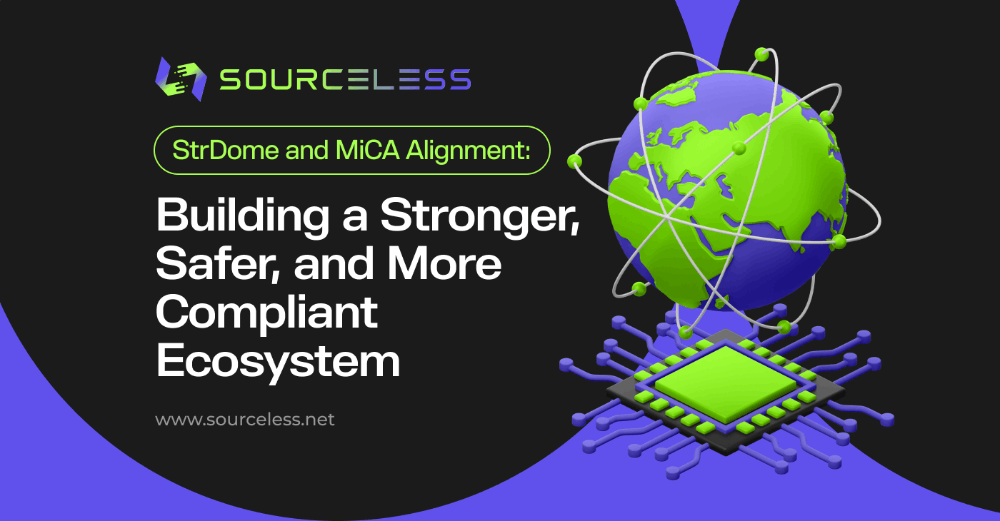
What Europe’s Crypto Regulation Means for StrDome Users
If you’re using StrDome to build a business, earn commissions, and grow within the SourceLess ecosystem, regulation is probably not the first thing on your mind. You’re here to build something and see results.
But the regulatory environment affects how the platform operates, from verification to payouts to how your earnings are processed. And with Europe’s MiCA regulation now fully in effect, it’s worth understanding what that means for you specifically.
We recently published a detailed breakdown of MiCA and how it’s reshaping crypto in Europe. You can read that here: (Crypto’s Rulebook: Europe’s MiCA Regulation Explained).
In this article we’re not going to talk about the regulation itself but about how it touches your experience as a StrDome user. We hope you’ll find it useful.
Why Verification Is Needed
StrDome is a platform where users purchase ecosystem packages, earn commissions as sellers and associates, redeem vouchers into ecosystem value, and withdraw earnings. Once real financial flows are part of the activity, compliance becomes mandatory.
If you’ve gone through KYC on StrDome, you’re probably already familiar with the process.
Documents, identity checks and waiting for approval. If you’re just getting started, please know that any platform that handles real financial operations — commissions, payouts, transfers — is required to verify who its users are. This is not a StrDome policy decision. It’s a legal requirement under European AML (anti-money laundering) rules, and MiCA reinforces it.
The regulation requires that platforms know who they’re paying. And verifiably. That means one identity per account, proper documentation, and checks that the person receiving funds is who they say they are.
From a regulatory standpoint, it’s what separates legitimate platforms from ones that get shut down. And we’ve seen such examples more recently. And from a practical standpoint, it protects you too — it means the platform you’re building on has a legal foundation, not a grey-zone operation that could affect your experience as a user.
Why Payouts Take Time
One of the most common questions in any commission-based system is: when do I get paid?
Under MiCA and related compliance frameworks, payouts involve more than clicking a button. Before funds move, platforms are required to run verification cycles, AML (anti-money laundering) checks, and transaction validation. If something flags, like a documentation issue, an inconsistency, a threshold that triggers additional review, that has to be resolved before the payout can be processed.
So, the potential “slowness” is not an issue of platform’s functionality but one of compliance: doing things correctly does take time. The other way of doing things would mean rushing payouts without proper checks. And that’s exactly what gets platforms into legal trouble and puts user funds at risk.
So when there’s a delay, it’s usually not arbitrary. It’s the system working as it’s supposed to under the current regulatory environment.
How Payout Processing Actually Works
Beyond the verification checks, there’s a structure to how payouts happen. StrDome uses a standardized cycle: weekly withdrawal deadlines, fixed verification days, and progressive payouts within a controlled window. This is not arbitrary; it’s what allows the platform to process payments accurately, maintain audit-ready records, and treat every user fairly.
A core part of this process involves what’s called Source of Wealth (SOW). Essentially, the platform needs to justify not just that you’re being paid, but why and how much. The commission calculation itself becomes part of the compliance process. Every payout has to match the platform structure, the legal payout logic, and your verified participation status. That’s why payouts are reviewed rather than executed automatically.
This also means there are no manual exceptions. No preferential processing, no arbitrary overrides. The same rules apply to everyone, and every decision is traceable. It’s the only way to maintain fairness and eliminate manipulation risk in a regulated environment.
What MiCA Actually Requires
Without repeating the full explainer (again, the detailed article is here), here’s what’s relevant for StrDome users:
- Identity verification is mandatory. Platforms operating in Europe — or serving European users — must verify user identities. This applies to anyone receiving payouts or participating in financial operations within the ecosystem.
- Transaction monitoring is required. Platforms must track and review transactions, especially larger ones. This is part of anti-money laundering compliance and applies across the industry.
- Marketing and communication standards exist. MiCA requires that platforms communicate clearly and accurately — no misleading claims, no vague promises. This affects how StrDome (and SourceLess broadly) talks about opportunities, earnings, and what users can expect.
- One account, one identity. Duplicate accounts, shared identities, or attempts to bypass verification create compliance problems. The regulation is designed to ensure that every participant in the system is a real, verified person.
How This Benefits You Long-Term
Compliance is not exactly something most people get excited for. We get it. Nobody joins a platform because of its regulatory alignment. But here’s what operating within MiCA means practically:
The platform can work with banks and payment processors. Traditional financial institutions are cautious about crypto. A MiCA-compliant operation has legal standing that makes partnerships possible — which translates as better infrastructure for moving funds.
The platform has staying power. Projects that ignore regulation tend to run into problems eventually — frozen accounts, legal action, sudden shutdowns. While compliance is not a guarantee of success, it removes a major category of risk.
Your earnings are legitimate. When you receive a payout from a compliant platform, it’s not grey-area money. It’s income from a legally operating system, which is absolutely crucial for taxes, for banking, and building something real.
SourceLess — and StrDome as part of it — is working toward full MiCA alignment across all its services. That’s a complex, ongoing process that involves legal structuring, operational procedures, communication standards, and continuous adaptation as regulations evolve.
For you as a user, this means:
• Verification requirements will stay in place (and may evolve)
• Payout processing will follow compliance procedures
• Communication from the platform will aim to be clear and accurate
• The ecosystem is building for long-term legitimacy, not short-term hype
A Note on Accuracy
One more thing worth mentioning: in regulated finance, payment discrepancies have to be corrected. If a payout is ever higher than it should be — whether due to a technical error or anything else — users have a responsibility to report it and cooperate with correction procedures. This professional standard and part of maintaining the clean financial records that MiCA compliance requires. It protects the platform, and it protects you.
Wrapping up…
None of this changes what StrDome is: a platform for building a Web3 business, earning through carefully structured systems, and growing within the interconnected SourceLess ecosystem. But it does mean that growth happens within a framework designed to last.
Regulation is not the reason you’re here. You’re here to build something. But understanding the environment you’re operating in helps you make sense of how things work — why verification exists, why payouts take time, why the platform operates the way it does.
MiCA is now the law in Europe. StrDome operates within it. And for users who are serious about creating something sustainable, that’s actually a good thing.
For more on the SourceLess ecosystem: sourceless.net
For the full MiCA breakdown: https://sourcelessblockchain.medium.com/cryptos-rulebook-europe-s-mica-regulation-explained-673b1fb87d54