The $16 Trillion Mirage: Why TradFi is Accidental Web3 (And They Don't Even Know It)

A cynical, data-backed guide to how Wall Street is copying crypto's homework while pretending to hate it.
Introduction: The Great Wall Street Masquerade
Let’s play a quick game.
Imagine a system where financial institutions trade billions of dollars using paper documents sent via DHL, wait three to five business days for settlement, pay millions in middleman fees, and pray that nobody fat-fingers a spreadsheet in London.
Now imagine that exact same system, but someone slapped a shiny "Digital Transformation 2026" PDF presentation over it.
Welcome to modern Traditional Finance (TradFi).
For the past decade, institutional suits have stood on public stages telling the world that “crypto is just funny internet money for speculative degens.” Yet, behind closed doors, the exact same risk departments are desperately trying to build on-chain settlement systems because their legacy infrastructure is literally held together by duct tape, COBOL code from 1980, and overworked junior analysts.
The irony? TradFi isn't just adopting Web3—they are accidentally becoming Web3.
Today, we are diving deep into the $16 Trillion Real-World Asset (RWA) tokenization supercycle, why the current global trade finance model is functionally broken, and how Chain Abstraction is quietly eating the institutional world alive. Grab your coffee—this is going to get spicy.
Part 1: The $16 Trillion Elephant in the Boardroom
If you ask a typical crypto trader what RWA means, they’ll probably tell you it’s “buying a fraction of a Rolex or a Miami apartment on Solana.”
While fractionalized luxury items make for great Twitter/X headlines, the actual institutional tidal wave isn't happening in luxury goods. It's happening in Trade Finance, US Treasury Bills, and Cross-Border Working Capital.
According to Boston Consulting Group (BCG), the tokenization of global illiquid assets is projected to hit $16 Trillion by 2030. To put that in perspective:
That is roughly 10% of global GDP.
It’s larger than the entire market cap of the S&P 500's top tech giants combined.
It’s enough money to buy every single meme coin on Pump.fun, throw it into the ocean, and still have enough left over to buy small sovereign nations.
PROJECTED TOKENIZED ASSET GROWTH (2030) |
+-------------------------------------------------------------+
| Real Estate & Infrastructure : $3.8 Trillion |
| Private Equity & Venture : $3.2 Trillion |
| Debt & Trade Finance : $4.1 Trillion |
| Public Bonds & Treasury Bills: $2.7 Trillion |
| Other Alternative Assets : $2.2 Trillion |
+-------------------------------------------------------------+
| TOTAL MARKET SIZE : ~$16.0 Trillion
Why are institutions suddenly obsessed with putting these assets on a ledger? Because legacy trade finance is currently running on 19th-century mechanics.
Part 2: The Bill of Lading Comedy Show
Let's talk about the Bill of Lading (BoL).
If you buy a shipping container of coffee beans from Brazil to sell in Europe, you need a Bill of Lading. It is the holy document that proves ownership of the physical goods inside that container.
Do you know how 80% of global shipping trade still handles this in 2026?
1. The paper document is printed in Brazil.
2. It gets physically signed with ink.
3. It gets put into an envelope.
4. An international courier flies it across the Atlantic Ocean.
If the courier loses the envelope, the cargo ship literally sits at the port accumulating thousands of dollars per day in demurrage fees because nobody can "prove" who owns the coffee.
Yes, in an era where we have quantum computing, humanoid robots, and generative AI, trillions of dollars in global trade rely on physical paper moving slower than the cargo ships themselves.
"But wait, isn't paperless trade already a thing?"
Every time you mention this to a TradFi skeptic, they say: "We have PDF invoices and central ERP software now!"
Sure. You digitized the paper into a PDF. But a PDF is not a negotiable financial instrument. You cannot programmatically split a PDF invoice into fractional liquidity pools, plug it into an automated money market, or use it as instant cross-border collateral without 14 layers of legal intermediaries taking a 3% cut.
Putting a paper invoice into a PDF format is like taking a picture of a horse and calling it a Tesla. It’s still a horse.
Part 3: Enter Smart Contracts and Legal Negotiability
This is where true RWA tokenization shifts from "tech hype" to "economic inevitability."
When an invoice or trade document is tokenized using institutional standards (such as ERC-3643 or ERC-1400), three things happen instantly:
1. Programmable Settlement: Money moves the exact second the shipment verification oracle (e.g., Chainlink / IoT sensors) confirms the cargo has docked. No 30-day payment delays.
2. Instant Liquidity: Small and medium enterprises (SMEs) don't have to wait 90 days for corporate buyers to settle bills. They can instantly mint their tokenized invoice and sell it into an on-chain DeFi liquidity pool for working capital.
3. Zero Counterparty Fraud: Double-financing (selling the same invoice to two different banks) vanishes because the cryptographic hash of the title lives immutably on-chain.
TRADITIONAL TRADE SETTLEMENT (Legacy)
[Paper Invoice] -> [Courier] -> [Bank Verification] -> [Manual Audit] -> [Payment in 60 Days]
Friction: HIGH | Cost: EXPENSIVE | Risk: HUMAN ERROR
ON-CHAIN RWA SETTLEMENT (Web3)
[Tokenized Asset] -> [Smart Contract Vault] -> [Oracle Verification] -> [Instant Liquidity]
Friction: ZERO | Cost: FRACTIONAL | Risk: CODE DRIVEN
Part 4: The Great UX Barrier – Why Chain Abstraction Wins
If tokenizing real-world trade is so obvious, why hasn't it completely taken over yet?
Simple answer: Web3 User Experience is still a nightmare for non-technical users.
Imagine telling a Chief Risk Officer at a $50B shipping conglomerate that in order to settle a trade contract, he needs to:
1. Download a browser extension wallet.
2. Securely write down 12 secret words on a piece of paper.
3. Buy a gas token on an exchange to pay for network transactions.
4. Bridge funds across three different Layer 2 chains while checking slippage settings.
He will laugh you out of the room and go back to his paper envelopes.
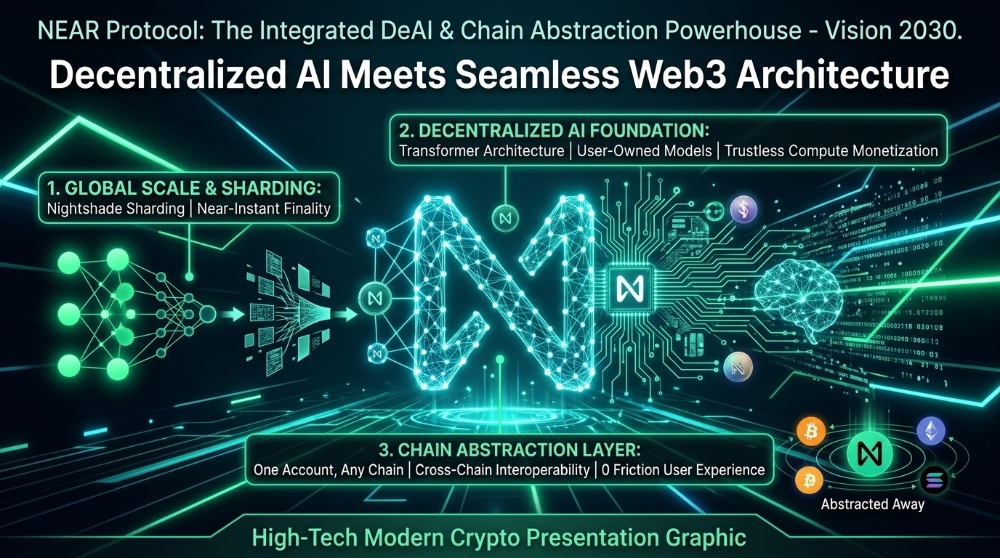
This is why Chain Abstraction (spearheaded by protocols like NEAR Protocol, Chainlink CCIP, and intent-based architectures) is the ultimate Trojan Horse for institutional adoption.
He will laugh you out of the room and go back to his paper envelopes.
This is why Chain Abstraction (spearheaded by protocols like NEAR Protocol, Chainlink CCIP, and intent-based architectures) is the ultimate Trojan Horse for institutional adoption.
Institutions do not want to care about which blockchain they are using. They don't care if it's NEAR, Ethereum, Solana, or an enterprise subnet. They want one-click execution:
Sign in with enterprise SSO (Okta / Google).
Pay gas fees in fiat or stablecoins seamlessly behind the scenes.
Execute cross-chain liquidations without knowing a bridge even exists.
When Web3 becomes completely invisible, that’s when the $16 Trillion actually moves on-chain.
Part 5: The RWA Hierarchy – Separating Signal from Noise
As the RWA narrative heats up, the market will be flooded with hundreds of "RWA tokens." 90% of them will be pure vaporware designed to dump on retail.
To navigate this cycle like a seasoned researcher, here is the survival framework:
1. Tier 1: Real Yield & Institutional Debt (The Sovereign Grade)
What it is: Tokenized US Treasuries, short-term sovereign debt, and top-tier corporate paper.
Key Players: Ondo Finance, BlackRock (BUIDL), Centrifuge.
Why it matters: Real, risk-free yields coming directly from off-chain financial markets into Web3 treasury vaults.
2. Tier 2: Trade Finance & Private Credit (The Growth Engine)
What it is: Tokenized invoices, freight receivables, and supply chain working capital.
Key Players: Goldfinch, Maple Finance, specialized institutional protocols.
Why it matters: Solves a real-world $2.5 Trillion trade finance gap while offering non-correlated high yields.
3. Tier 3: Speculative Fractional Real Estate & Collectibles (The Hype Zone)
What it is: Buying 0.0001% of a luxury watch or a beachfront condo.
Why to be careful: Highly illiquid, massive legal friction across international laws, and low secondary market volume.
Final Thoughts: Are You Positioned or Sitting on the Sidelines?
The transition of global asset settlement on-chain is not a speculative theory anymore. It is a slow-motion institutional migration that is already happening right under our noses.
TradFi isn't coming to Web3 because they love decentralization or cypherpunk ideology. They are coming because it is mathematically cheaper, faster, and safer for their balance sheets.
While the crowd is busy fighting over the next 24-hour meme coin migration, the real wealth in this cycle is being built at the infrastructure layer—where legal compliance, cross-chain messaging, and real-world cash flows intersect.
The $16 Trillion wave is rolling in. The only real question left is: are you building for the supercycle, or are you going to be the one watching from the sidelines?
What’s your take on RWA adoption? Is trade finance the true catalyst, or will regulatory friction slow it down? Drop your thoughts below—let’s debate! 👇
#RWA #Tokenization #TradeFinance #DeFi #Web3 #ChainAbstraction #CryptoAnalytics