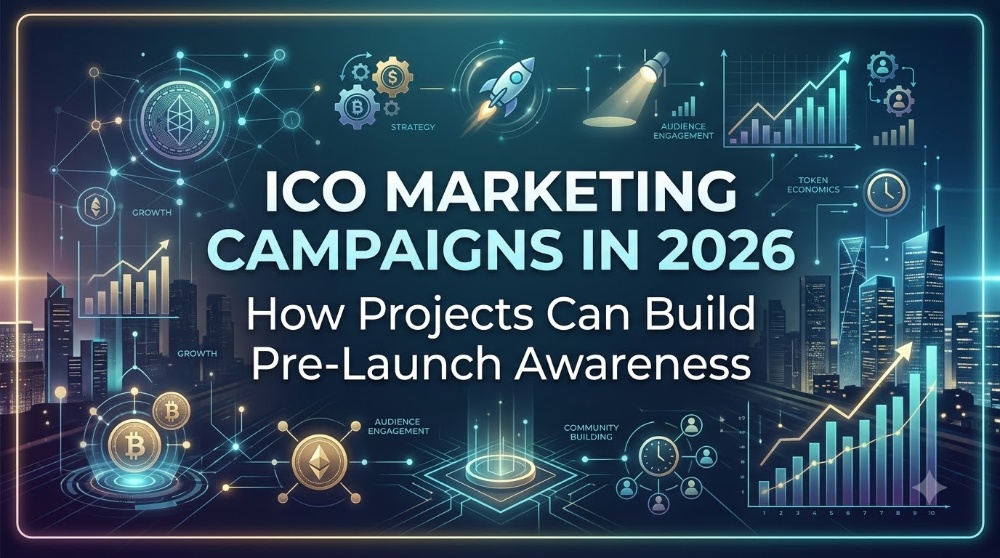
ICO Marketing Campaigns in 2026: How Projects Can Build Pre-Launch Awareness

This shift is especially important because crypto users increasingly rely on social platforms for project information. CoinGecko's research found that X, Telegram, and YouTube accounted for 84% of surveyed crypto users' primary social-media activity. The same research found that 73.8% of respondents obtained most of their crypto information from X, YouTube, or Telegram.
For projects preparing an ICO, these findings point toward a coordinated campaign rather than dependence on a single advertising channel.
Why Pre-Launch Awareness Matters for an ICO
Pre-launch marketing gives a project time to explain its purpose before asking people to participate in a token sale. This period can establish familiarity with the project, answer common questions, introduce the team, and demonstrate progress.
A project that appears online for the first time on the day of its ICO faces a difficult communication problem. Potential participants have limited time to understand its technology, token utility, roadmap, supply structure, and risks. Earlier communication allows these subjects to be introduced gradually.
The objective should not simply be to collect the largest possible number of followers. A large social audience does not automatically represent an informed or engaged community. Instead, projects should measure whether their audience reads documentation, joins discussions, attends community events, interacts with product demonstrations, and returns for project updates.
This distinction also changes how ICO marketing campaigns should be planned. Awareness should become a process of education and relationship building rather than a short promotional burst. ICO marketing agencies such as Blockchain App Factory can help projects promote their ICO through content marketing, crypto PR, social media campaigns, community management, influencer and KOL outreach, and targeted promotional activities. Working with an experienced agency can help project teams coordinate these activities across multiple channels while keeping the campaign messaging consistent with the project's documentation and launch plans.
Build the Project Narrative Before Promoting the Token
The first stage of an ICO marketing campaign should focus on the project's underlying proposition. Before discussing token price or sale dates, communication should explain what problem the project addresses and why blockchain technology is relevant to the solution.
The website and white paper should provide consistent information about the product, token functionality, roadmap, supply, allocation, governance, and development plans. Every public channel should communicate the same fundamentals.
Regulatory developments in 2026 make this approach even more important. In August 2026, the U.S. Securities and Exchange Commission proposed a new "Regulation Crypto Assets" framework covering certain investment contracts involving crypto assets. The proposal includes exemptions for offerings up to $5 million over four years and up to $75 million during a 12-month period, alongside disclosure requirements. It remains a proposal rather than a final rule.
Earlier SEC guidance also highlighted subjects such as business development, token-holder rights, supply, vesting, governance, technical architecture, and security audits as relevant disclosure considerations for crypto-related securities offerings.
For an ICO team, this means marketing content should never operate separately from legal and disclosure work. Promotional claims need to match the project's actual documentation.
Create a Multi-Channel Awareness Campaign
Crypto audiences are distributed across several platforms, so an ICO campaign should assign a specific purpose to each channel.
X can support public discussions, project updates, founder commentary, educational threads, and ecosystem conversations. Telegram can support direct community communication, announcements, AMAs, and launch reminders. YouTube can provide longer explanations through interviews, product demonstrations, founder discussions, and educational videos.
CoinGecko's 2026 analysis found that X represented 41.7% of respondents' primary crypto social-media activity, while Telegram represented 21.5% and YouTube 20.8%. Discord accounted for 6.8% and Reddit 4.5%.
These figures do not mean every ICO should allocate its budget according to those percentages. They show why a campaign should avoid treating one platform as the entire crypto audience.
Content should also move between platforms. A long founder interview can become short X posts, Telegram discussion points, video clips, website articles, and community questions. This creates repeated exposure without simply publishing identical material everywhere.
Use Education to Turn Attention Into Understanding
Educational content is one of the most useful tools during an ICO pre-launch period because it addresses the questions potential participants naturally have.
Content can explain the technology, token utility, ecosystem mechanics, governance model, development milestones, and market problem. Technical subjects can be presented through diagrams, videos, examples, and detailed articles rather than relying only on promotional language.
For example, a decentralized finance project could publish a series explaining its protocol architecture, fee model, governance process, security practices, and planned integrations. A gaming project could demonstrate how its token interacts with in-game assets and explain which functions are available at launch.
This approach also creates searchable material that can continue attracting visitors after individual social posts disappear.
The project should maintain a content calendar covering several stages:
- Education: Explain the problem, technology, and product.
- Proof: Present development progress, audits, partnerships, demonstrations, or measurable milestones where verifiable.
- Community: Host AMAs, discussions, polls, founder sessions, and feedback activities.
- Launch preparation: Explain eligibility, timelines, participation procedures, allocation details, and official channels.
Use Crypto KOLs With Verification and Disclosure
Crypto Key Opinion Leaders can extend an ICO campaign beyond the project's existing audience. Their value comes from access to established communities and their ability to explain projects through their own content formats.
The selection process should focus on audience relevance rather than follower count alone. A creator with a smaller audience interested in DeFi infrastructure may be more relevant to a DeFi protocol than a general crypto account with a much larger following.
Projects should examine engagement patterns, audience geography, previous promotional activity, content quality, and potential conflicts of interest. Marketing teams should also verify claims about audience size and activity where possible.
Regulatory awareness matters here as well. The European Securities and Markets Authority published a January 2026 factsheet concerning responsible promotion by finfluencers.
KOL campaigns should therefore include appropriate disclosure practices and avoid unsupported promises about token performance, guaranteed returns, or future prices.
Build Community Before the Token Sale
A Telegram or Discord group should not become active only a few days before the ICO. Early community development gives the team time to understand audience questions and identify recurring concerns.
Community managers can organize weekly discussions, product updates, founder AMAs, educational sessions, and feedback threads. These activities create a record of communication that potential participants can review before the sale.
Moderation also matters. Fake announcements, impersonation attempts, referral spam, and phishing links can damage confidence quickly. Official communication channels should be easy to identify, while important announcements should follow consistent verification procedures.
The strongest community programs do not measure success only through member counts. Metrics such as active participants, recurring questions, event attendance, content engagement, website visits, and documentation usage provide more useful signals.
Use PR and Earned Media to Establish Credibility
Public relations can give an ICO campaign third-party visibility. Interviews, technical articles, founder commentary, podcasts, research publications, and relevant media coverage can introduce the project to audiences that have not encountered its social accounts.
The focus should remain on newsworthy information. Product milestones, technical releases, partnerships that have actually been confirmed, research findings, and ecosystem developments provide stronger subjects than repetitive claims about being the next major token.
Media coverage should also connect back to authoritative project resources. If an article discusses token economics, readers should be able to locate the relevant documentation. This creates consistency between external coverage and the project's own information.
Track the Campaign Through Meaningful Metrics
Pre-launch ICO marketing should be managed through measurable stages. Instead of focusing only on impressions and follower growth, teams can monitor website traffic, white-paper visits, documentation engagement, community activity, email registrations, event attendance, KOL engagement, and conversion between campaign stages.
A simple funnel can look like this:
Awareness → Education → Community → Due Diligence → Registration → Participation
Each stage requires different content. High awareness with low documentation engagement may indicate that messaging is attracting attention without generating sufficient understanding. Strong community growth with low event participation may point to weak audience engagement.
This measurement approach allows marketing teams to adjust campaigns based on observed behavior rather than assumptions.
Conclusion
ICO marketing campaigns in 2026 need to begin well before the token sale. Projects can build pre-launch awareness by combining useful education, consistent messaging, community development, credible KOL partnerships, PR, and measurable campaign stages.
The central objective is not simply to generate attention. It is to help potential participants understand what the project does, how the token functions, what progress has been made, and what risks or limitations they should consider.
Regulatory developments also make accurate communication increasingly important. Projects should coordinate marketing with legal, technical, and disclosure teams so public claims remain consistent with official documentation. With that foundation in place, pre-launch marketing can create an informed audience rather than relying on short-lived promotional attention.