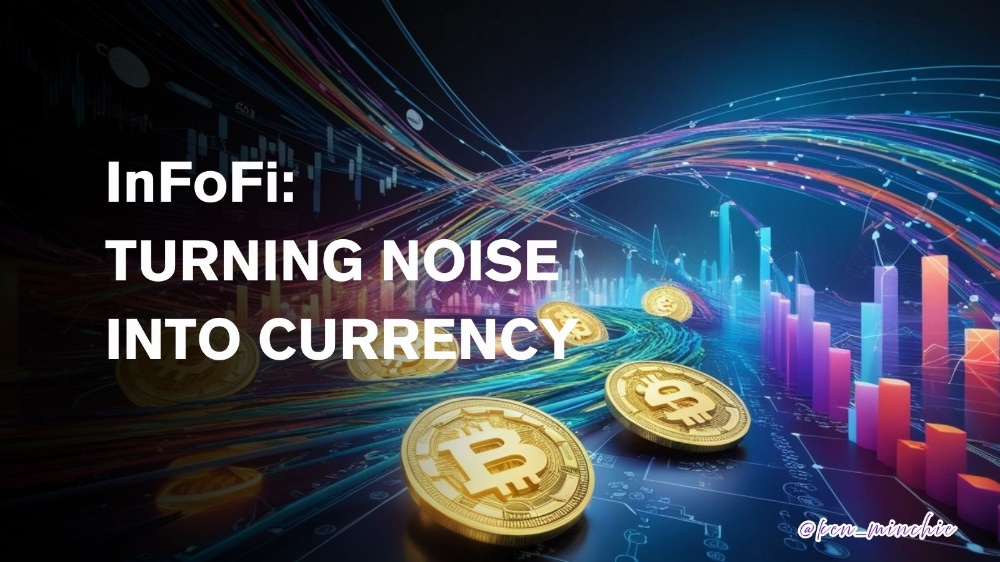
InfoFi: When Information Becomes Money — and the Noise Is the Currency

In the ever‑shifting landscape of Web3, a new financial frontier is emerging that doesn’t mine blocks or stack yield — it prices attention, influence, and information. This trend goes by a crisp portmanteau: InfoFi, short for Information Finance. At its core, InfoFi turns those endless signals pulsing across social feeds and blockchains into tradable, monetizable assets — and in some models, that “noise” is the currency itself.
 What Actually Is InfoFi?
InfoFi isn’t another meme coin hustle. It’s a structural experiment in assigning economic value to information itself. It leverages blockchain technology, tokenization, and AI to:
- Quantify attention and insight — turning clicks, social reactions, predictions, and even nuanced “mindshare” metrics into on‑chain data.
- Reward contributors — with tokens for sharing quality insights, engaging meaningfully, or generating attention that benefits a community or project.
- Enable markets of information — where you don’t just trade tokens, you trade signals.
Think of it as DeFi for data and attention, with blockchain proving who said what, when, and how valuable it turned out to be.
Noise as the New Currency
Here’s where it gets interesting (and a little weird): some projects in the InfoFi ecosphere are pushing beyond traditional tokens toward “noise‑based” markets.
Most blockchains and currencies measure value in fiat equivalents, locked value, or utility. But new systems — like trading platforms built on datasets of trends, sentiment, or attention scores — treat noise itself as a derivative you can speculate on. That means:
- Instead of betting on Bitcoin’s price, you might bet on how much a narrative dominates the conversation
- You can take long/short positions on specific cultural or market trends.
- The market’s attention becomes the actual asset, tradable like a commodity.
It’s akin to buying and selling the hype cycle itself — the loudness of conversation becomes a quantifiable signal.
This flips the traditional model: usually tokens are the unit of exchange; here, attention and trend intensity become tradable units — a currency of noise.
Where InfoFi Is Already Taking Shape
Several protocols are leading the charge:
- Kaito pioneered “InfoFi” by tokenizing user engagement through AI models that score and distribute rewards based on typed insight and community impact
- Noise‑style markets let users directly trade trend momentum and attention scores — effectively betting on what conversations will catch fire next.
- Platforms like Cookie.fun, Ethos, and others are expanding the ecosystem by offering different mechanisms to value reputation, trends, and social signals.
This isn’t just theory — some of these tokens are already listed on exchanges and traded like any other crypto asset.
Why This Matters — and Why It’s Controversial
The promise:
InfoFi decentralizes economic power. Instead of centralized platforms keeping the billions made from social attention, contributors and communities can capture a share of that value directly. InfoFi lets creators, analysts, and on‑chain explorers monetize insight instead of just eyeballs.
The problem:
When attention becomes currency, incentives shift. Instead of insight, systems can reward volume over value, spawning spammy AI content farms that chase rewards rather than true understanding. Recent community backlash highlights how some InfoFi reward models have devolved into attention farming, where noise proliferates and real signal gets buried.
This tension is at the heart of InfoFi’s evolution — turning information into value without letting the noise eat the signal.
So Is “Noise” Really the Currency?
In a metaphorical sense: yes.
In some models within InfoFi, attention, trend momentum, and visibility — the very things traditionally dismissed as noise — are being engineered as quantitative assets with economic value.
But to be clear: most InfoFi ecosystems still rely on tokens as the actual medium of exchange. What’s new is how the underlying value of those tokens is being derived: from information flows, social dynamics, and community impact rather than liquidity pools or block rewards.
In other words, noise isn’t the literal currency on all platforms — but in the emerging InfoFi mindset, noise (attention) is fuel, value, and sometimes the product itself.
Bottom Line
InfoFi is one of the most audacious experiments in Web3 today — trying to bridge data, attention, and finance in an entirely new way. Whether it ends up as the next big sustainable paradigm or a hype‑driven detour depends on how well the ecosystem learns to reward truth over volume and signal over noise.
And yes — in the future of decentralized attention markets, your tweet could be money, and your noise could be a currency.