A Hidden DePIN Pays $10–20/hr for Recording Your Voice

Can Training AI Become Your Next High-Paying Side Hustle?
Millions of people are already doing it.
Instead of buying expensive mining rigs or trading volatile tokens, they’re using their phones to contribute valuable data to artificial intelligence models and getting paid for it.
By the end of this article, you’ll understand exactly how ordinary people are turning simple phone recordings into real income and whether this opportunity is actually worth your time.
One of the most interesting examples of this emerging model is Silencio, a decentralized audio network that rewards users for recording everyday sound and voice data.
In this article, we’ll explore how Silencio works, how people are earning from it, the pros and risks involved, and why this DePIN project might be one of the most accessible ways to earn from AI today.
What Is Silencio?

The project has built a decentralized network that collects real-world audio data from everyday smartphone users.
This includes things like environmental noise levels, ambient sounds, and voice recordings.
According to the project, the network already has over 1.5 million contributors across more than 180 countries who have captured over 11 million hours of audio data.
That’s the equivalent of more than 1,300 years of recorded sound.
Silencio also claims it has already distributed over $3 million in value to contributors.
All data collected through the platform is anonymized, encrypted, and compliant with privacy regulations.
The Two Main Ways Silencio Works
Silencio operates through two core systems.
1. Silencio App (Noise Data Network)
Users download the Silencio app and measure environmental noise levels using their phone’s microphone.
The app divides the world map into hexagonal tiles.
Each time a user explores a new tile, records noise levels, or checks into venues like cafés, restaurants, or hotels, they earn in-app coins.
Users can also capture short ambient sounds or complete quests that reward additional coins.
Being the first person to record noise data in a new location can unlock extra rewards.
For example:
- Venue check-ins can earn around 10 coins
- First check-in at a new location can earn up to 100 coins
- Open measurements earn roughly 0.5 coins per minute
- Exploring new hexagon areas adds bonus coins
2. Silencio Voice AI
Silencio also offers tasks where users record voice data.
These tasks involve reading sentences aloud in different languages.
The recordings help train speech recognition systems, translation models, and voice assistants.
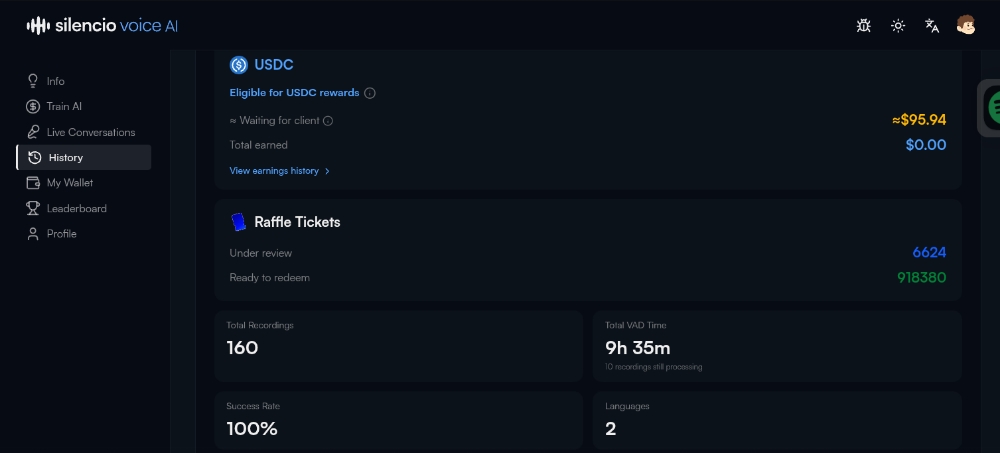
Voice AI tasks can pay up to about $10 per hour in USDC depending on the task and language.
Some higher-quality tasks or rare languages have reportedly reached $10 to $20 per hour.
Users typically complete short recording sessions where they read phrases, pronounce specific words, or speak with particular accents.
The goal is to create diverse training data for global AI systems.
How People Actually Earn on Silencio

Noise Measurement
Users earn in-app coins by recording environmental noise data while walking through their cities.
Each contribution helps build a global noise map that can later be used by businesses and governments.
Voice Recording Tasks
The highest earnings usually come from voice recording campaigns.
Users log in, choose available language tasks, record short speech segments, and receive USDC payments once the recordings are validated.
Daily Streak Multipliers
Silencio rewards consistency.
Each consecutive day of contribution increases a user’s reward multiplier.
The multiplier grows gradually and can reach up to 250% for long streaks.
For example, a 40-day streak can double the number of coins earned for each contribution.
Referral Rewards
The platform also offers referral incentives.
When a user invites a friend:
- Both receive 200 in-app coins
- The inviter earns 20% of their friend’s coin earnings
For voice recording tasks, referral systems have also offered around $2 USDC for each hour recorded by a referred user.
Beta Airdrop Rewards
Silencio allocated 7.5% of the total SLC token supply to reward early contributors during the beta phase.
These tokens were distributed based on how active users were on the platform.
Part of the allocation was released immediately at the token launch, while the rest was vested over several months.
Top contributors received additional bonuses, while some users were randomly selected for extra rewards.
What the Data Is Actually Used For
The audio data collected by Silencio has real-world applications beyond crypto.
Environmental noise data is sold through a Noise Data API to industries such as:
- Real estate developers
- hospitality companies
- urban planning organizations
- government agencies
For example, real estate companies may use sound data to evaluate neighborhood noise levels before property development.
Hotels and restaurants can analyze sound environments to improve customer experience.
City planners can identify areas with high noise pollution and design better urban infrastructure.
Voice data collected through Silencio helps train AI systems for:
- speech recognition
- translation models
- voice assistants
- robotics perception
- autonomous vehicles
Because the data comes from diverse speakers around the world, it helps improve the accuracy of global AI systems.
Pros of Silencio
- Low barrier to entry: Anyone with a smartphone can start contributing without specialized equipment.
- Multiple earning streams: Users can earn through noise measurements, voice recordings, streak bonuses, referrals, raffles, and token rewards.
- Privacy-focused design: The platform emphasizes anonymized data collection, encrypted storage, and user data ownership.
- Real-world utility: Silencio already sells its data through commercial APIs used by multiple industries.
- Growing adoption: With more than 1.5 million contributors and millions of hours of recorded audio, the network is expanding quickly.
Cons and Risks
- Earnings vary: Voice tasks can pay well, but noise-measurement coins may not always have immediate monetary value.
- Battery and data usage: Running measurement sessions can drain phone battery and consume mobile data.
- Token volatility: The SLC token value may fluctuate depending on market demand.
- Privacy concerns: Even with anonymization, some users may still feel uncomfortable contributing audio data.
Conclusion

Instead of large tech companies collecting information for free, decentralized networks like Silencio allow individuals to share in the value their data creates.
Whether you're recording voice samples, mapping noise levels in your city, or referring friends to the platform, every contribution helps train the next generation of AI systems.
If decentralized infrastructure networks continue growing, projects like Silencio may become one of the easiest ways for everyday people to participate in the AI economy.
Sometimes the biggest technological shifts don’t happen in research labs.
Sometimes they start with millions of ordinary people pressing “record” on their phones.
What do you think?

Five years from now, will people regret ignoring opportunities like this… or will most of these “AI side hustles” quietly disappear??