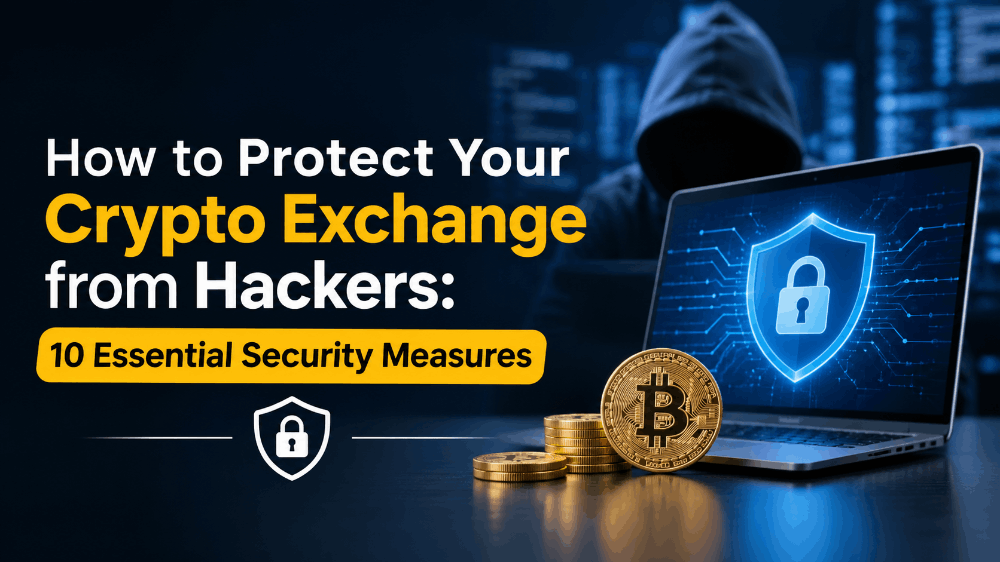
How to Protect Your Crypto Exchange from Hackers: 10 Essential Security Measures

The cryptocurrency industry has transformed how people manage, trade, and transfer digital assets. Cryptocurrency exchanges now handle millions of transactions, manage substantial digital asset holdings, and connect users across multiple blockchain networks. However, as the industry grows, cybercriminals are developing increasingly sophisticated methods to exploit vulnerabilities in crypto platforms.
A single security weakness can expose sensitive user information, compromise wallet infrastructure, disrupt trading operations, and result in significant financial losses.
The Binance security incident reported on October 29, 2026, is an important reminder of these risks. According to Binance's initial investigation, attackers gained unauthorized access to an internal wallet-signing service and initiated transactions outside the normal withdrawal process. The incident involved multiple attack techniques, including social engineering, compromised devices, and unauthorized transaction authorization.
This raises an important question for cryptocurrency businesses: How can crypto exchanges protect their platforms against increasingly sophisticated cyberattacks?
Building a secure cryptocurrency exchange requires more than encryption or a strong login system. Businesses need a comprehensive security strategy that covers wallet infrastructure, private key management, authentication, transaction monitoring, smart contracts, APIs, and internal access controls.
In this guide, we explore 10 essential security measures that can help cryptocurrency exchanges strengthen their infrastructure, protect digital assets, and reduce exposure to cyber threats.
Why Are Cryptocurrency Exchanges Becoming Targets for Hackers?
Cryptocurrency exchanges are attractive targets because they manage valuable digital assets and provide access to financial transactions across multiple blockchain networks.
Unlike traditional financial systems, blockchain transactions are generally irreversible once confirmed. If attackers gain unauthorized access to private keys or transaction-signing systems, recovering transferred assets can become extremely difficult.
Several factors increase the security risks associated with cryptocurrency exchanges.
1. Large Digital Asset Holdings
Centralized exchanges often manage substantial cryptocurrency reserves through hot wallets, cold wallets, and custodial infrastructure. These assets make exchanges attractive targets for financially motivated attackers.
2. Vulnerable Private Key Management
Private keys authorize blockchain transactions. If attackers compromise the systems responsible for generating, storing, or using private keys, they may gain the ability to transfer digital assets without permission.
3. Complex Blockchain Infrastructure
Modern exchanges integrate multiple blockchain networks, wallets, APIs, smart contracts, liquidity providers, and third-party services. Each integration introduces potential security considerations.
4. Insider Threats and Social Engineering
Cybercriminals may target employees rather than directly attacking the exchange's public-facing infrastructure. Phishing, fake recruitment interviews, malicious software, and stolen credentials can provide access to internal systems.
5. Weak Access Controls
Poorly configured permissions, unsecured administrative accounts, and excessive employee privileges can create opportunities for unauthorized access.
For these reasons, exchange security must cover both external cyberattacks and internal operational risks.
10 Essential Security Measures to Protect Your Crypto Exchange from Hackers
Protecting a cryptocurrency exchange requires multiple layers of security. No single technology can eliminate every threat, but combining appropriate security controls can significantly reduce the risk of unauthorized access and financial losses.
Here are 10 important measures every cryptocurrency exchange should consider.
1. Implement Multi-Factor Authentication (MFA)
Passwords alone are not sufficient to protect cryptocurrency exchange accounts and administrative systems.
Multi-factor authentication requires users to verify their identity through additional authentication methods before accessing sensitive platform functions.
For example, an exchange can combine:
- Password-based authentication.
- Authenticator applications.
- Hardware security keys.
- Passkeys and phishing-resistant authentication.
- Biometric authentication where supported.
- Additional verification for sensitive account activities.
Businesses should apply stronger authentication requirements to administrators, developers, wallet operators, and employees with privileged access.
It is also important to implement step-up authentication for sensitive activities such as changing withdrawal addresses, modifying account security settings, or approving large transactions.
How it helps: MFA reduces the likelihood that stolen passwords alone will provide attackers with access to exchange accounts and critical administrative systems.
2. Use MPC Wallet Technology for Private Key Protection
Private key management is one of the most important aspects of cryptocurrency exchange security.
Traditional wallet architectures may create a single point of failure if a private key is stored or accessed through a compromised system.
Multi-Party Computation (MPC) provides an alternative approach by distributing cryptographic signing authority across multiple participants or devices.
Instead of reconstructing a complete private key in one location, MPC protocols allow participants to collaboratively generate a valid transaction signature.
Key benefits include:
- Distributed control over transaction signing.
- Reduced dependence on a single key-storage location.
- Better separation of signing responsibilities.
- Flexible authorization policies.
- Improved protection against certain single-point compromises.
However, MPC does not eliminate every security risk. The implementation must also consider compromised endpoints, participant authentication, malicious signing requests, backup procedures, and authorization policies.
Businesses looking to implement this architecture can explore Techfyte's MPC Wallet Development Services.
Techfyte develops MPC-based wallet infrastructure designed to distribute cryptographic key control and support enterprise and institutional digital asset management.
How it helps: MPC can reduce single-point key compromise risks and strengthen transaction authorization when implemented with appropriate operational controls.
3. Separate Hot Wallets and Cold Wallet Storage
Hot wallets and cold wallets serve different purposes in cryptocurrency exchange infrastructure.
Hot wallets remain connected to the internet and support deposits, withdrawals, and everyday transactions. Cold wallets store private keys offline and are generally used for longer-term asset storage.
Keeping all exchange reserves in internet-connected wallets can increase exposure if an attacker compromises the exchange's wallet infrastructure.
A more controlled approach involves separating operational funds from long-term reserves.
Important practices include:
- Maintain only the necessary operational balance in hot wallets.
- Store longer-term reserves in appropriately secured cold wallets.
- Establish predefined limits for hot wallet balances.
- Use controlled procedures for transferring assets between storage environments.
- Require multiple approvals for significant fund movements.
- Monitor wallet balances and unusual transaction activity.
- Regularly review storage and recovery procedures.
Cold storage also requires careful physical security, backup management, and recovery planning.
How it helps: Separating online operational funds from offline reserves can limit the amount of assets immediately exposed to a compromised hot wallet.
4. Implement Multi-Signature Transaction Authorization
Multi-signature technology requires multiple authorized signatures before a transaction can be executed.
For example, an exchange can configure a wallet so that three out of five designated signers must approve a transaction.
This reduces dependence on one individual, device, or compromised credential.
A practical multi-signature security structure can include:
- Separate authorization responsibilities.
- Independent signer devices.
- Defined approval thresholds.
- Additional verification for high-value transfers.
- Transaction review before signing.
- Detailed records of approvals and execution.
Businesses should also ensure that transaction signers are independent and that their credentials and devices are protected separately.
MPC and multi-signature solutions are related but technically different approaches. They should be selected according to the exchange's custody model, supported blockchain networks, and operational requirements.
How it helps: Multiple authorization requirements can prevent a single compromised account from independently approving sensitive fund transfers.
5. Integrate AI-Powered Threat Detection and Transaction Monitoring
Traditional security systems often rely on predefined rules to identify suspicious activities. However, sophisticated attackers may use techniques that are difficult to detect through basic rule-based monitoring.
AI and machine learning can help exchanges analyze transaction patterns, login activity, account behavior, and unusual system interactions.
Potential applications include:
- Identifying unusual withdrawal patterns.
- Detecting suspicious login locations and devices.
- Monitoring abnormal transaction volumes.
- Identifying unexpected changes in user behavior.
- Flagging unusual administrative activities.
- Detecting potential account takeover attempts.
- Prioritizing security alerts for investigation.
For example, if an account normally processes small withdrawals but suddenly initiates several high-value transfers to unfamiliar addresses, the monitoring system can flag the activity for additional verification.
AI should support, not replace, deterministic security controls. Exchanges should combine behavioral detection with predefined transaction limits, authorization policies, and human incident-response procedures.
Businesses can explore Techfyte's AI Development Services to understand how AI-powered systems can be developed and integrated into business applications.
How it helps: AI-assisted monitoring can improve visibility into unusual activities and help security teams investigate potential threats more quickly.
6. Strengthen API Security and Access Management
Cryptocurrency exchanges depend on APIs to connect trading engines, wallet services, mobile applications, liquidity providers, payment gateways, and external blockchain networks.
An insecure API can expose sensitive information or allow unauthorized users to interact with critical platform functions.
To strengthen API security, exchanges should implement:
- Strong API authentication.
- Short-lived access tokens where appropriate.
- Role-based permissions.
- API rate limiting.
- IP allowlisting for sensitive integrations where practical.
- Encryption for data transmission.
- Input validation and request filtering.
- Secure secret and credential management.
- Continuous API activity monitoring.
API keys should also have restricted permissions. For example, a trading API should not automatically receive withdrawal permissions unless the business requirement specifically justifies them.
Administrative and wallet-related APIs should receive additional protection through network restrictions, strong authentication, and independent approval workflows.
How it helps: Strong API security reduces unauthorized access opportunities and limits the potential impact of compromised credentials or integrations.
7. Secure Employee Devices and Internal Systems
The Binance incident also highlights why cryptocurrency exchanges must protect internal systems and employee devices.
Attackers do not always begin with a direct attack on the exchange's public infrastructure. They may target developers, administrators, or other employees to obtain access to sensitive systems.
A comprehensive endpoint and employee security strategy should include:
- Endpoint Detection and Response (EDR).
- Regular operating system and software updates.
- Device encryption.
- Restricted installation of unauthorized applications.
- Phishing awareness training.
- Secure developer environments.
- Privileged access management.
- Regular credential rotation where appropriate.
- Monitoring for suspicious employee account activity.
Businesses should also protect their software development environments, source-code repositories, CI/CD pipelines, and deployment credentials.
A compromised development device should not automatically provide access to production wallet infrastructure.
How it helps: Securing employee devices and internal systems reduces the chances of attackers using compromised endpoints to access critical exchange infrastructure.
8. Conduct Smart Contract Audits and Blockchain Security Testing
Many cryptocurrency exchanges integrate smart contracts for deposits, withdrawals, token transfers, staking, DeFi services, and other blockchain operations.
A vulnerability in a smart contract can create opportunities for unauthorized transactions, fund manipulation, or unexpected contract behavior.
Common smart contract security concerns include:
- Reentrancy vulnerabilities.
- Access control weaknesses.
- Integer and arithmetic errors.
- Improper validation of external calls.
- Oracle manipulation.
- Incorrect transaction authorization.
- Insecure upgrade mechanisms.
- Cross-chain bridge vulnerabilities.
Businesses should conduct security reviews before deploying smart contracts to production.
A comprehensive review may include:
- Manual source-code review.
- Automated vulnerability scanning.
- Unit and integration testing.
- Static and dynamic analysis.
- Fuzz testing.
- Formal verification where appropriate.
- Independent security audits.
- Remediation and retesting.
An audit should not be treated as a one-time guarantee. Smart contracts may require additional reviews when their code, dependencies, permissions, or operating environment changes.
Explore Techfyte's Blockchain Development Services to learn about blockchain engineering and smart contract development capabilities.
How it helps: Security testing can identify weaknesses before deployment and reduce the risk of vulnerabilities affecting production blockchain applications.
9. Establish Real-Time Transaction Monitoring and Withdrawal Controls
Not every unauthorized transaction begins with a successful account takeover. Attackers may also exploit weak approval workflows or manipulate legitimate transaction processes.
Crypto exchanges should implement transaction monitoring systems that evaluate the risk of withdrawals and other sensitive asset movements.
Important controls include:
- Withdrawal limits based on risk and account activity.
- Address allowlisting.
- Additional approval for high-value transfers.
- Delayed withdrawals after sensitive account changes.
- Transaction velocity monitoring.
- Suspicious destination address screening.
- Automated alerts for unusual transfers.
- Emergency transaction suspension procedures.
For example, if an administrator attempts to change wallet authorization settings and immediately initiates a large withdrawal, the exchange should be able to trigger additional verification or temporarily block the operation.
The monitoring system should evaluate the entire transaction context rather than relying on transaction value alone.
How it helps: Transaction controls can prevent or delay suspicious asset movements and give security teams additional time to investigate potential attacks.
10. Perform Regular Security Audits and Maintain an Incident Response Plan
Even well-designed cryptocurrency exchanges can develop vulnerabilities as their infrastructure, integrations, and user base evolve.
Security audits and penetration testing help identify weaknesses that may not be visible during regular development.
A complete security assessment should cover:
- Web and mobile application security.
- API vulnerabilities.
- Wallet infrastructure.
- Private key management.
- Smart contract security.
- Cloud infrastructure.
- Employee access permissions.
- Third-party integrations.
- Network configuration.
- Backup and disaster recovery systems.
However, identifying vulnerabilities is only one part of exchange security.
Businesses also need an incident response plan that defines how teams should react when suspicious activities or security breaches occur.
A practical incident response plan should include:
Detection: Identify unusual activity through monitoring and security alerts.
Containment: Isolate compromised systems, restrict suspicious access, and suspend affected operations when necessary.
Investigation: Identify the attack path, affected credentials, systems, wallets, and transactions.
Recovery: Restore systems from trusted backups and validate their integrity before returning to production.
Communication: Notify relevant stakeholders and follow applicable regulatory and legal reporting requirements.
Prevention: Review the incident, address the root cause, and strengthen security controls to reduce the likelihood of recurrence.
Security testing should also be repeated after major platform upgrades, infrastructure changes, and new integrations.
How it helps: Regular assessments and documented response procedures help exchanges identify weaknesses, reduce incident impact, and recover more systematically.
How AI and Blockchain Security Work Together to Protect Crypto Exchanges
AI and blockchain technologies can complement each other in modern cryptocurrency security architectures.
Blockchain provides transparent transaction records and cryptographic verification, while AI can analyze activity patterns and identify potential anomalies.
When integrated thoughtfully, these technologies can help exchanges strengthen their security operations.
Here are some practical applications:
Technologies Used to Strengthen Crypto Exchange Security
- Artificial Intelligence (AI): Detect unusual transaction and login patterns.
- Machine Learning (ML): Identify suspicious user behavior and behavioral anomalies.
- Blockchain Analytics: Monitor suspicious wallet activities and transaction flows.
- MPC Wallets: Distribute cryptographic signing authority to reduce the risk of private key compromise.
- Multi-Signature Wallets: Require multiple approvals before authorizing sensitive transactions.
- Smart Contract Auditing: Identify vulnerabilities and security weaknesses in smart contracts.
- Automated Monitoring: Generate real-time alerts for suspicious activities and potential security threats.
For example, an exchange could combine AI-based transaction monitoring with multi-signature authorization.
If a transaction appears unusual, the monitoring system can flag it for review. The authorization system can then require additional approval before the transfer is executed.
This combination creates multiple layers of protection rather than depending on a single security technology.
How Techfyte Helps Businesses Build More Secure Crypto Platforms
Developing a cryptocurrency exchange requires more than a trading interface and blockchain integration. Businesses need carefully designed infrastructure that supports digital asset management, transaction processing, authentication, and operational security.
Techfyte helps businesses develop blockchain, Web3, AI, and cryptocurrency solutions with security-focused architecture.
Whether you are launching a new exchange or upgrading an existing platform, Techfyte can help address important technical requirements throughout the development process.
1. Cryptocurrency Exchange Development
Techfyte develops customized cryptocurrency exchange platforms with trading engines, wallet integrations, liquidity management, and administrative functionality.
The development process can incorporate security-related requirements such as authentication, access controls, transaction monitoring, and secure asset management.
Explore Techfyte's Crypto Exchange Development Guide to understand the architecture, features, security requirements, and development considerations involved in building an exchange.
2. Secure Crypto Wallet Development
Wallet infrastructure plays a critical role in protecting digital assets.
Techfyte develops custodial, non-custodial, multi-chain, and MPC-based wallet solutions designed around key management, transaction authorization, and digital asset operations.
Businesses can explore Techfyte's Crypto Wallet Development Services to learn more about wallet architecture and available development capabilities.
3. Spot Exchange Development with Secure Wallet Infrastructure
Techfyte also develops spot trading exchange platforms with secure wallet and asset management capabilities.
Depending on project requirements, the architecture can incorporate hot and cold wallet management, multi-signature security, transaction processing, user authentication, and monitoring.
Learn more about Techfyte's Spot Exchange Development Services.
4. Blockchain and Smart Contract Development
A cryptocurrency platform may depend on multiple smart contracts and blockchain integrations.
Techfyte provides blockchain development and smart contract engineering services to help businesses build blockchain-based applications according to their technical requirements.
Security testing and independent auditing should be incorporated into the project scope wherever required.
Explore Techfyte's Blockchain Development Services to learn more.
5. AI Development and Intelligent Monitoring
AI can support cryptocurrency businesses through intelligent automation, predictive analysis, and behavioral monitoring.
Techfyte's AI development capabilities can help businesses explore AI-powered solutions for identifying unusual patterns, analyzing operational data, and improving monitoring workflows.
Learn more about Techfyte's AI Development Services.
The right combination of blockchain engineering, wallet infrastructure, AI, and security controls can help businesses establish a stronger technical foundation for their cryptocurrency platforms.
Important: Security depends on implementation, configuration, operational practices, independent validation, and continuous maintenance. No development approach can guarantee complete protection against every cyberattack.
Crypto Exchange Security Checklist: What Should Businesses Verify?
Before launching or upgrading a cryptocurrency exchange, businesses should review their security architecture against the following checklist.
Crypto Exchange Security Checklist
- User Authentication: Implement MFA and phishing-resistant authentication.
- Private Key Management: Use MPC, HSMs, or appropriate secure key custody solutions.
- Wallet Architecture: Maintain controlled separation between hot and cold wallets.
- Transaction Approval: Implement multi-signature or equivalent authorization controls.
- API Security: Apply strong authentication, encryption, and rate limiting.
- Employee Security: Use endpoint protection and privileged access controls.
- Smart Contracts: Conduct independent security audits and regular testing.
- Transaction Monitoring: Establish withdrawal limits and anomaly detection.
- Infrastructure Security: Implement network protection and secure deployment practices.
- Incident Response: Maintain tested recovery plans and emergency response procedures.
Businesses should regularly review this checklist because security requirements change as exchanges introduce new assets, blockchain networks, integrations, and trading features.
Final Thoughts
Cryptocurrency exchange security is no longer something businesses can address after launching their platforms. It must be considered from the earliest stages of system architecture and remain a continuous priority throughout the platform's lifecycle.
Recent cryptocurrency security incidents demonstrate that attackers may target more than public-facing applications. Internal signing services, employee devices, privileged credentials, APIs, and wallet authorization systems can also become part of an attack.
Implementing MFA, MPC wallet technology, cold storage, multi-signature authorization, AI-assisted monitoring, API protection, smart contract audits, and incident response planning can help exchanges reduce their exposure to common security threats.
For businesses planning to launch or upgrade a cryptocurrency exchange, investing in security-focused development is an important step toward protecting digital assets and maintaining user confidence.
Techfyte helps businesses develop cryptocurrency exchanges, secure wallet infrastructure, blockchain applications, and AI-powered solutions with security considerations built into the development process.
Ready to build a more secure cryptocurrency platform? Connect with Techfyte to discuss your exchange development and blockchain infrastructure requirements.
Book a Free 30-Minute Consultation: https://techfyte.com/contact-us/
Frequently Asked Questions (FAQs)
1. How can I protect my cryptocurrency exchange from hackers?
You can strengthen exchange security through multi-factor authentication, secure private key management, MPC wallets, hot and cold wallet separation, multi-signature authorization, API protection, transaction monitoring, and regular security audits.
2. What is the most important security feature of a crypto exchange?
There is no single security feature that protects an entire exchange. However, private key management and transaction authorization are particularly important because they directly affect control over digital assets.
3. How do MPC wallets improve cryptocurrency security?
MPC wallets distribute cryptographic signing authority among multiple participants rather than relying on one complete private key in a single location. This can reduce single-point compromise risks and improve transaction authorization controls.
4. Why should crypto exchanges use cold wallet storage?
Cold wallets keep private keys offline, reducing exposure to internet-based attacks. Exchanges can use them to store longer-term reserves while maintaining limited balances in hot wallets for everyday transactions.
5. Can AI prevent cryptocurrency exchange hacks?
AI can help identify suspicious transaction patterns, unusual login behavior, and potential security anomalies. However, it cannot prevent every attack. It should work alongside authentication, access restrictions, transaction authorization, and incident response controls.
6. How often should a cryptocurrency exchange undergo security audits?
Security assessments should be performed before major production releases and after significant infrastructure or smart contract changes. Exchanges should also schedule periodic independent assessments based on their risk profile and regulatory requirements.
7. What is the difference between MPC and multi-signature wallet security?
MPC distributes cryptographic signing operations among multiple participants to produce a signature. Multi-signature wallets require multiple distinct signatures to authorize a transaction. Both can strengthen authorization, but they have different technical implementations and blockchain compatibility requirements.
8. Can Techfyte help develop a secure cryptocurrency exchange?
Yes. Techfyte offers cryptocurrency exchange development, crypto wallet development, blockchain engineering, and AI development services. The specific security architecture and controls can be planned according to the platform's custody model, business requirements, and supported blockchain networks.