NFTs and Real-World Assets: Who Is Responsible for Keeping Them Alive?

When someone buys an NFT, they may believe the artwork, document, or other asset now exists permanently on the blockchain.
That is not usually true.
In most cases, the blockchain stores only a record of ownership and a link to data hosted somewhere else. The NFT may point to an image, video, document, metadata file, or real-world asset record stored through IPFS or another external service.
If that external data disappears, the ownership record may remain on the blockchain while the asset itself becomes inaccessible.
This raises an important question:
Who is responsible for keeping an NFT or real-world asset alive?
The creator?
The marketplace?
The platform that sold it?
The blockchain?
Or the person who owns it?
The safest answer is the owner.
🔗 What Does the Blockchain Actually Store?
Not every NFT stores its complete media directly inside a blockchain transaction.
Images, videos, legal documents, and other files can be far too large to record efficiently inside every blockchain node. Instead, many NFT systems store smaller pieces of information on-chain, including:
- The NFT name
- Its owner
- Its creator
- The transaction that created it
- Metadata describing the asset
- A link or content identifier pointing to its media
The actual file may be stored on a normal web server or through a distributed system such as IPFS.
This allows blockchains to record ownership without forcing every node to store every image, video, or document forever.
However, it also means the existence of the blockchain record does not automatically guarantee the continued availability of the linked file.
🌐 A Web Link Is Not Permanent Storage
Some NFT platforms have used ordinary website addresses for their metadata and media.
For example, an NFT could point to:
https://example-nft-platform.com/assets/12345.png
That works for as long as the platform keeps the domain, server, and file online.
But companies close.
Websites disappear.
Domains expire.
Servers fail.
Businesses change ownership or decide that maintaining old NFT files is no longer profitable.
If the platform disappears, the blockchain may still show that a wallet owns NFT number 12,345. The link recorded for that NFT, however, may lead nowhere.
The ownership transaction survives.
The media does not.
This is one of the major problems NFT holders have faced when platforms, marketplaces, and hosting services have gone offline.
📦 How IPFS Improves This
IPFS handles files differently from ordinary websites.
Instead of locating a file through a specific server and domain, IPFS identifies it through its contents. The resulting content identifier, often called a CID, changes if the file changes.
This provides two important benefits.
First, the NFT is not permanently tied to one company’s web server. Anyone with the correct file can make that same content available through IPFS.
Second, users can verify that the returned file is the same content originally referenced. If someone modifies the file, it produces a different identifier.
This makes IPFS a much better option for NFT and real-world asset media than relying on a traditional website URL.
However, IPFS does not automatically mean a file will exist forever.
📌 IPFS Files Still Need to Be Pinned
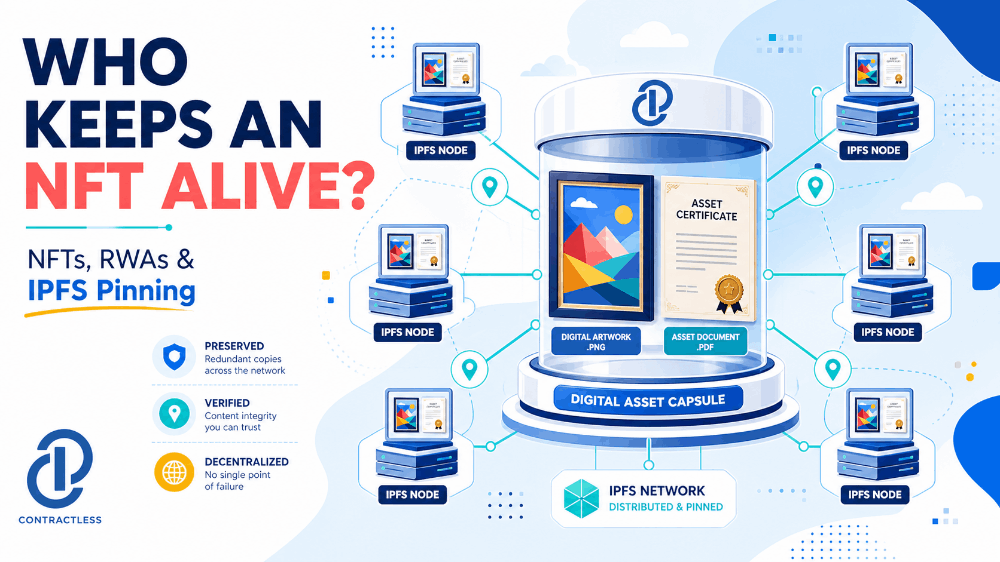
IPFS can distribute a file across many computers, but at least one computer must continue storing and providing it.
This is where pinning becomes important.
Pinning tells an IPFS node to retain a file instead of treating it as temporary cached data that can eventually be removed.
An NFT platform may pin all the NFTs created through its service. That is helpful, but it still leaves owners dependent on the platform.
If the platform closes its IPFS node, stops paying a pinning provider, or removes old content, those files could eventually become unavailable unless someone else has pinned them.
Distributed storage is only meaningfully distributed when multiple independent parties preserve the data.
One platform operating one IPFS node is still a single point of failure.
👤 NFT Holders Should Pin Their Own Assets
Anyone holding an NFT or real-world asset should run a local IPFS node and pin the metadata and media associated with the assets they own.
This creates an independent copy that does not depend on:
- The original creator
- The seller
- The marketplace
- The NFT platform
- A commercial pinning provider
- A single company remaining operational
If the original platform disappears, the owner’s IPFS node can continue providing the same content.
Other people can retrieve the file using the same CID because the content has not changed. The asset can remain accessible even though the company that originally hosted it no longer exists.
This is what digital ownership should look like.
Owning an NFT should involve more than trusting someone else to keep it alive.
⚠️ Pin Both the Metadata and Media
NFTs frequently use more than one linked file.
The blockchain record may point to a metadata file. That metadata file may then contain a second link pointing to an image, video, document, or other media.
Pinning only the image may not be enough.
If the metadata disappears, wallets and applications may no longer know the asset’s name, description, properties, or media location.
If the metadata survives but the media disappears, the asset information may still exist while the actual content is unavailable.
Owners should identify and pin every required part of the asset, including:
- The primary metadata file
- Images
- Videos
- Audio
- Documents
- Animation files
- Supplemental records referenced by the metadata
For real-world assets, this could also include supporting documents or other records used to describe what the blockchain asset represents.
🏛️ Real-World Assets Make Preservation Even More Important
A missing profile picture is frustrating.
A missing document connected to a real-world asset could be far more serious.
An RWA may represent or describe something outside the blockchain, such as:
- Artwork
- Collectibles
- Property
- Equipment
- Precious metals
- Certificates
- Ownership records
- Authenticity documents
- Agreements or supporting evidence
The blockchain may prove that a wallet owns a specific RWA transaction, but it cannot display an external document that no longer exists.
Pinning cannot independently prove that every statement inside a document is legally valid. It also cannot force courts, governments, or companies to recognize a blockchain record.
What it can do is preserve the exact referenced data so it remains available for inspection.
That distinction matters.
A blockchain can secure a record, while IPFS helps preserve the external content connected to that record.
🔐 Local Preservation Strengthens Ownership
An NFT holder who depends entirely on a marketplace does not have complete control over the continued availability of their asset.
They may control the blockchain transaction, but the marketplace still controls whether the media remains accessible.
Pinning changes that relationship.
The owner no longer needs permission from the platform to preserve the asset. They do not need access to the seller’s account or server. They do not need the original company to remain in business.
They need only the referenced content and an IPFS node capable of retaining it.
This does not eliminate every risk associated with NFTs or real-world assets. It does, however, remove one of the most preventable risks: losing access because someone else stopped hosting the files.
⛓️ How Contractless Handles NFTs and RWAs
Contractless records NFTs and real-world assets directly through base-layer transaction types.
Ownership, creation details, series information, and other asset fields are validated by the blockchain without relying on a smart contract.
The hosted metadata and media can use IPFS, allowing the asset to reference content outside any single platform.
But Contractless cannot force someone to continue hosting that content.
No blockchain can make an external file permanently available if no one retains a copy.
That responsibility must be shared between creators, platforms, collectors, and asset holders.
Creators should pin what they create.
Platforms should pin what they display.
Most importantly, owners should pin what they own.
🚨 An NFT Platform Should Never Be the Only Copy
NFT history has already shown what happens when users assume platforms will exist forever.
Marketplaces close.
Projects are abandoned.
Hosting bills stop being paid.
Pinning services expire.
The blockchain may continue operating exactly as designed, but the media connected to those blockchain records can still disappear.
This is not necessarily a failure of the blockchain.
It is a failure to preserve the external data.
The easiest way to prevent that failure is redundancy. The creator can keep one copy, the platform can keep another, and every owner can pin the assets held in their wallet.
The more independent nodes that retain the content, the less likely it is to disappear.
✅ Ownership Comes With Preservation
Blockchain ownership removes the need for a company to maintain the official list of who owns an asset.
IPFS removes the need for one specific server to host its files.
Neither system removes the need for someone to preserve the data.
That is why anyone holding an NFT or RWA should operate a local IPFS node and pin the metadata and media for every asset they care about.
Do not assume the marketplace will remain online.
Do not assume the seller will preserve the original files.
Do not assume that placing a CID on a blockchain automatically stores the referenced content forever.
If an NFT or real-world asset matters enough to own, it should matter enough to preserve.