AI and the need for power

The Clock Is Ticking: Why the AI Revolution Is Resurrecting Three Mile Island and Triggering a Nuclear Arms Race
We tend to associate the artificial intelligence revolution with advanced code, the digital cloud, and algorithms changing the world second by second. However, reality is proving to be far more mundane. The world’s most powerful tech companies have run headfirst into a brutal wall of physics: they are running out of electricity.
To keep their ambitions alive, giants like Microsoft, Amazon, and Google are taking the most radical step in the history of modern energy—turning en masse to nuclear power, signing series of contracts worth billions of dollars, and triggering a massive nuclear renaissance.
The Brutal Math of Exponential Growth
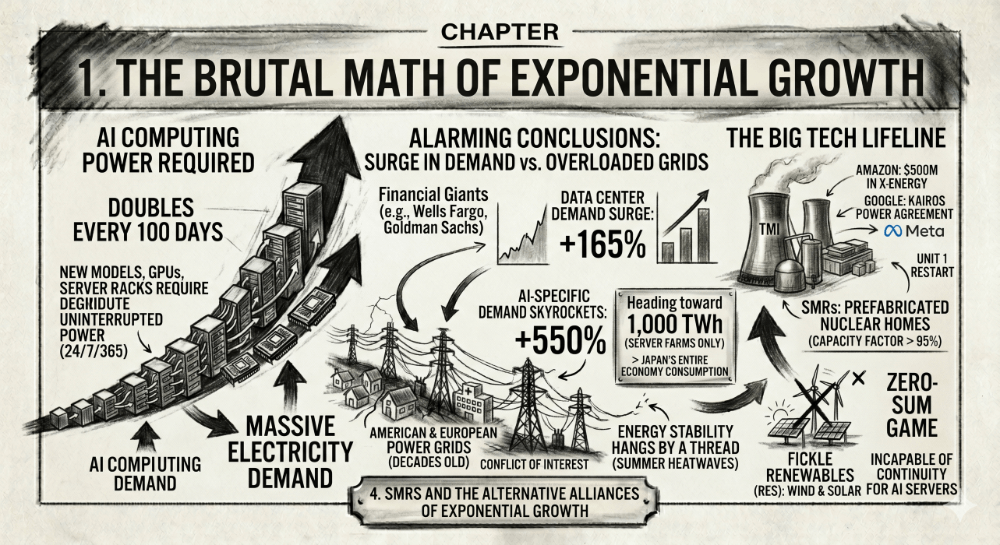
Independent analyses by financial giants such as Wells Fargo and Goldman Sachs converge on the same alarming conclusions: overall electricity demand from data centers will surge by 165% over the next few years, while the demand generated strictly by AI algorithms will skyrocket by a staggering 550%.
Globally, we are heading toward a consumption level of 1,000 terawatt-hours (TWh) by server farms alone. This is more electricity than the entire highly developed economy of Japan consumes annually. Meanwhile, the American and European power grids, built decades ago and patched up as needed, are already barely coping with summer heatwaves. Clashing with such a massive new consumer, the energy stability of these systems hangs by a thread.
Stable, emission-free nuclear sources, characterized by a capacity factor exceeding 95%, have become the only viable lifeline for Big Tech. Fickle renewable energy sources (RES), such as wind or solar, are incapable of guaranteeing such rigorous continuity of supply for servers.
Resurrecting an Old Nightmare: Microsoft’s Plan
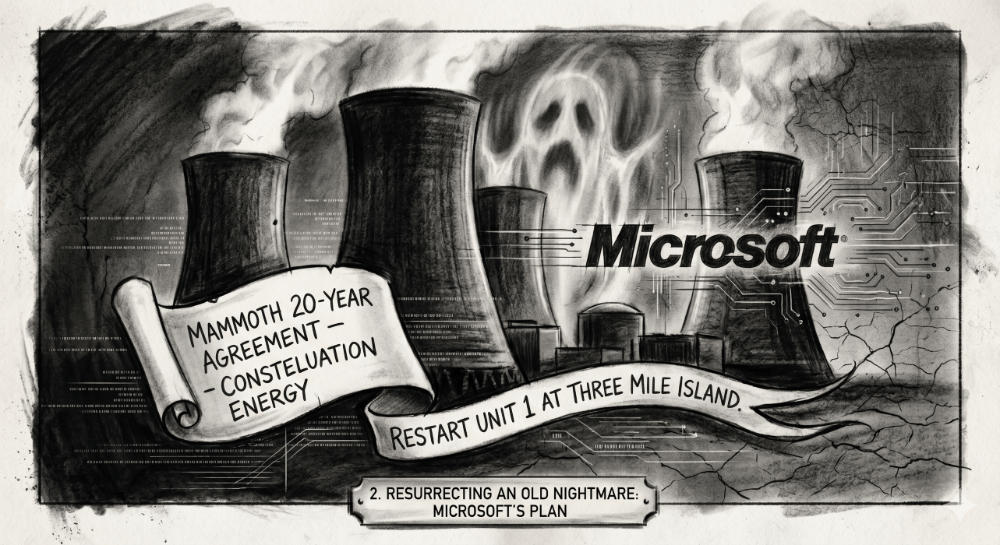
It was at this very complex in 1979 that a partial core meltdown occurred in the neighboring Reactor No. 2, resulting in the most serious accident in the history of US commercial nuclear power. Although the undamaged Unit 1 subsequently operated safely for forty years and was decommissioned in 2019 purely for economic reasons, the mere name of the location still triggers historical trauma.
Key Parameters of the Crane Clean Energy Center Project
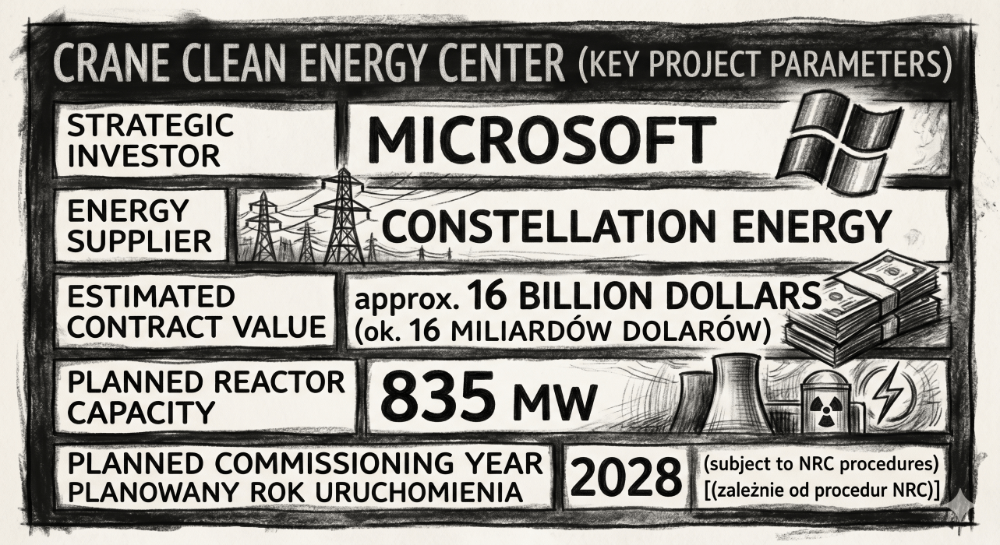
To ease public anxieties, the facility has been officially renamed the Crane Clean Energy Center. The project aims to bring 835 megawatts of clean energy back to the grid, but the process requires navigating a dense maze of rigorous US Nuclear Regulatory Commission (NRC) procedures and renewing environmental permits.
SMRs and the Alternative Alliances of Google and Amazon
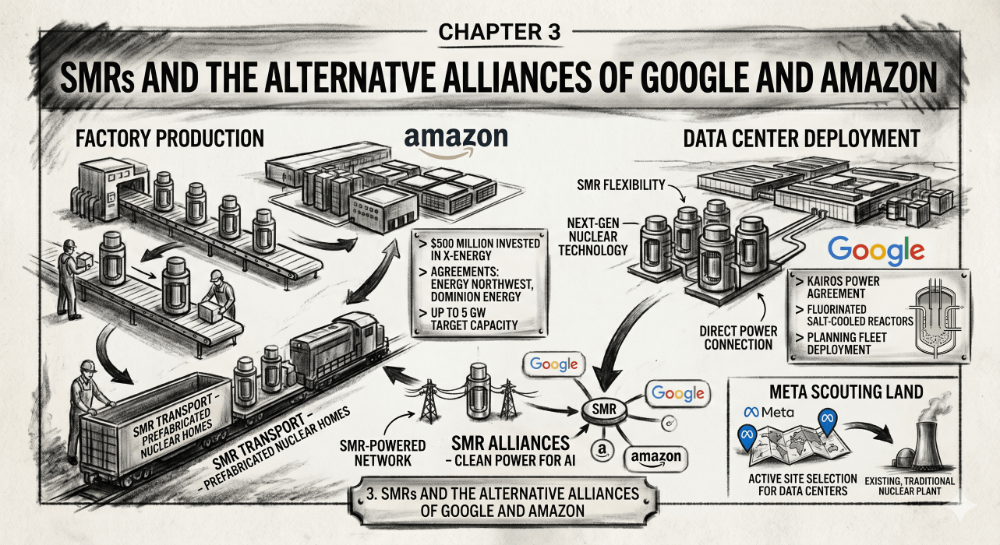
SMRs are designed to be the nuclear equivalent of prefabricated homes. Instead of spending a decade and tens of billions of dollars building a unique structure on-site, smaller reactors are mass-produced in factories, then transported and assembled directly next to data centers.
- Amazon has invested $500 million in X-energy as part of a Series C1 funding round. In parallel, the giant signed agreements with Energy Northwest and Dominion Energy, aiming to ultimately generate up to 5 gigawatts (GW) of new nuclear capacity.
- Google is not lagging behind. The company entered into a pivotal agreement with Kairos Power, planning to deploy a fleet of small, fluorinated salt-cooled reactors, the first of which is expected to start supplying power to the grid around 2030.
- Meta (owner of Facebook) has also been actively scouting land to build data centers directly adjacent to existing nuclear power plants.
"Behind the Meter"—A Zero-Sum Game and Public Unrest
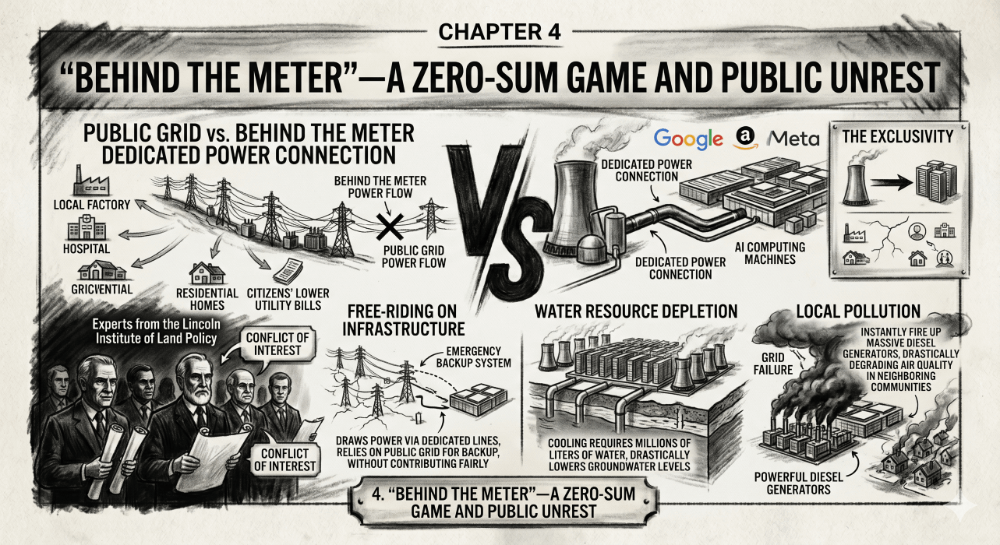
When a corporation buys out a reactor's capacity exclusively or builds a server farm directly next to a power plant, the electricity flows via dedicated cables straight to the AI computing machines. It never enters the public transmission grid. It does not power local factories, cool homes during heatwaves, or lower citizens' overall utility bills.
[Image diagram showing public grid vs behind the meter dedicated power connection]
Experts from the Lincoln Institute of Land Policy point to a deep conflict of interest:
- Free-riding on infrastructure: Even though data centers draw power via dedicated lines, they still rely on the public grid as an emergency backup system, often without contributing fairly to the costs of upgrading transmission networks.
- Water resource depletion: Server farms generate monstrous amounts of heat. Cooling them requires millions of liters of water, which can drastically lower groundwater levels in arid regions.
- Local pollution: In the event of a grid failure, data centers instantly fire up massive diesel generators, drastically degrading air quality in neighboring communities.
In a world of finite production capacity, every megawatt locked behind a corporate meter is a megawatt missing for the rest of society. Analysts warn that if the pace of building new energy sources fails to catch up with the appetite of algorithms, grid operators could face a dramatic choice within a matter of months: who to disconnect during a crisis—servers driving global business, or hospitals and residential areas?
The New Commodity War for Uranium
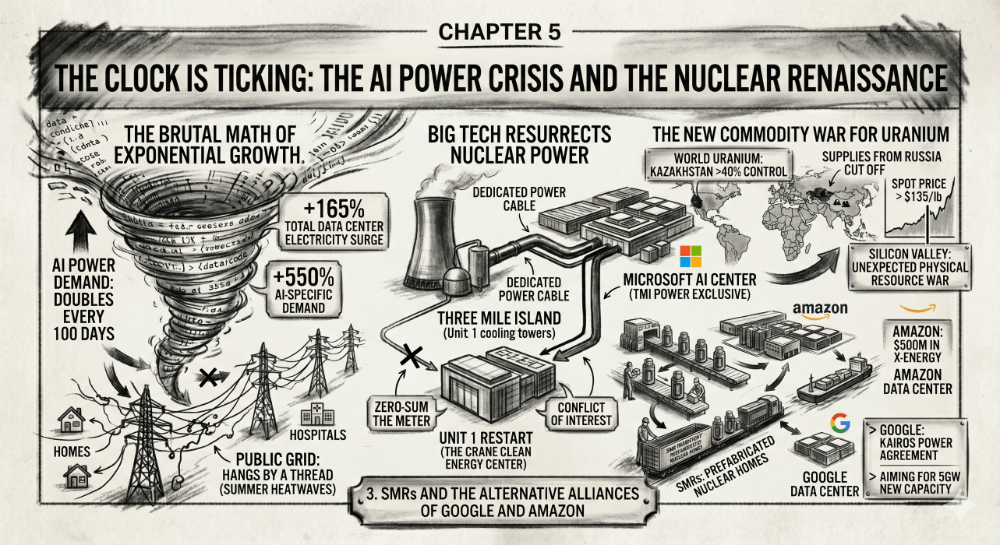
The architecture of the global nuclear fuel supply chain mirrors the 1970s oil crisis. Over 40% of global uranium mining is controlled by Kazakhstan, while supplies from Russia (a key player in the fuel enrichment process) have been largely cut off from Western markets by sanctions and geopolitical tensions.
Silicon Valley companies, which for years cultivated an image as creators of a clean, digital, and borderless future, find themselves stuck in a classic, brutal war over a physical resource—the most heavily regulated and politically charged fuel on Earth.
Summary: Power is the New Competitive Advantage
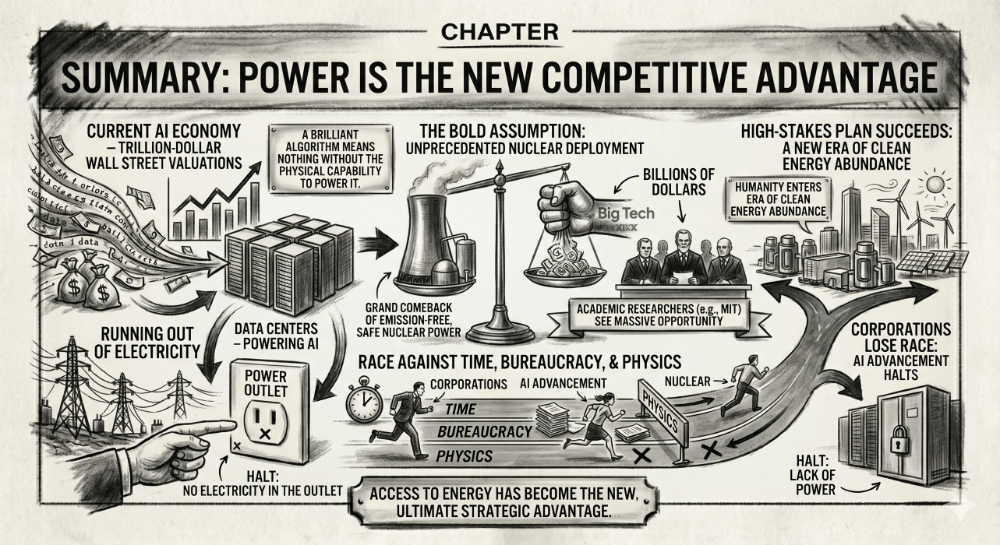
Academic researchers, including those at the Massachusetts Institute of Technology (MIT), see a massive opportunity in this phenomenon—billions of dollars from tech giants could fund the grand comeback of emission-free, safe nuclear power.
If this high-stakes plan succeeds, humanity will enter a new era of clean energy abundance. However, if corporations lose the race against time, bureaucracy, and physics, the advancement of AI won't halt for lack of innovative ideas or better code. It will halt because there is no electricity in the outlet. In the world of AI, possessing a brilliant algorithm means nothing if you lack the physical capability to power the machines that run it. Access to energy has become the new, ultimate strategic advantage.
Resources:
https://introl.com/blog/nuclear-power-ai-data-centers-microsoft-google-amazon-2025
https://ceo.com.pl/en/the-ai-boom-is-turning-power-into-the-worlds-most-strategic-resource-50823/
https://www.investing.com/analysis/nuclear-energy-stocks-surge-40-as-microsoft-amazon-bet-billions-on-ai-power-200667915
https://www.lincolninst.edu/publications/land-lines-magazine/articles/land-water-impacts-data-centers/
https://www.cbc.ca/radio/thecurrent/generative-ai-and-nuclear-energy-1.7362127
http://www.youtube.com/watch?v=34KeF-4j1Y8