What The Tech?! The Modem

In a pre-fibre world, modems would do most of the heavy lifting.
In a world with silent, solid-state drives, high-performance CPUs and high-speed broadband, the ’90s-era modem looks positively ancient by modern standards. With kilobit data speeds, while hogging the phone line during its noisy operation, the Modem was an essential part of the early internet.
Its presence would lay the foundations for media streaming, allow students to leverage the internet for education for the first time, and give us the first steps towards the E-commerce industry.
As always, it’s an interesting tale, so let’s go check it out!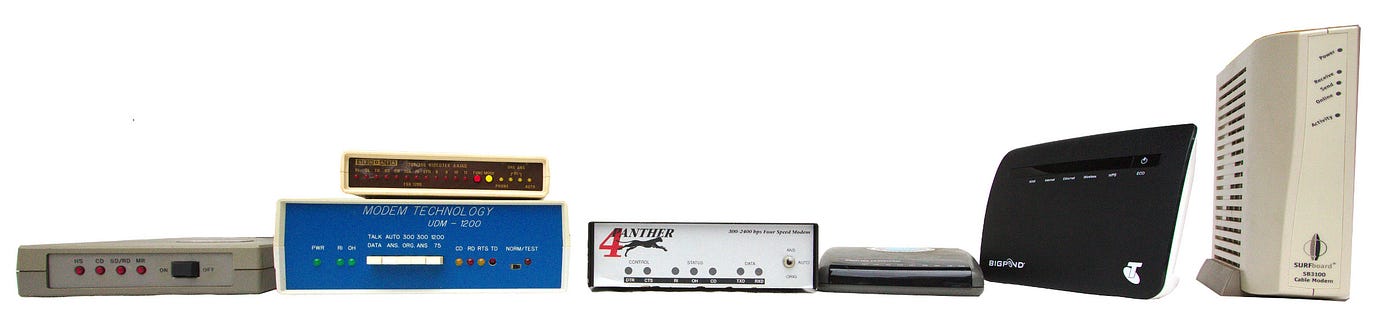
The Background
It would be the 1950s when the United States military would look to interconnect its phone lines for defence purposes. It’s well documented at this point that the internet started with military foundations, and the modem would be a natural extension of this.
The secret is in the name. A MOdulator / DEModulator, the MODEM would play a key role in helping to connect the early stages of the internet. Its job was extremely simple. Convert digital data into a form that can travel across an analogue network, and then convert it back again at the other end.
Computers speak in digital signals, ones and zeros. Telephone lines carry analogue audio. The modem sits between them and translates, allowing the whole system to work properly.
In the late 50’s and early 60’s, the modem was a large, cumbersome device like many other computer components of the era. However, by the late 60’s and early 70’s, they were becoming smaller, more compact and capable of far greater speeds.
It’s important to point out that at the time, the concept of Personal Computing didn’t really exist yet. With machines being both bulky and expensive, the computing of the day was done for either governmental, military or commercial purposes.
It would take the foundations of the personal computing revolution to start before we would see peripheral hardware start to filter down into the domestic market.
The experience of many early internet users would be defined by the instantly recognisable shriek of the 90’s era modem. That noise was the modulation/demodulation system at work, the modem’s defining feature. While it’s now a long-retired relic of the past, for many, the tone remains instantly recognisable.
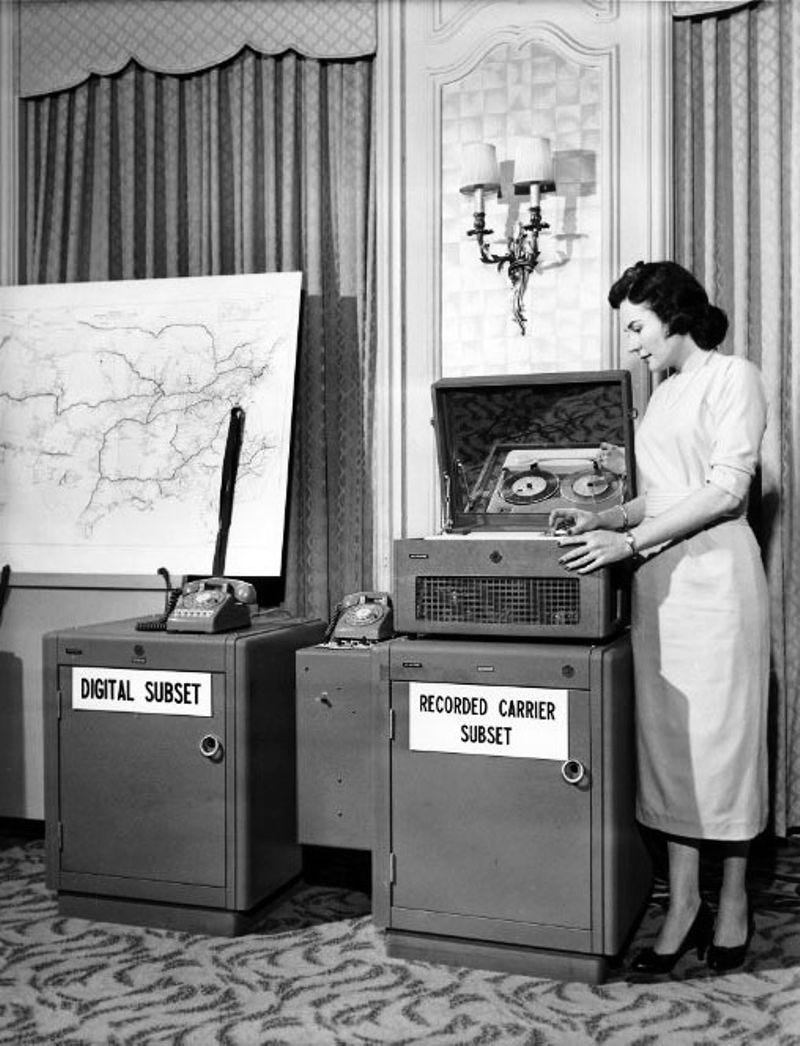 A 50s era AT&T modem. As you can see, the thing is a beast. Source: Wikipedia.
The Golden Era
What would start as a separate box outside the computer would eventually move into a dedicated piece of hardware designed to sit within the computer itself. As the computer revolution of the 80s hit, the modem would play a key role and go through intensive periods of development to support the consumer market.
One of the most noteworthy evolutions would be the increasing ability to hit higher and higher transfer speeds. Speeds were measured in baud, a unit roughly equivalent to bits per second at the time, and the early numbers were humbling. At 300 baud, transferring a single, low-res photograph would take the better part of an hour.
The consumer market would shift all of this. As the concept of the World Wide Web started to take hold, modems suddenly had a legitimate need to increase speeds. 2,400 baud gave way to 9,600, then 14,400, then 28,800. Each jump felt revolutionary at the time. Yet without fail, each one became insufficient almost immediately.
When the ceiling would come, it would arrive at the 56,600 cap that would be determined not by hardware, but by limitations within the telephone network itself.
Voice calls were digitised at the telephone exchange at a sample rate that hard-capped data throughput at around 56 kilobits per second. No amount of engineering could push data faster than the network carrying it allowed, and the telephone network had no interest in carrying anything other than voice calls.
To evolve and achieve greater speeds, something fundamental had to change.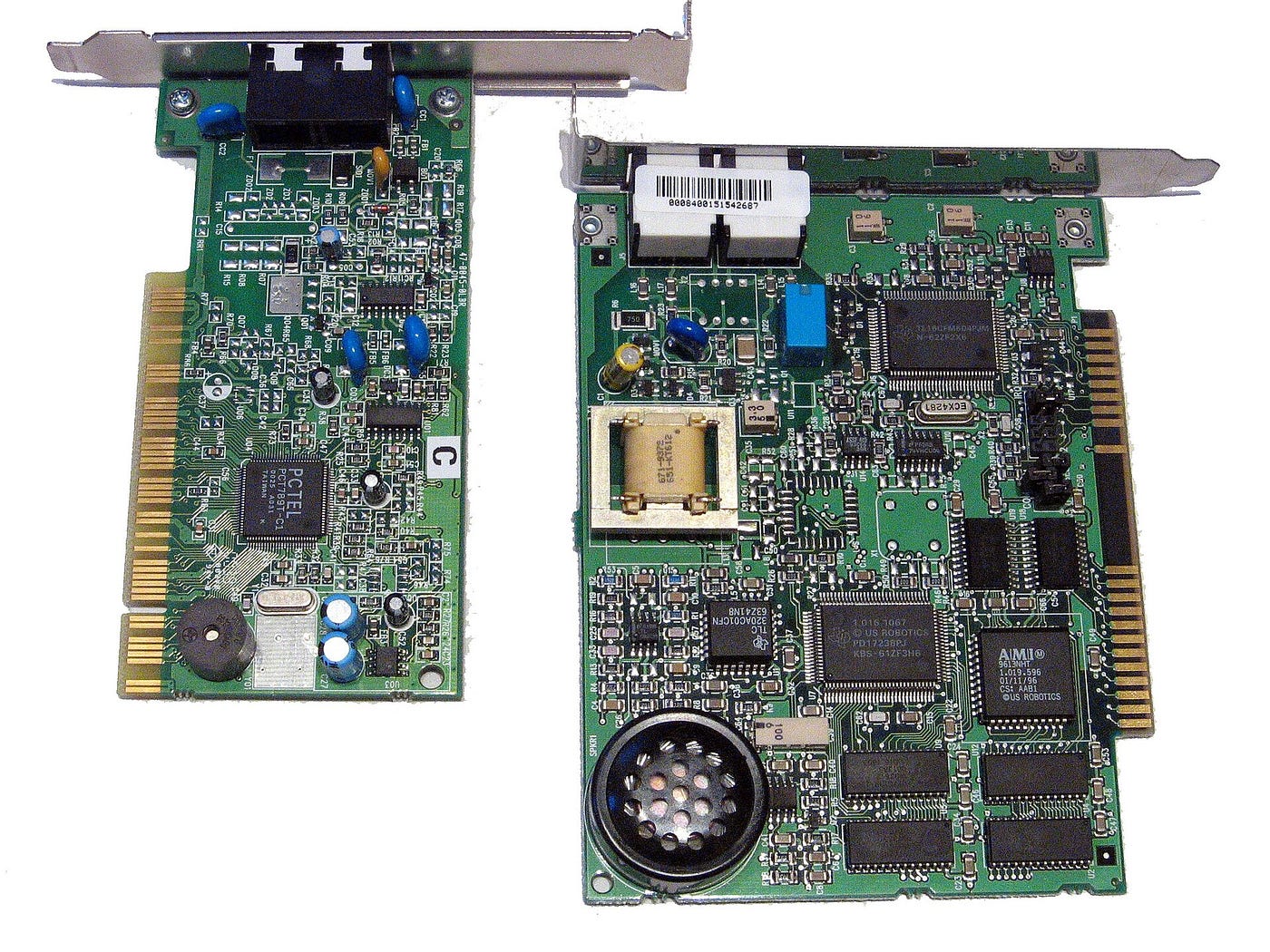 Modems would eventually move from external units to being part of the computer from the outset. Source: Wikipedia.
The Need For Speed
As the late 90s rolled around, the foundations of consumer internet were replaced, and they looked nothing like the drab, often text-based pages seen in the earlier ARPANET. Media would play a key role, and early internet web pages would require pictures, audio files and even videos, all streamed in a timely fashion anywhere on the globe.
This was an interesting time to be an internet user. While the foundations of the modern internet had been laid, the reality was that the technology that helped to enable that was never really designed to be served at scale by technology like the modem.
While the modem would play a key role in driving this expansion, with millions of sales through the 90s, the reality was that it was tapped out and incapable of providing the future capacity needed for the internet to thrive.
As the copper network would be repurposed using new technology like Digital Subscriber Line (DSL), reliance on the modem would slowly start to draw down. This was built on an insight that seems obvious in retrospect. The copper telephone wire running into your home was only being used for voice calls, which occupy a very narrow slice of the frequencies that copper wire can actually carry. DSL used the rest of that capacity for data, allowing voice and internet to run simultaneously over the same physical wire without interfering with each other.
As this would evolve into the consumer-focused ADSL, the newly designed fibre-optic transmission cables were also starting to make more of a mainstream appearance.
The stage was now set for the modem to slowly start stepping back from the limelight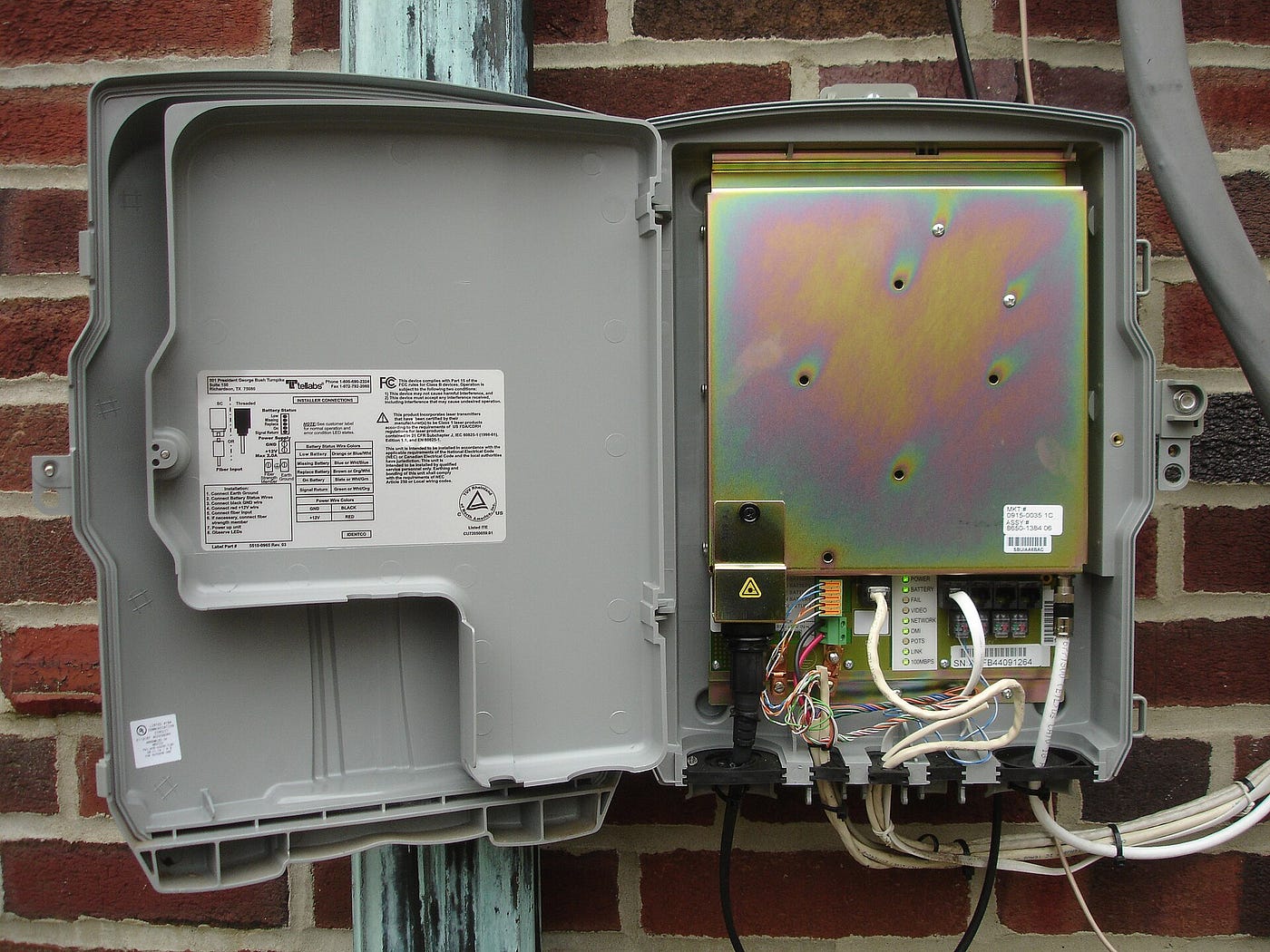 The old telephone-based models of old are long gone, however light-based versions still remain. Source: Wikipedia.
A Slow Drawdown
Like the horse being retired by the car, the camera going digital, and the landline network being replaced by wireless, technology can often be so prevalent in the mainstream that it can seem “too big to fail”.
The reality is, though, that for the most part, technology and by extension, consumer habits can often shift reasonably quickly. While the modem would play a key role in the early years of many children, by the time they were teenagers, the technology had been replaced by something else entirely. Even the landline telephone network that helped to power the whole process is essentially useless for telephony, thanks to the evolution of mobile telephones.
We’ve come a long way since the birth of the modem. The noise is gone, the speeds are unrecognisable, and the device handling it all sits quietly in the corner without anyone giving it a second thought.
Which, when you consider where it started, is a remarkable thing in itself.
If you liked the article, Get the Book.
Investigator515 explores the RF spectrum, cybersecurity, and the hidden tech behind modern espionage.
Follow for new content weekly
Bluesky • X • Substack
You might also like,
- OSINT Investigators Guide to Self Care & Resilience
- Spies In The Mud: The RF-111 Aardvark
- What The Tech?! Space Shuttles