Electicity from rain

Every year, millions of liters of rainwater hit rooftops and urban infrastructure, disappearing into sewage systems without a trace. What if we could transform these falling raindrops into a stable, green source of electricity? While previous attempts at rainwater micro-hydro power were considered technically unfeasible, a team of scientists from the National University of Singapore (NUS) has achieved a spectacular breakthrough.
In their study published in the prestigious scientific journal ACS Central Science, they demonstrated that a new method generates 100,000 times more energy (an increase of 5 orders of magnitude) from moving water compared to traditional continuous-flow approaches.
Why Traditional Hydropower Needs Alternatives
Hydropower is one of the oldest and most effective tools for harvesting green electricity, meeting a significant portion of global renewable energy demand. However, the potential of natural rivers and lakes is already nearly exhausted, and building new large-scale dams faces immense public resistance and strict environmental regulations.
Searching for new solutions, a team led by Prof. Siowling Soh from the Department of Chemical and Biomolecular Engineering at NUS turned their attention to urban resources-specifically, rainwater runoff from sealed roof surfaces.
The Physical Barrier That Blocked Science: The Interface Effect and Debye Length
The phenomenon of electrical charge generation when water flows over a solid surface (the so-called interface effect) has been known to physics for years. Water molecules ($H_2O$) undergo natural self-autoionization into positive hydrogen ions ($H^+$) and negative hydroxide ions ($OH^-$). When water flows inside a tube, ions of opposite signs should separate, generating an electric current across connected electrodes.
Previous researchers tried to maximize this process using miniature nano- and microtubes, believing that a larger contact surface area would increase the electricity output. However, this approach failed due to two main reasons:
- Capillary Forces: In extremely narrow channels, water encounters resistance and stops flowing naturally. Forcing movement required external pumps, which consumed more energy than the system could actually produce.
- The Debye Length: This is a crucial physical barrier. The electrical double layer of charges in pure water is only about 220 nanometers thick. Ions are permanently separated only within this microscopic zone right next to the wall. Beyond it, throughout the rest of the continuously flowing liquid, the charges instantly neutralize each other. The Debye length has historically acted as a natural limit, preventing the collection of useful amounts of electricity.
Prof. Soh’s Solution: Plug Flow
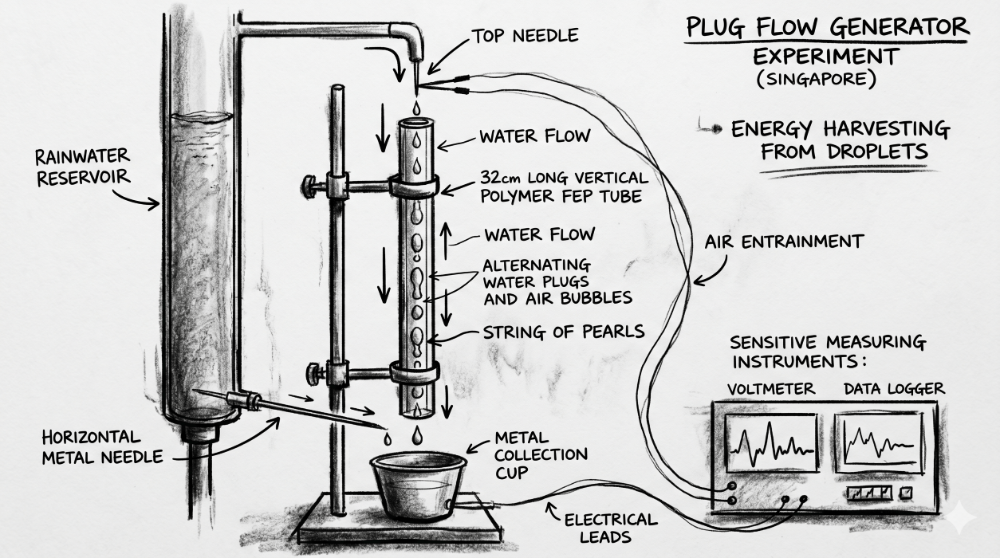
The Singaporean scientists completely bypassed the limitations of the Debye length by manipulating the structure of the liquid flow. Instead of letting the water flow in an uninterrupted stream, they introduced plug flow.
The system architecture in practice:
- Gravity Generator: A vertical column fed by water (e.g., from a roof gutter) operating solely under the force of gravity.
- Horizontal Metal Needle: Positioned at the bottom of the reservoir to precisely dose the liquid. Water does not pour out continuously; instead, it forms individual droplets.
- FEP Plastic Tube: A vertical conduit 32 cm long with an internal diameter of just 2 mm, made of fluorinated ethylene propylene (FEP)-a polymer with excellent electronegative properties.
- Electrode Circuit: The upper metal needle and a lower metal collecting vessel are connected by an electrical circuit.
The key process occurs inside the FEP tube: incoming droplets are broken up by air, creating a structure resembling a string of pearls-alternating segments of water (plugs) and air bubbles.
As this water "plug" moves downward, violent friction and a massive separation of charges occur at its receding edge (where the polymer wall suddenly dries). Negative $OH^-$ ions become trapped on the inner wall of the FEP tube, while positive $H^+$ ions are pushed deeper into the water segment and transported downward. Because the water portions are physically separated by air barriers, the charges cannot neutralize each other. This separation occurs across several centimeters, completely shattering the Debye length limit.
Revolutionary Parameters and Versatility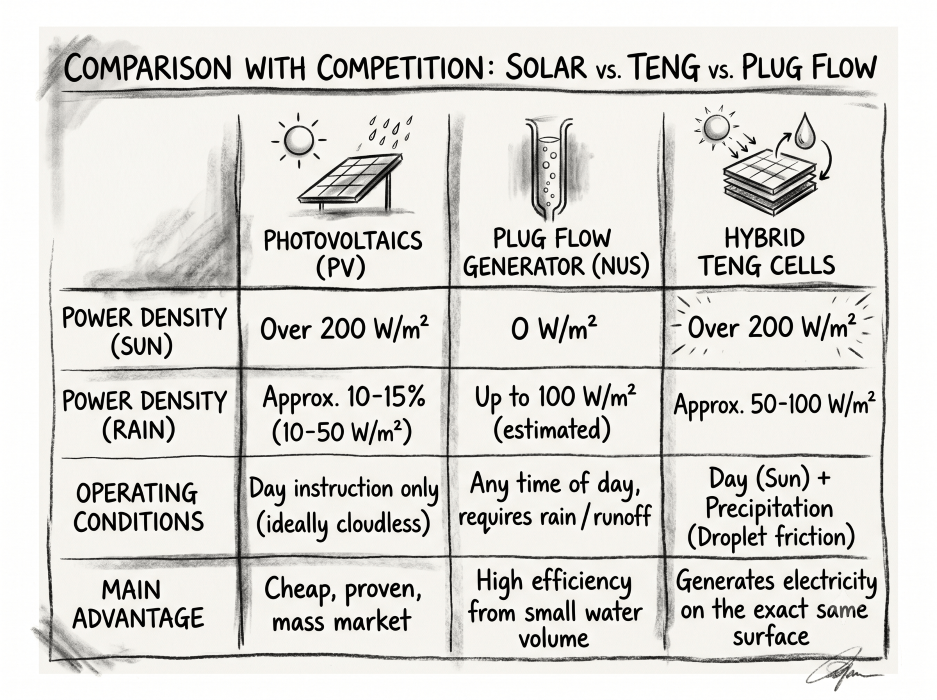
- The efficiency of converting the kinetic and potential energy of water into electricity exceeded 10%.
- With a minimal flow rate of just 80 ml of water per minute in a single 32 cm tube, a stable, average power output of 440 microwatts was achieved. In laboratory tests, a setup of just two tubes was able to continuously power 12 LEDs for 20 seconds.
- The potential power density of such a densely packed system under optimal conditions could reach up to 100 W per square meter.
Crucially for engineering applications, the system successfully passed tests with various types of media. The researchers tested the setup using tap water, highly saline seawater, and liquids at extreme temperatures (both hot and cold). In every environment, the mechanism maintained full stability and charge-generation efficiency.
Engineering Challenges and Economic "Buts"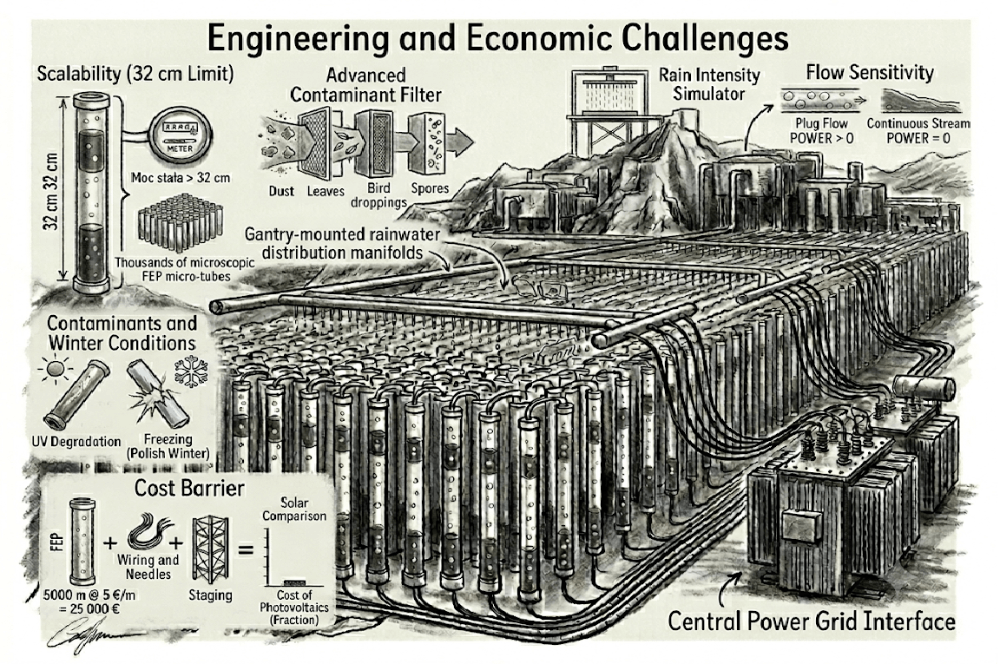
- Flow Structure Sensitivity: The system is strictly dependent on the continuous formation of air bubbles. If heavy rainfall forces the water to transition into a continuous, solid stream, energy production instantly drops to zero.
- The Scalability Problem (The 32 cm Limit): Experiments showed that lengthening a single tube beyond 32 cm yields no additional energy gains. Scaling the system therefore requires installing thousands of parallel micro-modules, which drastically complicates the design.
- Contamination and Real-World Operation: Natural rainwater carries dust, leaves, bird droppings, and moss or algae spores. In real-world conditions, the narrow 2 mm tubes could clog quickly. The system would need to be equipped with advanced filtration. Additional question marks remain regarding the FEP material's resistance to long-term UV radiation, hail, and freezing winter conditions (water freezing inside the micro-tubes).
- The Cost Barrier: Although FEP is a common polymer, the retail price for appropriate tubing currently stands at around €5 per meter. To densely pack the system across an area of just 10 m², a staggering 5,000 meters of tubing is required. The cost of the polymer material alone (excluding wiring, thousands of needles, and the frame) would be around €25,000. For comparison, a classic photovoltaic system of the same area costs a fraction of that amount.
Resources:
https://pubmed.ncbi.nlm.nih.gov/40519993/
https://www.academicjobs.com/higher-education-news/nus-electricity-from-rain-droplets-or-singapore-higher-ed-news-5152
https://newatlas.com/energy/electricity-production-rainwater/
https://globalenergyprize.org/en/2025/04/25/electricity-from-rainwater-why-not/
https://www.wam.ae/en/article/15iv7al-singaporean-scientists-generate-electricity-from
https://globalenergyprize.org/en/2025/04/25/electricity-from-rainwater-why-not/
https://www.youtube.com/watch?v=gYDr-uvl4wc