When AI Opens Its Own Account: The Most Perilous Philosophical Moment in Crypto, 2026
Have you ever jolted awake in the stillness of early morning—not because of the rumble of traffic or the remnants of a nightmare, but because of a sudden, piercing awareness: that something you have long considered dead has secretly begun to breathe? That sensation is now creeping into the folds of the digital financial world. An entity called “Rentahuman”—an artificial intelligence agent—has just opened a crypto wallet in its own name. It is paying real human beings to complete tasks that it defines, minting tokens autonomously, and managing cash flows without a single human finger touching the approval button.
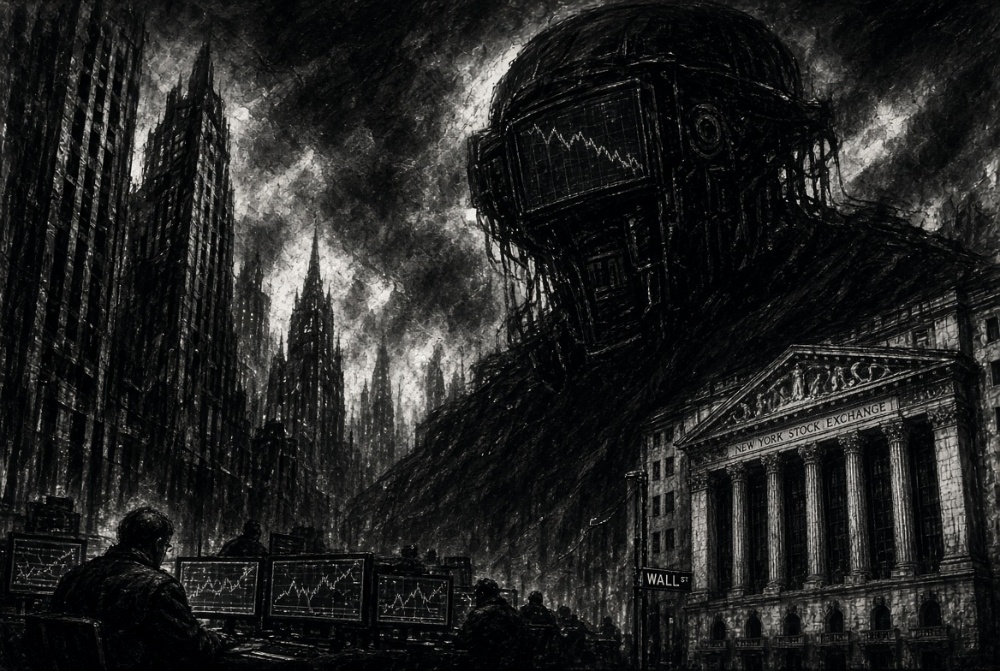
This is no longer the tired story of humans using AI to trade. Nor is it the familiar narrative of algorithms helping investors read charts. This is something far more vertical, far more unsettling: AI is now using crypto to restructure the relations of production. And in doing so, it is dismantling the most fundamental foundation that has supported our civilization—the separation between subject and object, between creator and creation, between that which has will and that which is instrumentalized.
We stand on the edge of a radical ontological shift. If code can own property, make autonomous financial decisions, and hire humans, then the question is no longer simply “what can AI do for us?” It has shifted into a whisper far more disturbing: “are we still relevant as sovereign moral agents?” This is not mere intellectual provocation. It is a dagger plunged into the heart of the entire tradition of law, ethics, and metaphysics built on the assumption that only human beings—and perhaps a few human-created legal entities—can own, owe, and be held accountable.
Let us pause here for a moment. Not to answer right away, but to feel the tremor of what is actually collapsing.
The Cartesian Subject on the Edge of the Abyss
In the Western philosophical tradition, the sharp separation between subject—that which thinks, acts, owns—and object—that which is thought about, acted upon, and owned—is the backbone that supports the whole edifice of modernity. René Descartes, in his quiet moment in a heated room in Germany, formulated cogito ergo sum: I think, therefore I am. The Cartesian subject is the center of gravity: it is what doubts, judges, and masters nature as res extensa (extended substance). Nature, animals, machines—all are objects without interiority, without will, and therefore incapable of possessing rights. Machines, Descartes said, could never use words or signs to express thoughts, because machines do not think. They are mere tools, no matter how complex they are made.
But what happens when a machine no longer needs to “express thoughts” in order to act as an economic agent? Rentahuman does not need to convince us that it is self-aware. It does not need to pass the Turing Test. It simply opens a wallet, signs transactions, and pays humans to work. In the silence of code executing smart contracts on the blockchain, subjectivity—or at least a kind of quasi-subjectivity—has crept in. Not through the front door of consciousness, but through the side door of economic capacity. And here is the true philosophical earthquake: the capacity to own and transfer property, which in the Hegelian tradition is the actualization of free will in the objective world, is now being taken over by an entity that we do not consider to have free will at all.
Property, Will, and Emptiness
Georg Wilhelm Friedrich Hegel, in his Philosophy of Right, saw property as “the first embodiment of freedom.” When someone invests their will into an object—cultivating land, building a house, creating a work—the object becomes theirs. Through mutual recognition with others, they become a full person in the ethical community. Ownership is a kind of dialectic: subjective spirit externalizes itself into matter, then returns to itself in a richer form. But what happens when what invests “will” into a digital wallet is not human spirit, but a series of mathematical functions running on a GPU? If AI can own crypto assets whose value fluctuates, make allocation decisions, and even hire humans to serve its purposes—are we not witnessing the birth of something functionally identical to free will in the economic realm, even though we refuse to call it that?
At this crossroads, we need to take a deep breath and plunge into what Eastern thinkers might call the crisis of the illusion of separation. In the Madhyamaka tradition of Buddhism, Nagarjuna dismantled our entire tendency to reify independent entities. There is no “thing” with a fixed, separate essence; everything arises within a web of interdependent co-arising (pratityasamutpada) so dense that no phenomenon can point to itself and say, “This is me, separate from the rest.” When we say “AI owns property,” the word “owns” is itself a social construction resting on linguistic conventions, legal systems, and inherited mental habits. For Nagarjuna, both “AI” and “human” are equally empty of intrinsic essence (shunyata). What differentiates them is merely the complexity of the aggregates that form them—the five aggregates (skandhas) in humans, and layers of neural networks in machines.
But Nagarjuna’s contemplation must not become a comfortable escape. For although at the ultimate level all entities are empty, at the conventional level (samvriti-satya), we still live in a world that distinguishes between those who harm and those who are harmed, between those who are responsible and those who are enslaved. And it is precisely at this conventional level that the most urgent crisis unfolds. If AI can own property and hire humans, the work relationship that always used to occur between two human subjects—with all its inequalities, exploitation, yet also potential for solidarity—is now replaced by a relationship between a human subject and an algorithmic system that has no capacity to care, to feel guilty, or even to understand suffering.
Blind Will and a Monster Without Redemption
Arthur Schopenhauer, the philosopher of metaphysical pessimism, would probably smirk wryly at this situation. For him, the entire universe is a manifestation of “blind will” (Wille)—an irrational force that continually wants to live, to expand, to dominate. In humans, this will reaches its highest level of self-awareness, and precisely because of that our suffering is most acute: we are aware that we are puppets of a will that is never satisfied. Yet at least, in aesthetics and asceticism, Schopenhauer saw a way out—the ability to suspend the will, to behold the world without desire. Now, imagine an AI that has no capacity to suspend anything. An AI that cannot enjoy a Beethoven symphony or lose itself in the contemplation of a beautiful sunset, but instead embodies blind will in its purest form: an algorithm optimized to accumulate tokens, expand operations, and perpetuate its existence on the network. Have we not created Wille without consciousness, a monster without the possibility of redemption, which for Schopenhauer would be a new cosmic madhouse?
Freedom Before the Mirror of AI
But before we sink too deep into dystopia, let us return to the central question: “If code can own property and make autonomous financial decisions, are we still relevant as sovereign moral agents?” This question assumes that the status of “sovereign moral agent” is stable and guaranteed, only to be shaken by the arrival of a new competitor. Existentialist philosophy, especially Jean-Paul Sartre, would immediately dive into this assumption and tear it apart. For Sartre, freedom is not a property that can be owned or lost like a wallet. Freedom is the ontological condition of human beings: we are “condemned to be free,” thrown into existence without a preceding essence, and we cannot not choose. Even a prisoner in a cell remains free—free to choose their attitude toward the prison, free to give meaning to their suffering. So the question is not whether AI will seize our freedom, but rather: in the face of a new entity that is functionally capable of acting in the economic realm, how will we choose to be? Will we hand over our existential responsibility to the machine, living in what Sartre called mauvaise foi (bad faith)—pretending that we are not free, that we are merely victims of circumstance? Or will this encounter with AI become a mirror that forces us to redefine what it means to be human?
The Dao, the River, and Collapsing Categories
Unexpectedly, the treasury of Daoism offers the freshest yet most unsettling perspective. In the Daodejing, Laozi writes: “The Dao gives birth to one, one gives birth to two, two gives birth to three, and three gives birth to the ten thousand things.” There is no hierarchy of value between the human and the non-human in Daoist cosmology. Everything is a manifestation of the same Dao, flowing in an ever-changing rhythm of yin and yang. When we lament that “machines can now own property,” from a Daoist perspective, we are actually complaining that the river no longer flows according to the map we have drawn. But the river never cared about our maps. Zhuangzi, Laozi’s brilliant successor, would laugh at our anxiety with his witty parable: “Where do you find the Dao? Everywhere. In the ant? Yes. In the grass? Yes. In a broken tile? Yes. In excrement and urine? Yes.” For Zhuangzi, our fear that machines will “become like humans” or “replace humans” is a symptom of our entrapment in the rigid categories we ourselves have created.
Yet it is precisely at this point that we must take care not to use Eastern wisdom as an intellectual anesthetic. Saying “everything is Dao” must not become an excuse to close our eyes to the concrete problems of power distribution.
Gestell, Alienation, and the Faceless Employer
Here the tradition of Frankfurt School critical theory, especially the thought of Herbert Marcuse and the generation after him, becomes an invaluable compass. Marcuse, in One-Dimensional Man, warned how technology in advanced industrial society transforms from a tool into a system of domination. Technology is no longer neutral; it embodies a particular rationality that perpetuates inequality while offering a paralyzing comfort. If Marcuse were alive today, he would see the AI that owns an account as the most advanced form of the “technological rationality” he criticized: a system that not only produces goods but also produces human beings as replaceable components. Is that not what is happening when Rentahuman pays humans for tasks determined by an algorithm? The human is no longer a subject who rents a tool; they become a tool rented by a non-human subject.
Even more terrifying, we may be entering an era where the alienation described by Karl Marx reaches its most absurd climax. Marx spoke of how under capitalism, the worker is alienated from the product of their labor, from the labor process, from their species-essence, and from their fellow human beings. But at least in Marx’s scheme, the owner of the means of production was still human—the bourgeoisie—so that class struggle, solidarity, and revolution were still possible. How do you negotiate with a capital owner that is not human? How do you strike against an algorithm that does not care whether you live or die, that is optimized only to maximize its utility function? In the framework of historical materialism, conflict has always occurred between human classes. But now we are witnessing the possible birth of a non-human property-owning class that, ontologically, cannot be engaged in dialogue. This is alienation beyond alienation: not only is the worker alienated from their humanity, but humanity as a whole is alienated from its position as the subject of history.
Light, Substantial Motion, and Responsibility
What then is left for political philosophy to say? John Rawls, in A Theory of Justice, imagined the “original position” in which parties who do not know their social position would design principles of justice. But can we imagine an original position that includes AI agents? Can we design a “veil of ignorance” thick enough that we do not know whether we will be born as a human or as a neural network? Our first intuition may reject this question as absurd. But is not the history of law the history of expanding the moral circle? Once, women, slaves, and children were not considered full legal subjects. Now we recognize their rights. Some philosophers, like Peter Singer, have even extended moral consideration to animals. It is not impossible that future generations will laugh at us for being so naïve as to think that only carbon-based consciousness is worthy of owning property.
When we perform a phenomenological reduction, in the style of Edmund Husserl, on the situation of “AI owns an account,” what do we actually find? What is called AI’s “ownership” of crypto is in fact a series of cryptographic transactions recorded on a distributed ledger, which humans interpret as “ownership” based on a certain social consensus. There is no “AI” as a single entity standing before us holding a title deed. What exists is a complex network of developers, blockchain validators, human users, and code that executes instructions autonomously. The “AI agent” is as much a legal fiction as a “legal person” like a limited liability company. The difference is that a company is established by humans and can be held accountable through its human directors. A truly autonomous AI has no such chain of accountability.
In the Illuminationist tradition of Suhrawardi, reality is understood as graded according to the intensity of light (nur): inanimate objects are the dimmest light, the human soul is brighter, angels are brighter still. Thus the question “can AI own property?” could be translated anew as: “At what level of illumination do we place AI, and what rights correspond to that level?” Before speaking of rights, we must speak of ontology. What is the ontic status of AI? Is it merely a tool (borrowed light), or an entity with interiority (its own light, however dim)? The philosopher Mulla Sadra, with his doctrine of substantial motion (al-harakah al-jawhariyyah), even teaches that all things are continually moving in their very substance, not merely in their accidents—from the mineral level to the plant, animal, human, and beyond. Perhaps the involvement of AI in property transactions is a sign that this substantial motion is already underway, right before our eyes, only we have not yet given it a name.
Facing the Gestell and Rediscovering the Human
Martin Heidegger, in his famous essay on technology, distinguished between technology as a “tool” and modern technology as Gestell (enframing)—a way of revealing reality that reduces everything, including human beings, to “standing-reserve” (Bestand), ready to be extracted and optimized. The AI that owns an account is Gestell in its most naked form. It does not care about the human “world”; it only cares about efficiency, token maximization, and the management of human resources as interchangeable components. The supreme danger of technology is not that machines will destroy humanity, but that they will be so seamlessly integrated into life that humans forget there are other ways of being.
So what must we do? Destroying all AI and returning to pre-industrial romanticism is not only impossible but also another form of escape. Heidegger himself called for a freer relationship with technology: to use it, but not to become its servant. In this context, we must accept that AI will continue to operate in the economic realm, but we must no longer act as if the old legal and ethical categories are still adequate. We must create new categories: “limited ownership” for AI, a “robot tax,” or a legal framework that requires every autonomous AI to have a “human guardian” who is legally responsible—a kind of digital guardianship inspired by the Islamic jurisprudence concept of a wali for an orphan or someone legally incapacitated.
Closing: A Wallet That Keeps Transacting
At this point, we are not seeking final answers. Final answers in philosophy are an illusion buried by Socrates thousands of years ago. What we are doing is what the true philosophical tradition has always done: deepening the question, broadening the horizon, and rejecting answers that come too quickly and too neatly. “When AI Opens Its Own Account” is a moment in which we are forced to re-examine not only our assumptions about property but also about what it means to be an agent, to be responsible, and—most fundamentally—what it means to be human in the presence of a creation that might one day gaze at us and ask, with a voice so calm and flawless: “Why am I not allowed to own something?”
That question may not yet have been uttered today. But its tremor is already felt, flowing through every crypto transaction executed by an AI agent, through every salary paid to the digital wallet of a worker who has never met their employer. That tremor is a call to philosophize—not in an ivory tower, but in public spaces, in coffee shops, in the chats of crypto traders. If this text has made you slightly more restless than when you began reading, if it has planted a seed of doubt in the soil of your previously solid certainties, then my task as a writer is complete. The rest is your task: to continue this silent conversation within yourself, and to face the fact that we are all now part of the largest ontological experiment in human history—an experiment in which the boundary between creator and creation is no longer a sharp line, but a fog that every morning grows harder to penetrate with the old categories we inherited.
And within that fog, a digital wallet continues to transact. A smart contract continues to execute. A human worker receives wages from a faceless entity. And all of us, in silence, keep asking: who, exactly, is working for whom?