A Review of Brave New World by Aldous Huxley
Published in 1932, Brave New World remains one of the most influential dystopian novels ever written. Long before modern debates about artificial intelligence, genetic engineering, consumer culture, and psychological manipulation, Huxley imagined a technologically advanced society that had solved humanity’s traditional problems—war, poverty, and instability: at the cost of individuality, truth, and genuine freedom. The novel is not merely a warning about tyranny imposed through violence; rather, it examines a far subtler danger: oppression achieved through pleasure, comfort, and consent.
Plot and Setting
The novel takes place in a futuristic global state known as the World State, centered primarily in London several centuries after a catastrophic world war. Society has achieved stability through scientific control of reproduction, psychological conditioning, and rigid social stratification.
Human beings are no longer born naturally. Instead, they are artificially created in laboratories using the Bokanovsky Process, mass-producing individuals engineered for predetermined social roles. Citizens belong to castes—from intelligent Alphas to subservient Epsilons—each biologically designed to accept its position. From infancy, individuals undergo hypnopaedic conditioning, learning slogans such as: “Everyone belongs to everyone else.”
The narrative initially follows Bernard Marx, an Alpha who feels alienated from his perfectly ordered society. His discomfort grows when he visits a Savage Reservation and encounters John, a man raised outside the World State who has grown up reading Shakespeare. John’s introduction into the technologically perfected society becomes the novel’s central conflict.
John, often called “the Savage,” reacts with horror to a civilization built on superficial happiness, casual sexuality, and emotional numbness. His struggle exposes the moral emptiness beneath apparent social harmony.
Major Themes
1. Happiness Versus Freedom
The defining philosophical question of Brave New World is whether happiness justified by stability is worth the loss of freedom. The World State eliminates suffering by eliminating choice. Citizens are conditioned not to desire what they cannot have, ensuring perpetual satisfaction.
The government official Mustapha Mond articulates the system’s logic clearly: “Happiness has got to be paid for.” In this world, the price of happiness is individuality, art, religion, and intellectual inquiry. Pain, uncertainty, and passion—essential elements of human experience—are removed in favor of predictable pleasure.
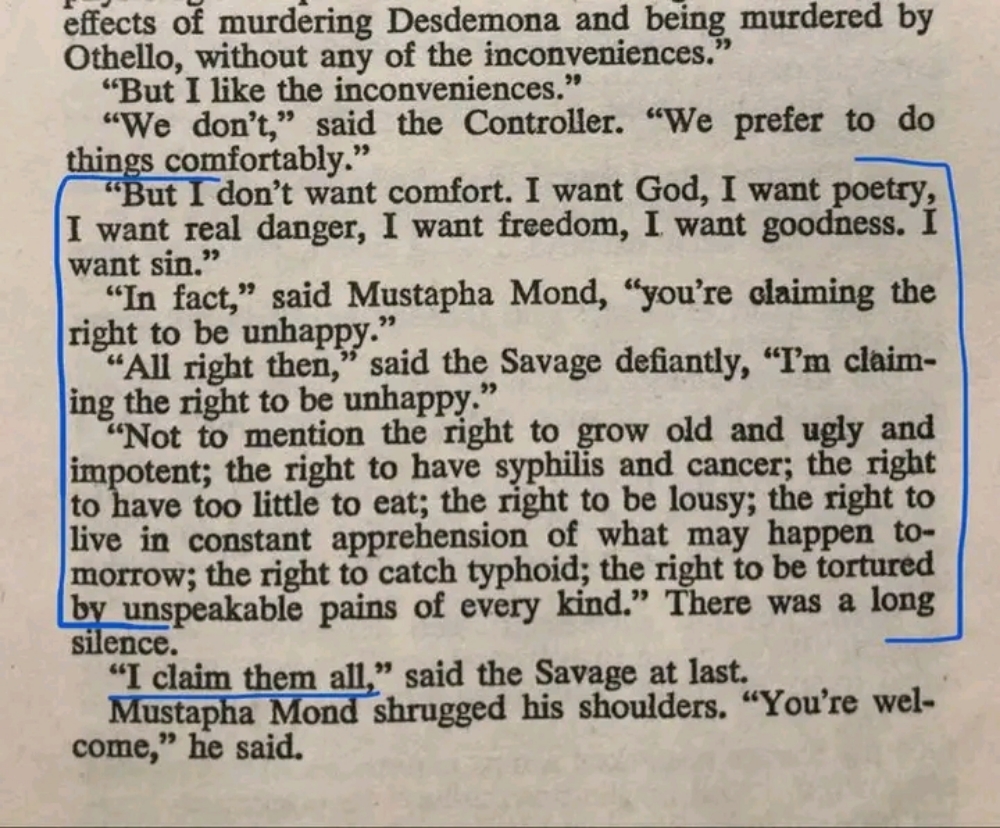
John’s resistance culminates in one of the novel’s most famous declarations: “I don’t want comfort. I want God, I want poetry, I want real danger, I want freedom.” His statement encapsulates Huxley’s argument that authentic humanity requires the possibility of suffering.
2. Technology and Social Control
Unlike many dystopias that rely on fear, Huxley imagines domination through technological convenience and psychological manipulation. Citizens willingly maintain the system because it satisfies their desires.
The drug soma exemplifies this control mechanism. Whenever discomfort arises, citizens consume soma to induce artificial bliss. As one slogan proclaims: “A gramme is better than a damn.” Rather than suppressing dissent violently, the World State prevents it from forming at all.
Huxley foresaw a future in which entertainment, pharmaceuticals, and consumer culture might pacify populations more effectively than censorship or force.
3. Consumerism and Conditioning
Economic stability depends on constant consumption. Citizens are conditioned to dislike solitude, reflection, and durable goods because these threaten economic productivity. Emotional depth is replaced by endless distraction.
The society’s obsession with novelty anticipates modern advertising culture and algorithm-driven entertainment. Individuals define themselves through consumption rather than moral or intellectual development, raising questions about whether modern societies risk similar tendencies.
4. The Loss of Art, Religion, and Meaning
In the World State, great literature, philosophy, and spiritual belief are banned because they provoke strong emotions and independent thought. Shakespeare, which shapes John’s worldview, symbolizes the complexity of human feeling that the new society cannot tolerate.
Mustapha Mond explains that high art belongs to unstable ages; stability requires cultural simplification. Huxley thereby suggests that creativity flourishes precisely because humans struggle with uncertainty and mortality.
Style and Narrative Technique
Huxley’s narrative style blends satire, philosophical dialogue, and social commentary. The opening chapters employ rapid shifts in perspective, mimicking the mechanical efficiency of the society itself. Later sections slow down, allowing ideological debates—especially between John and Mustapha Mond—to dominate the narrative.
The contrast between the clinical language of scientific conditioning and John’s Shakespearean emotional intensity dramatizes the clash between engineered happiness and authentic humanity.
Huxley’s tone is deeply ironic. The society appears successful by conventional standards—peaceful, prosperous, and orderly—forcing readers to question their own assumptions about progress.
Relevance and Contemporary Significance
Nearly a century after its publication, Brave New World feels remarkably prophetic. Modern developments in biotechnology, social media algorithms, pharmaceutical culture, and mass entertainment echo Huxley’s concerns about voluntary conformity.
The novel speaks directly to contemporary debates about genetic engineering, data-driven behavior prediction, and the psychological effects of constant stimulation. Huxley warns that societies may sacrifice freedom not under coercion but through the pursuit of comfort and distraction.
Unlike dystopias centered on surveillance and fear, Huxley’s vision is unsettling precisely because it feels plausible. People are not forced to obey; they are conditioned to love their servitude.
Conclusion
Brave New World endures as a profound philosophical critique of modern civilization. Through its unsettling depiction of a perfectly stable society, Huxley challenges readers to reconsider the meaning of happiness, freedom, and human fulfillment.
The novel’s enduring power lies in its refusal to offer simple answers. Is suffering necessary for meaning? Can technological progress coexist with individuality? Huxley leaves readers with an uncomfortable realization: a world without pain may also be a world without depth.
Ultimately, Brave New World is less a prediction than a warning—a reminder that humanity’s greatest threat may not be oppression imposed from above, but the quiet surrender of freedom in exchange for comfort.