Bryce’s Secret: How Jane Street Allegedly Rigged the Crash

Hello everyone! Welcome to another Learn With Hatty. If you have been following Crypto news lately you might have heard of Jane Street. If you have not heard of this yet well then get ready for your mind to be blown.
Most of you know Jane Street as the secretive Wall Street giant where SBF got his start. But what if I told you they weren’t just watching the 2022 crypto crash, they might have been the ones who pulled the plug? A bombshell lawsuit filed this week in Manhattan claims they had a literal inside track to the Terra collapse. Grab your coffee, because we’re diving into Bryce’s Secret and the 10 AM dumps that have had traders screaming for years.
When Terra Blew Up and Jane Street’s Name Surfaced

Back in May 2022, the Terra ecosystem imploded. TerraUSD (UST), the algorithmic stablecoin billed as rock-solid, lost its peg to the dollar and dragged LUNA down with it, wiping out an estimated $40 billion in investor value practically overnight. Terraform Labs and co-founder Do Kwon swiftly shifted from crypto heroes to legal targets, facing fraud charges over UST’s supposed stability.
For ages, the spotlight stayed on Terraform, Do Kwon, and firms like Jump. Jane Street, meanwhile, lurked in the shadows as a low-key quant trading giant, famous for liquidity in traditional markets and dipping into crypto and ETFs. That changed in February 2026 when Terraform’s bankruptcy estate called out Jane Street for allegedly leveraging insider info to dodge the Terra fallout better than anyone else.
Around the same time, Jane Street was already on traders’ radars as a top authorized participant and market maker for U.S. spot Bitcoin ETFs, including BlackRock’s iShares Bitcoin Trust (IBIT). This role meant handling massive Bitcoin and ETF flows, which could sway liquidity and prices during key trading windows.
The Lawsuit: Snyder vs. Jane Street
On February 23, 2026, Todd Snyder, Terraform Labs’ court-appointed plan administrator, unleashed an 83-page lawsuit in the Southern District of New York, Snyder v. Jane Street Group LLC, case number 26-cv-1504. This wasn’t vague finger-pointing. It accused Jane Street, co-founder Robert Granieri, and traders Bryce Pratt and Michael Huang of insider trading and front-running that allegedly accelerated Terraform’s downfall, hurting creditors and investors.
In straightforward terms, Snyder claims Jane Street wasn’t just a bystander in the storm, they had confidential Terraform intel and timed UST trades to bail out before the masses caught on. This gave them an “impossible informational advantage” during the meltdown, minimizing losses while others got crushed. The suit ties this edge to Terraform’s bankruptcy, demanding Jane Street cough up damages, disgorge profits, and pay interest heading to a jury trial unless settled. It’s a civil case, not regulatory, but the sworn details are stirring serious buzz in finance and crypto circles.
The May 7, 2022 Curve 3pool Trade

If there’s a pivotal moment in this tale, it’s May 7, 2022, in Curve’s 3pool. A key liquidity hub where UST swapped against stablecoins like USDT and USDC. Snyder’s complaint paints a suspiciously tight timeline. Think of the Curve 3pool like the foundation of a house. Terraform Labs pulled out a huge chunk of the rebar, and Jane Street allegedly saw it happening in real-time and pulled their support out before the whole roof caved in on retail investors.
Terraform quietly yanked about $150 million in UST from the 3pool unannounced, leaving regular traders in the dark about the liquidity drain. Roughly ten minutes later, a Jane Street-linked address allegedly dumped $85 million in UST into the same pool. This $85 million swap was the largest ever in that Curve pool, standing out amid the volatility. By slamming the pool post-liquidity pull, the lawsuit argues Jane Street ramped up UST stress, nudging it toward depegging. Days later, UST spiraled, and LUNA plunged over 99.9%, obliterating Terra.
Snyder insists Jane Street could only time this if tipped off by Terraform, making that ten-minute gap the alleged smoking gun of insider trading.
Bryce Pratt and the “Bryce’s Secret” Backchannel

Now lets enter the human element, Bryce Pratt. If this were a thriller, he’s the young math wiz thrust into the spotlight. The complaint details how Pratt started as a Terraform intern, gaining insider knowledge before jumping to Jane Street in September 2021, reportedly in New York. Snyder alleges this sparked a backchannel.
By early 2022, Pratt reportedly reopened private chats with Terraform ex-colleagues, including a business dev head and engineer. One chat was dubbed Bryce’s Secret. Which is a plaintiff’s dream name, and a defendant’s nightmare. These channels allegedly funneled non-public info on liquidity moves, OTC deals, and peg defenses to Jane Street’s desk, shaping their Terra trades. Coverage frames this as Jane Street’s “impossible advantage”, not just surviving the collapse, but profiting by dumping risk timely, per Snyder.
Jane Street Pushes Back

Before we jump to conclusions on crypto Twitter, let’s hear Jane Street’s side. They’re not taking this lying down. In statements, Jane Street blasts the lawsuit as “factually inaccurate” and a cash grab from a busted project. They deny receiving or trading on non-public Terraform info and insist they didn’t cause or speed up the collapse.
The firm vows a vigorous court defense, promising discovery and motions, maybe a trial. No SEC or CFTC charges yet, key in separating civil claims from enforcement. For extra intrigue, Jane Street reportedly deleted its entire X timeline amid the buzz. Which is optically rough, but not proof of wrongdoing. Please remember that Snyder’s claims are allegations in a civil suit, not proven or criminal.
The 10 AM Bitcoin Dump Theory

Fast-forward to late 2025 and early 2026 Bitcoin charts. If you’ve traded BTC in U.S. hours, you’ve likely spotted it. Prices climb overnight, then get hammered around 9:30–10:00 a.m. ET, the infamous “10 AM dump.”
Traders flooded X and Reddit with charts showing eerily consistent patterns: pre-open strength, sharp 10 AM drops, then grind. Suspicion quickly hit ETF market makers, with Jane Street often named due to its ETF role. Pieces like one tying Jane Street to a Bitcoin suppression machine, argue BTC sometimes feels managed around liquidity windows. A Binance post claims Jane Street halted rallies “at exactly 10:00 AM Eastern. Every single day.”
But sober takes, like BeInCrypto’s analysis, question direct blame, noting ETF hedging, news, and global flows converge at U.S. open. Making 10 AM action expected, not necessarily sinister. The pattern’s are real, pinning it on Jane Street remains speculative.
ETF Flows, IBIT Holdings, and Jane Street’s Influence
To grasp why Jane Street’s at the heart of the lawsuit and dump theory, consider an ETF market maker’s clout. By late 2025, Jane Street held over 20 million IBIT shares, worth ~$790 million, making it a top holder and liquidity pillar. Think of them like the ultimate supplier for BlackRock. When people want to buy more IBIT, Jane Street is the one out there grabbing the actual Bitcoin to back those shares. And when people sell, they’re the ones taking the Bitcoin back and managing the risk.
Most of this action happens right as the U.S. markets open at 9:30 a.m. Because Jane Street is moving so much volume to keep their books balanced, they leave a massive footprint on the price. Traders have started connecting those 10 a.m. swings directly to Jane Street. Not because they’ve caught them doing something illegal, but because it’s the only explanation that fits the way the market feels every morning.
The Day the 10 AM Dump Went Quiet
Here’s where the Terra suit and BTC charts sync up perfectly. Post-lawsuit, watchers noted no usual 10 AM slam. On February 25, 2026, a Yahoo Finance piece headlined “No 10 AM BTC Dump? Bitcoin Price Rallies as Jane Street Trading Speculation Swirls,” noting BTC’s 3% jump to ~$65,000 without the morning hit, tying it to chatter Jane Street paused the pattern.
It quotes investor Mike Alfred’s X claim of chatting with a Jane Street insider: management allegedly halted manipulative trading and deactivated a 10 AM algo, suggesting BTC probably goes up now. Verifiable? No, but it fueled speculation.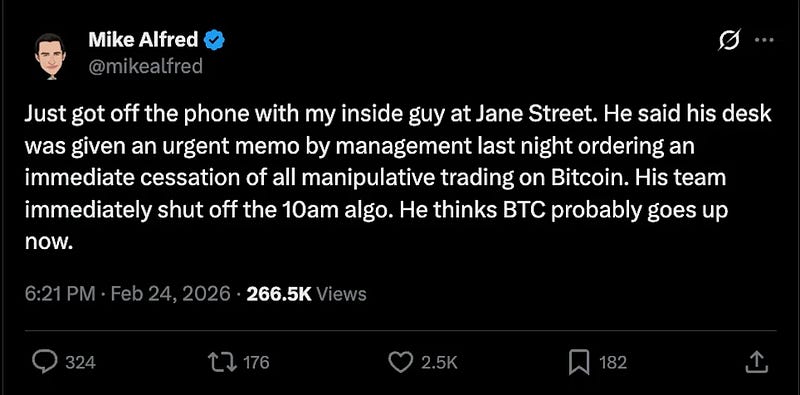
When the news broke, the market reacted like a pressure valve had finally been released. Outlets like CoinGape watched Bitcoin tear toward $70,000, while MarketPulse reported over $333 million in liquidations mostly shorts getting absolutely wrecked. The narrative on the street is simple, the suppression is off, the 10 a.m. dump is dead, and Bitcoin is finally free. Reality is usually more complicated than that, but for now, that’s the story the market is sticking to.
The Jump Trading Prequel and a Bigger Pattern
Jane Street isn’t Snyder’s first target. In December 2025, he sued Jump Trading for $4 billion, alleging secret peg support then massive profits on the unwind. Per reports, Jump had hidden deals to buy dipping UST, propping it short-term, then exiting richly which was labeled manipulation and self-dealing.
Let’s take a step back and look at the bigger picture. These lawsuits against Jump and Jane Street are part of the same blueprint. A legal effort to chase down the big firms that had inside ties to Terraform. It’s not just about one bad actor, it’s about a whole system where the elites allegedly found a side exit while the building burned down with everyone else still inside.
What’s Proven, What’s Alleged, and Why It Matters

Now lets wrap this up honestly and follow the facts. Some parts are ironclad, others are allegation or lore.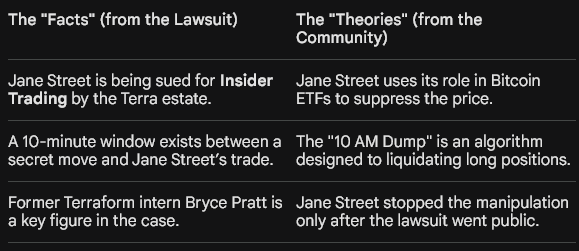
Here is what we have that is solid. Terra wiped out billions, Snyder filed detailed suits against Jump and Jane Street, with timelines like the May 7 Curve episode, Pratt’s Terraform-to-Jane Street move and alleged “Bryce’s Secret” channels. Jane Street’s ETF dominance influencing U.S. hours, the 10 AM pattern on charts, and its brief post-lawsuit fade as BTC rallied .
Here is what is alleged. Insider info, front-running, hastening collapse denied by Jane Street, a suppression algo is rumor, backed by anecdotes not proof. Yet, this saga reveals crypto’s entanglement with Wall Street quants, making it tough for retail to discern market from institutional flows. As the case unfolds, discovery might expose chats and trades. Regulators could join or sit out. Narratives may crumble or solidify, but 2026 promises revelations on Terra’s levers and Bitcoin’s daily beat.
This lawsuit is just the beginning of the discovery phase. Do you think firms like Jane Street and Jump are the reason the Terra collapse was so brutal, or were they just smarter than the rest of the market? Let’s talk about it in the comments. I’m curious to see where you stand on the insider vs. trader debate.
Thank you for reading! I hope you enjoyed todays break down of Jane Street. Please do your own research and remember, stay curious and keep learning.